
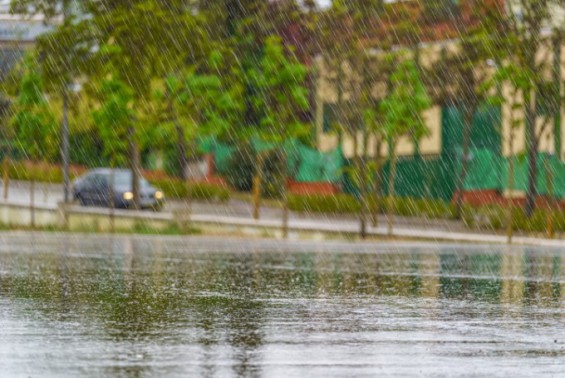
For decades, the arrival of the Changma—South Korea’s traditional summer monsoon—was a predictable rhythm of the calendar. It brought steady, soaking rains that nourished the peninsula’s agriculture and signaled the height of summer. But in recent years, that rhythm has fractured. The steady rains have been replaced by what locals increasingly call “water bombs”: sudden, violent bursts of localized precipitation that can dump months’ worth of rain in a matter of hours.
These extreme weather events are no longer anomalies; they are becoming the new baseline. From the sprawling urban canyons of Seoul to the rolling hills of the Chungcheong region, the pattern is clear: rainfall is becoming more concentrated, more frequent, and significantly more destructive. This shift is not a coincidence of bad luck but the result of a volatile intersection between global climate change and a surge in atmospheric water vapor.
As a journalist who has covered geopolitical instability and human rights across Eurasia, I have seen how environmental degradation acts as a threat multiplier. In South Korea, this multiplier is manifesting as a hydrological crisis. The convergence of warming oceans and a destabilized jet stream is rewriting the rules of the Korean summer, leaving cities and rural communities struggling to adapt to a climate that is changing faster than their infrastructure can keep pace.
Understanding why this is happening requires looking beyond the immediate storm clouds. It involves a complex interplay of thermodynamics and atmospheric dynamics that are transforming the Korean Peninsula into a focal point for extreme precipitation.
The Evolution of the Changma: From Steady Rain to ‘Water Bombs’
The traditional Changma is characterized by a stationary front where cold air from the north meets warm, moist air from the south. Historically, this front moved slowly, distributing rain relatively evenly across the peninsula. However, climate scientists are observing a fundamental shift in this mechanism. The front is becoming more unstable, and the rain is becoming “localized”—meaning it hits specific neighborhoods or districts with devastating intensity while areas just a few kilometers away remain dry.

This phenomenon is driven largely by the intensification of the Northwest Pacific Subtropical High. As the planet warms, this high-pressure system has been shifting and expanding, altering the path of moisture-laden winds. When these winds collide with the Korean Peninsula’s complex topography, they create “linear precipitation systems.” These are narrow bands of intense rain that can remain stationary over a single region for hours, acting like a conveyor belt of water.
The result is a dramatic increase in the frequency of extreme precipitation events. According to the Korea Meteorological Administration (KMA), the intensity of heavy rain events has shown a rising trend, with a higher proportion of total annual precipitation falling during these short, violent bursts. This shift makes traditional flood forecasting significantly more difficult, as the “localized” nature of the rain defies broad regional models.
The Science of Vapor: Why the Rain is Stronger
To understand why the rain is becoming more intense, one must look at the basic physics of the atmosphere. The driving force is a principle known as the Clausius-Clapeyron relationship, which dictates that for every 1 degree Celsius rise in air temperature, the atmosphere can hold approximately 7% more water vapor.
As global temperatures climb, the atmosphere becomes a larger sponge. In the context of South Korea, this is exacerbated by the warming of the surrounding seas. The West Sea (Yellow Sea) and the East China Sea have seen sea surface temperatures rise, increasing the amount of evaporation and pumping vast quantities of moisture into the air. When a trigger—such as a cold front or a low-pressure system—hits this moisture-saturated air, the release of energy is far more explosive than it was thirty years ago.
This “water vapor supply” acts as the fuel for the storm. When the atmospheric instability is high, this moisture condenses rapidly into massive cumulonimbus clouds, leading to the “water bomb” effect. The Intergovernmental Panel on Climate Change (IPCC) has consistently warned that global warming will increase the frequency and intensity of heavy precipitation events, a trend that is now vividly apparent in the East Asian monsoon system.
Regional Vulnerabilities: The Central and Chungcheong Focus
While the entire peninsula is at risk, the central regions—including the Seoul Metropolitan Area—and the Chungcheong provinces have become hotspots for these disasters. This regional concentration is due to a combination of atmospheric convergence and geographic features.

In the central region, the interaction between the moisture-laden southwesterly winds and the rugged terrain of the peninsula often causes the air to rise abruptly, triggering intense rainfall. The urbanization of the Seoul area has created an “urban heat island” effect. The excess heat trapped by concrete and asphalt can enhance atmospheric instability, effectively “pulling” more moisture into the city and intensifying localized storms.
The Chungcheong region, acting as a bridge between the north and south, often finds itself directly under the stationary fronts that cause prolonged heavy rain. In recent years, this area has suffered significant casualties and infrastructure damage due to flash floods and landslides. The combination of steep slopes in some areas and the sudden volume of water creates a lethal environment where soil saturation leads to rapid slope failure.
The Human and Economic Toll of Hydrological Instability
The transition to extreme rainfall has exposed critical gaps in South Korea’s disaster preparedness. Most urban drainage systems were designed based on historical rainfall averages that are no longer relevant. When a “water bomb” drops 100mm or more of rain in a single hour, the sewers simply cannot evacuate the water fast enough, leading to “flash flooding” that can submerge basements and underground parking garages in minutes.
The economic impact is twofold. First, there is the immediate cost of disaster recovery—repairing collapsed roads, restoring power grids, and compensating displaced residents. Second, there is the long-term agricultural disruption. While the total amount of rain may not have changed drastically, the way it falls is destructive. Instead of a steady soak, crops are either drowned in a flood or suffer from “dry spells” between the bursts of extreme rain.
Beyond the economics, there is a profound human cost. The unpredictability of these storms increases the risk to vulnerable populations, particularly those living in semi-basement apartments (banjiha) in Seoul, which became a global symbol of urban climate vulnerability during the devastating floods of 2022.
Adapting to a Volatile Future
South Korea is now in a race to upgrade its resilience. The government has begun investing in “deep underground rain storage tunnels”—massive subterranean reservoirs designed to catch excess runoff during peak intensity and release it slowly after the storm passes. These are essential for cities where there is no more surface room for expanding drainage pipes.
the KMA is refining its “nowcasting” capabilities. Because these storms are so localized, traditional forecasts are often too broad. Nowcasting uses high-resolution radar and AI to predict rainfall at a neighborhood level with 1-to-3-hour lead times, allowing authorities to issue hyper-local evacuation orders.
However, infrastructure alone is not a cure. Climate adaptation requires a shift in urban planning, including the creation of “sponge cities” that use permeable pavements and green roofs to absorb water naturally rather than funneling it all into pipes.
Key Takeaways on Korea’s Changing Rainfall
- Shift in Pattern: The traditional steady monsoon (Changma) is being replaced by “localized heavy rain” or “water bombs.”
- Thermodynamic Driver: Warmer air holds more moisture (Clausius-Clapeyron principle), fueling more intense bursts of rain.
- Regional Impact: Central and Chungcheong regions are particularly vulnerable due to topography and atmospheric convergence.
- Infrastructure Gap: Existing drainage systems are often overwhelmed by rainfall intensities that exceed historical design limits.
- Adaptive Solutions: Focus is shifting toward deep underground storage, AI-driven nowcasting, and “sponge city” urban design.
The Global Context: A Warning for All Coastal Nations
What is happening in South Korea is a microcosm of a global trend. From the devastating floods in Pakistan to the atmospheric rivers hitting the Western United States, the “intensification of the hydrological cycle” is a hallmark of a warming planet. The ability of the atmosphere to hold and then suddenly release massive amounts of water is becoming the primary way climate change manifests in many regions.

For South Korea, the challenge is not just about surviving the next summer, but about redesigning a society to exist in a state of permanent volatility. The transition from a predictable climate to an unpredictable one requires a fundamental rethink of how we build our cities, how we farm our land, and how we protect our most vulnerable citizens.
The next major checkpoint for South Korea’s climate resilience will be the release of the updated National Climate Change Adaptation Plan, which is expected to detail new mandates for urban drainage and flood-resistant housing. As we move further into this decade, the ability to anticipate and withstand these “water bombs” will be the true measure of the country’s stability.
Do you believe urban centers are doing enough to prepare for extreme weather? Share your thoughts in the comments or share this article to join the conversation on climate adaptation.