
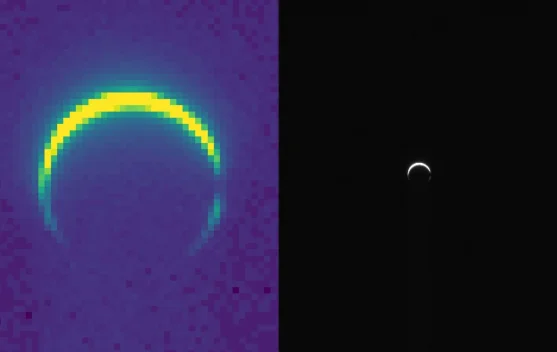
In a stunning display of deep-space navigation and imaging, NASA’s Psyche mission has captured a rare, colorized image of Mars appearing as a thin, luminous crescent. The photograph, taken as the spacecraft closes in on the Red Planet, serves as both a scientific milestone and a visual prelude to a critical maneuver that will dictate the future of the mission’s journey through the solar system.
The image was captured on May 3, 2026, while the spacecraft was positioned approximately 3 million miles (4.8 million kilometers) from Mars. This encounter is not merely a photographic opportunity; it is a strategic approach for a NASA Psyche mission Mars gravity assist scheduled for May 15, 2026. This maneuver is designed to provide the spacecraft with a necessary boost in speed and a precise adjustment of its trajectory, propelling it toward its ultimate destination: the metal-rich asteroid Psyche.
For those following the mission, the imagery provides a glimpse into the complex geometry of interplanetary travel. Because the spacecraft is approaching Mars from a high-phase angle, the planet does not appear as a full disk but as a sliver of light, mirroring the appearance of a crescent Moon during its new moon phase. This perspective occurs when the Sun is positioned “above” both the spacecraft and the planet, leaving only a small portion of the Martian surface illuminated from the spacecraft’s point of view.
The Anatomy of a Martian Crescent: Dust and Light
The technical execution of the image highlights the precision of the spacecraft’s onboard instrumentation. The observation was conducted using the multispectral imager’s panchromatic or broadband filter. To prevent the image from becoming entirely washed out by the intensity of the reflected sunlight, the team utilized an incredibly short exposure time of just 2 milliseconds. Despite this rapid shutter speed, parts of the resulting image remain oversaturated due to the extreme brightness of the crescent.


One of the most scientifically intriguing aspects of the image is the apparent width of the crescent. In a vacuum, a celestial body would show a sharp divide between light and shadow. However, the light seen in this image is a combination of sunlight reflected off the Martian surface and sunlight scattered by dust particles within the planet’s atmosphere. Because Martian atmospheric dust varies rapidly over time, the exact brightness of the crescent was difficult for mission controllers to predict prior to the image acquisition.
This atmospheric scattering creates an optical effect where the crescent appears to extend further around the curve of the planet than it would if Mars lacked an atmosphere. This phenomenon provides a visual reminder of the active, dust-laden environment that characterizes the Martian climate. A distinct gap is visible on the right side of the extended crescent; according to NASA, this gap coincides with the planet’s icy north polar cap, which reflects light differently than the dust-heavy regions of the planet.
The Physics of the Flyby: Why Mars is a Necessary Pit Stop
The upcoming gravity assist on May 15 is a fundamental component of the mission’s flight plan. In planetary science, a gravity assist—or “slingshot maneuver”—allows a spacecraft to use the gravitational field of a planet to alter its path and speed without consuming vast amounts of onboard fuel. By diving into Mars’ gravitational well at a specific angle and velocity, the Psyche spacecraft will “steal” a small amount of orbital energy from the planet to accelerate its journey.
This boost in speed is essential for the spacecraft to reach the asteroid belt within a reasonable timeframe. Without the Martian assist, the trajectory toward asteroid Psyche would require significantly more propellant, potentially limiting the mission’s operational lifespan or reducing the scientific payload the craft could carry. The May 15 maneuver will not only increase velocity but will also refine the spacecraft’s angle of approach to ensure it intercepts the asteroid accurately.
The collaboration behind this mission involves a powerhouse of aerospace and academic expertise, with credits for the mission and imagery attributed to NASA, JPL-Caltech, and Arizona State University (ASU). The integration of these institutions ensures that the complex mathematics of the gravity assist are executed with pinpoint accuracy, as even a minor deviation at this stage could result in missing the target asteroid by thousands of miles.
Destination Psyche: The Road to 2029
While the current focus is on the Martian flyby, the overarching goal remains the arrival at asteroid Psyche. The spacecraft is currently on a long-term trajectory that will see it reach the asteroid in 2029. Psyche is a unique target for solar system exploration, as it is believed to be the exposed metallic core of an early protoplanet, offering a rare opportunity to study the internal composition of planetary bodies without having to drill through thousands of miles of rock.

The journey from Mars to the asteroid belt is a vast stretch of void, but the data gathered during the Mars approach—including the performance of the multispectral imager—serves as a critical “test run” for the instruments that will eventually map the surface of the asteroid. The ability to capture high-resolution, colorized images of Mars from 3 million miles away demonstrates that the spacecraft’s imaging systems are calibrated and ready for the challenges of the outer solar system.
As the spacecraft continues its approach, mission controllers will be monitoring the telemetry closely to ensure the May 15 gravity assist occurs exactly as planned. This event marks one of the final major navigational milestones before the spacecraft enters the long cruise phase toward the asteroid belt.
The next confirmed checkpoint for the mission is the gravity assist maneuver on May 15, 2026, which will officially reshape the spacecraft’s path toward its 2029 arrival. We invite our readers to share their thoughts on this mission in the comments below and share this update with fellow space enthusiasts.