
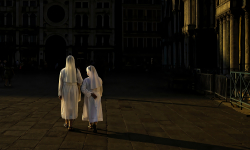
For millions of mothers, the midnight hour is rarely a time of peace. It is often the peak of a grueling cycle of wake-ups, feedings, and the quiet, heavy exhaustion that accompanies early parenthood and the demands of raising children. While many navigate these hours in perceived isolation, a viral discovery has revealed a surprising source of spiritual solidarity: a community of cloistered nuns who intentionally wake in the middle of the night to pray for them.
The story gained global attention through a social media post by Leanne Bowen, a Catholic watercolor artist and mother of two. Bowen shared her experience after attending a self-led prayer retreat with the Norbertine Sisters in Tehachapi, California. What began as a personal spiritual getaway evolved into a revelation about the hidden rhythms of cloistered life and a specific, compassionate intention behind their midnight prayers.
During her stay, Bowen observed the frequent and fervent prayer life of the community, noting that approximately 40 sisters live within the cloister on the other side of a stone wall. While she was initially familiar with the standard schedule of daily prayers, one specific entry on the calendar caught her attention: Matins, scheduled for 12 a.m.
The Discovery of the ‘Motherhood Hour’
Confused by the timing of a midnight service, Bowen sought clarification from a sister who served as her point of contact during the retreat. This sister, who was permitted to step out of the silence of the cloister to assist guests, provided an explanation that resonated deeply with Bowen and, subsequently, thousands of others online.
The sister explained that the midnight prayer is a significant commitment, lasting for one hour. More importantly, she revealed the specific purpose of this timing. “Yes, that prayer is long- for an hour. That is when we intercede for moms. It is our motherhood hour, where we get up with you,” the sister told Bowen, according to reports from EWTN.
This intentional act of “getting up” with mothers—matching the timing of their most tricky hours—transforms a standard liturgical prayer into a gesture of profound empathy. By aligning their spiritual labor with the physical and emotional labor of motherhood, the sisters offer a form of unseen companionship to women who often feel alone in the dark hours of the night.
Understanding the Role of Cloistered Intercession
To understand why this practice is so significant, it is necessary to understand the nature of cloistered religious life. Cloistered sisters, such as the Norbertine Sisters in Tehachapi, live a life of separation from the world to devote themselves entirely to prayer and contemplation. Their lives are structured around a rigorous schedule of liturgical hours, which include prayers such as Lauds and Vespers.
Intercessory prayer—the act of praying on behalf of others—is a cornerstone of this vocation. While the sisters may not have direct, daily interactions with the mothers they pray for, their belief is that spiritual intercession provides a tangible support system. The “motherhood hour” is a specific application of this mission, targeting a demographic characterized by high levels of stress, sleep deprivation, and emotional fatigue.
The viral nature of Bowen’s post suggests that the need for such support is widespread. The responses to the story highlighted a common thread among mothers: a longing for recognition of the “invisible” work performed during the night. The knowledge that a community of women is intentionally awake and praying specifically for them serves as a psychological and spiritual lifeline.
Key Aspects of the Midnight Prayer Practice
- Timing: The prayers occur during Matins at 12 a.m., coinciding with common wake-up times for parents of young children.
- Duration: The intercession lasts for one hour, reflecting a dedicated block of time for this specific intention.
- Intent: The practice is designed as an act of solidarity, described by the sisters as “getting up” with mothers.
- Community: The prayers are carried out by a cloistered community of approximately 40 Norbertine sisters in California.
The Impact of Spiritual Solidarity
The reaction to the Norbertine Sisters’ practice underscores a broader conversation about the challenges of modern motherhood. In an era of curated social media images, the reality of “weary moms” is often obscured. The revelation that religious sisters dedicate their sleep to intercede for these women provides a counter-narrative of solidarity and shared burden.
For many, the appeal of the story lies in the concept of the “unseen supporter.” The fact that the sisters remain behind a stone wall, unknown to the women they are helping, mirrors the often-unseen nature of motherhood itself. This symmetry creates a powerful emotional connection, suggesting that while a mother may be alone in her room at midnight, she is not alone in the wider spiritual community.
The story serves as a reminder of the role that traditional religious practices can play in addressing contemporary emotional needs. By utilizing the ancient structure of the liturgical hours to address a specific modern struggle, the Norbertine Sisters have found a way to make their cloistered life relevant to the daily struggles of families worldwide.
As this story continues to circulate, it highlights a persistent human need for empathy and the comforting knowledge that someone, somewhere, is mindful of one’s struggles during their most vulnerable moments.
There are currently no scheduled public updates or official statements regarding changes to the sisters’ prayer routines, as these practices are part of their ongoing daily commitment to intercessory prayer.
Do you find comfort in the idea of unseen support during difficult times? We invite you to share your thoughts and experiences in the comments below.