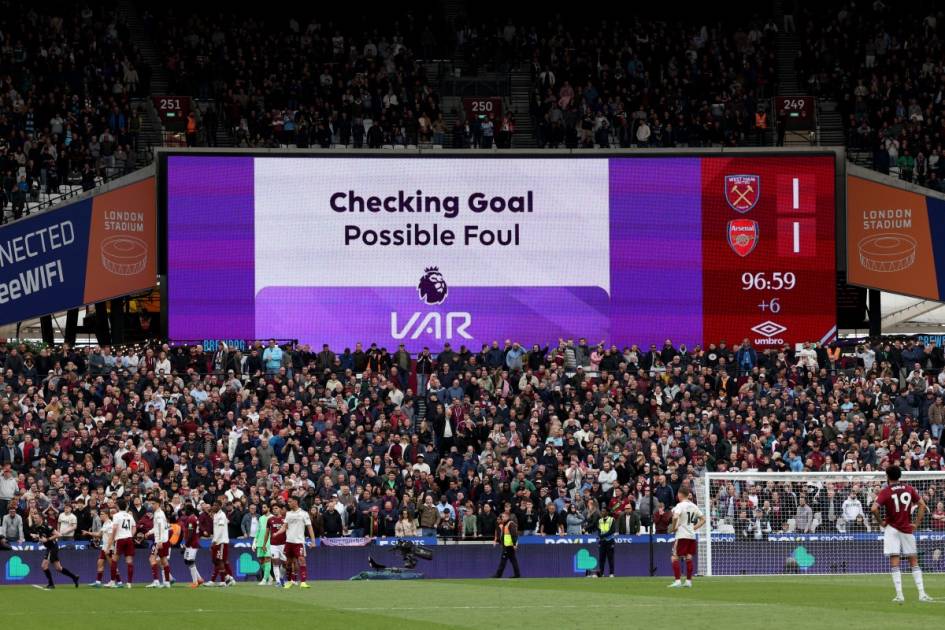
For decades, the “dark arts” of football were reserved for the periphery of the game—the subtle tug of a jersey, the strategic foul to stop a counter-attack, or the opportunistic nudge during a corner. However, in the current Premier League era, these subtle maneuvers have evolved into a sophisticated, high-stakes tactical system. At the center of this evolution is a growing and heated Premier League set-piece controversy that has pitted tactical innovation against the traditional interpretation of the Laws of the Game.
The debate has reached a boiling point as teams, most notably Arsenal, have refined a method of attacking set pieces that involves deliberately crowding the opposing goalkeeper. By positioning players directly in the keeper’s line of sight or physically obstructing their ability to come for a cross, teams are creating a chaotic environment where the advantage swings heavily toward the attacker. This shift has left referees struggling for consistency and managers demanding clarity from the governing bodies of the sport.
What was once viewed as incidental contact is now being recognized as a calculated strategy. As the margins for victory in the English top flight become razor-thin, the ability to manufacture a goal from a corner or a wide free-kick has become a primary objective. This tactical pivot has not only changed how matches are played but has also sparked a wider conversation about the integrity of the game and whether the current rules are equipped to handle the modern “blocking” era.
The tension is no longer confined to the touchline. The discourse has migrated to the International Football Association Board (IFAB) and FIFA, as officials consider whether the current definitions of “obstruction” and “impeding” need a comprehensive overhaul before the 2026 World Cup. For fans and pundits, the question is simple: is this clever coaching, or is it a systematic violation of the spirit of fair play?
The Arsenal Blueprint: Engineering Chaos in the Six-Yard Box
While many teams utilize set pieces, Arsenal has transformed them into a science. Much of this success is attributed to the influence of specialized set-piece coaching, specifically the work of Nicolas Jover. Under this regime, the Gunners have moved away from simply crossing the ball into a crowd, instead employing a rigorous system of “blocking” and “screening.”
The core of the tactic involves placing one or two physically imposing players directly in front of the goalkeeper. This serves two purposes: it obscures the goalkeeper’s vision of the ball’s flight and prevents them from moving toward the point of impact. When the ball is delivered, the goalkeeper is often trapped or forced to navigate a human shield, leaving the primary attacker with a clear path to the ball. This method has significantly increased the efficiency of Arsenal’s attacking routines, turning static plays into high-probability scoring opportunities.
This approach has not gone unnoticed by the rest of the league. Opposing managers have expressed frustration, arguing that the tactic effectively “neutralizes” the goalkeeper—the one player on the pitch permitted to use their hands. The controversy intensifies when these tactics are met with inconsistent officiating. In some matches, referees allow the crowding as part of the physical nature of the game; in others, they penalize the attackers for impeding the goalkeeper’s movement, leading to accusations of bias and a lack of standardized criteria.
The Legal Grey Area: IFAB and the Definition of Obstruction
To understand why this is so difficult to referee, one must look at the IFAB Laws of the Game. The primary point of contention lies in the distinction between “occupying space” and “impeding the progress of an opponent.”
According to the current laws, impeding an opponent is only an offense if the player is actively trying to obstruct the opponent’s movement without the ball. However, in a crowded six-yard box during a corner, the line between “standing your ground” and “blocking a path” is incredibly thin. Referees must decide in a fraction of a second whether a player is simply occupying a legal position or is intentionally using their body to prevent the goalkeeper from performing their duty.
This ambiguity creates a “referee’s nightmare.” If a referee calls a foul every time a player is in the goalkeeper’s way, the game would be interrupted by free-kicks every single corner. Conversely, if they allow total freedom, the goalkeeper becomes a passenger in their own penalty area. The lack of a clear, binary rule on “blocking the keeper” has led to the current state of chaos, where the outcome of a match can be decided by a referee’s subjective interpretation of a crowded box.
The VAR Dilemma and the Search for Consistency
The introduction of the Video Assistant Referee (VAR) was intended to eliminate “clear and obvious errors.” However, when it comes to set-piece obstruction, VAR has often added to the confusion rather than resolving it. Because the six-yard box is so densely packed during a corner, the camera angles often fail to provide a definitive view of whether a player’s arm or shoulder illegally impeded the goalkeeper.
the “clear and obvious” threshold makes it nearly impossible for VAR to overturn a referee’s decision on a blocking foul. Unless there is a blatant push or a pull, the subjective nature of “impeding” means the on-field decision almost always stands. This has led to a growing sense of frustration among players and managers who feel that the technology is failing to address a systemic tactical loophole.
The debate over VAR’s role in these incidents reflects a broader struggle within the Premier League to balance the flow of the game with the desire for absolute precision. As teams continue to refine their blocking techniques, the pressure on VAR officials to identify subtle obstructions increases, yet the tools available often prove insufficient for the task.
Global Implications: FIFA and the 2026 World Cup
The controversy in England is not merely a local issue; it is a bellwether for the international game. FIFA and IFAB are closely monitoring how the Premier League handles these tactical evolutions, as similar strategies are beginning to appear in other top European leagues. There is significant concern that if the rules are not clarified, the 2026 World Cup could be defined by “tactical fouling” and obstruction during set pieces.
Reports suggest that FIFA is wary of allowing the “Arsenal style” of goalkeeper crowding to become the global standard. The concern is that such tactics diminish the skill of the goalkeeper and shift the game toward a battle of physical obstruction rather than athletic ability. There are ongoing discussions regarding whether a “protection zone” should be established around the goalkeeper or if the rules on impeding should be tightened to specifically protect the keeper’s ability to move toward the ball.
If IFAB decides to implement a “revolutionary” change to the rules, it could fundamentally alter how teams approach set pieces. A stricter interpretation of obstruction would force coaches to move away from blocking tactics and return to more traditional crossing and movement-based routines. However, any such change would be met with resistance from the architects of the modern blocking game, who argue that they are simply utilizing the rules as written.
Impact on Players and Coaching Philosophy
The rise of the “set-piece specialist” coach is a direct result of this tactical arms race. Coaches like Nicolas Jover have shifted the perception of corners from a “coin flip” to a calculated play. This has placed a new premium on players with specific physical profiles—tall, strong defenders who can hold their position under pressure and “screen” the goalkeeper effectively.

For goalkeepers, the environment has become increasingly hostile. Modern keepers are now required to be more aggressive in their communication and physical presence to avoid being pinned down by blockers. The psychological toll is also evident, as keepers often feel unprotected by the officiating, leading to increased tension and confrontations during matches.
This evolution also affects how young players are trained. Academies are now incorporating set-piece “blocking” and “unblocking” into their curriculum, recognizing that these skills are just as vital as passing or shooting in the modern game. The shift toward “engineered chaos” represents a broader trend in football where data and marginal gains are applied to every single second of the match.
Key Takeaways from the Set-Piece Debate
- Tactical Evolution: Teams are increasingly using “blocking” and “screening” to obstruct goalkeepers during set pieces, turning corners into high-probability scoring opportunities.
- Regulatory Gap: Current IFAB laws on “impeding” are too ambiguous to provide consistent officiating in crowded penalty areas.
- VAR Limitations: The density of players in the six-yard box makes it difficult for VAR to identify “clear and obvious” obstruction.
- Global Concern: FIFA and IFAB are evaluating these tactics to determine if rule changes are necessary before the 2026 World Cup to preserve the role of the goalkeeper.
- Coaching Shift: The emergence of specialized set-piece coaches has transformed static plays into a scientific process of manipulating space and opposition.
What Happens Next?
The resolution of this controversy will likely come in one of two ways: a formal clarification of the Laws of the Game by IFAB or a directive from the Premier League’s refereeing body to standardize the interpretation of “obstruction.”
The next critical checkpoint will be the IFAB Annual General Meeting, where proposed changes to the Laws of the Game are debated and voted upon. Any decision made there will dictate how referees handle goalkeeper crowding not only in the Premier League but across all FIFA-affiliated competitions. Until then, managers will continue to push the boundaries of the rules, and goalkeepers will continue to fight for space in an increasingly crowded box.
Do you believe blocking the goalkeeper should be strictly penalized, or is it just a clever part of the modern game? Share your thoughts in the comments below and join the conversation on social media.
Keep reading