
For many managers, the most daunting part of the job isn’t the quarterly budget review or a high-stakes client pitch; it is the ten-minute window spent delivering a demanding performance critique. There is a pervasive, visceral anxiety associated with correcting a teammate, often rooted in a desire to be liked or a fear of triggering a defensive reaction. In the modern workplace, many leaders fall into the trap of “ruinous empathy,” where the desire to spare an employee’s feelings outweighs the necessity of professional growth.
However, avoiding these conversations is not a kindness; it is a strategic failure. When managers fail to address performance gaps or behavioral issues, they don’t just hinder the individual employee—they jeopardize the entire team’s morale. High performers often grow resentful when they perceive that mediocrity is tolerated, and the struggling employee is denied the very information they need to improve. Learning how to give difficult feedback to coworkers and direct reports is therefore less about “being the bad guy” and more about acting as a catalyst for professional evolution.
Effective feedback is a cornerstone of psychological safety—a concept pioneered by Harvard Business School professor Amy Edmondson. Psychological safety is the belief that one will not be punished or humiliated for speaking up with ideas, questions, concerns, or mistakes. Paradoxically, the way to build this safety is not by avoiding conflict, but by handling it with such transparency and support that the employee feels safe to fail, learn, and iterate. When feedback is delivered predictably and constructively, it ceases to be a threat and becomes a tool for development.
Navigating these interactions requires a blend of emotional intelligence and a structured framework. By shifting the objective from “correction” to “collaboration,” managers can transform a potentially volatile encounter into a productive roadmap for success. This guide outlines the verified strategies and psychological frameworks necessary to deliver tough feedback that sticks, preserves the relationship, and drives measurable results.
The Architecture of Preparation: Setting the Stage for Success
The success of a difficult conversation is often determined before the first word is spoken. Delivering feedback on a whim—or “in the heat of the moment”—usually triggers a fight-or-flight response in the recipient, shutting down the prefrontal cortex and making rational processing nearly impossible. Preparation ensures that the feedback is based on objective data rather than subjective emotion.
The first step in preparation is the gathering of evidence. Managers should move away from generalizations such as “you’ve been unproductive lately” or “your attitude is negative.” These phrases are vague and invite argument. Instead, a manager should compile specific examples: missed deadlines, specific errors in a report, or documented instances of disruptive behavior in meetings. Objectivity acts as a shield against perceived bias and keeps the conversation focused on the work, not the person.
Timing and environment are equally critical. Feedback should be delivered as close to the event as possible to ensure the details are fresh, but only after the initial emotional surge has subsided. The setting must be private, and neutral. Delivering a critique in an open-office plan or via a group email is a breach of professional etiquette that almost guarantees a defensive reaction. A private meeting room or a dedicated one-on-one video call signals that the conversation is important and that the employee’s dignity is being respected.
Finally, the manager must define the “desired state.” Before entering the room, ask: What does success look like after this conversation? Is the goal a change in a specific technical skill, a shift in communication style, or a correction in attendance? Having a clear objective prevents the conversation from meandering into a list of grievances and keeps it focused on a solution-oriented path.
Frameworks for Delivery: Moving Beyond the ‘Feedback Sandwich’
For decades, the “feedback sandwich”—layering a piece of criticism between two compliments—was the gold standard of management. However, modern organizational psychology suggests this method is often counterproductive. The positive “bread” can dilute the importance of the critique, leaving the employee confused about the urgency of the issue, or worse, making the compliments feel insincere and manipulative.
Instead, high-performing leaders utilize the SBI Model (Situation-Behavior-Impact), a framework developed by the Center for Creative Leadership. This method strips away judgment and focuses on observable facts:
- Situation: Define the specific time and place. (e.g., “During the project sync meeting on Tuesday morning…”)
- Behavior: Describe the observable action without using adjectives. (e.g., “…you interrupted Sarah four times while she was presenting the data.”)
- Impact: Explain how the behavior affected the team or the outcome. (e.g., “…Sarah was unable to finish her point, and the team missed a critical piece of information regarding the budget.”)
By using the SBI model, the manager avoids attacking the employee’s character. Instead of saying “You are disrespectful” (a character judgment), they say “You interrupted” (a behavior). This distinction is vital; people can change their behaviors, but they rarely feel they can change their fundamental character, which is where the most intense defensiveness arises.
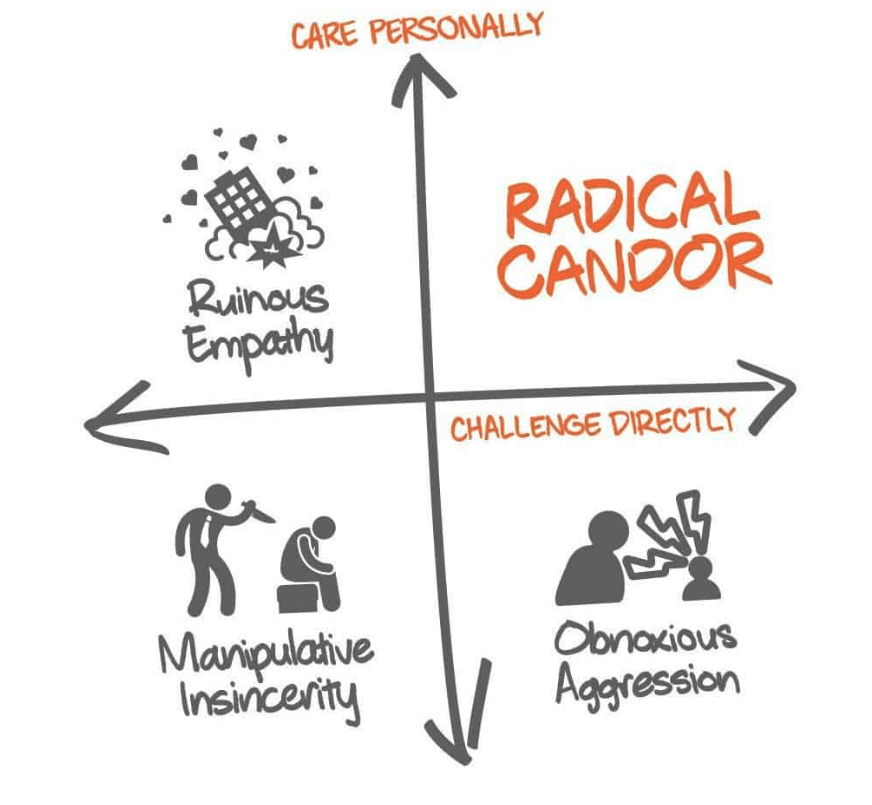
Another powerful approach is “Radical Candor,” a framework popularized by former Google executive Kim Scott. Radical Candor is the intersection of Caring Personally and Challenging Directly. According to Scott, when you challenge someone without caring for them, it is “obnoxious aggression.” When you care for them but fail to challenge them, it is “ruinous empathy.” The goal is to be clear and direct because you actually care about the person’s long-term career trajectory. Radical Candor emphasizes that being “nice” is not the same as being “kind”; kindness is telling someone the truth so they can improve.
Managing the Emotional Response: Active Listening and De-escalation
Even the most perfectly structured feedback can trigger a strong emotional response. An employee may react with silence, tears, anger, or denial. The manager’s role in these moments is not to argue the facts, but to manage the emotion. If a manager responds to anger with anger, the professional objective is lost, and the meeting devolves into a power struggle.
Active listening is the most effective tool for de-escalation. This involves more than just hearing words; it requires reflecting them back to the employee to ensure they feel understood. Phrases such as “I hear that you feel frustrated because you believe the workload was unrealistic” do not necessarily mean the manager agrees with the premise, but they acknowledge the employee’s perspective. This validation lowers the emotional temperature and allows the employee to move back into a rational state of mind.
When faced with denial—the “that never happened” response—the manager should return to the documented evidence. Instead of debating the memory of the event, they can say, “I understand you remember it differently, but I have the email thread here where the client expressed confusion over the instructions. Let’s look at how we can prevent that confusion in the future.” This shifts the focus from “who is right” to “how do we fix this.”
It is also important to allow for silence. Many managers feel the need to fill every gap in conversation to ease the tension. However, silence gives the employee space to process the information and formulate a thoughtful response. Rushing the conversation often leads to a superficial agreement (“Yes, I’ll fix it”) that lacks genuine commitment because the employee hasn’t actually internalized the feedback.
From Critique to Commitment: Creating an Actionable Path Forward
Feedback without a plan is merely a complaint. The final stage of the conversation must be the transition from the “what” (the problem) to the “how” (the solution). The most effective way to do What we have is through collaborative goal setting, rather than top-down mandates. When an employee helps create the solution, they take psychological ownership of the outcome.
Managers should utilize the SMART goal framework to ensure the path forward is unambiguous. Goals should be Specific, Measurable, Achievable, Relevant, and Time-bound. Instead of agreeing that the employee will “communicate better,” a SMART goal would be: “For the next four weeks, you will provide a written status update every Friday by 4:00 PM, outlining completed tasks and any blockers.”
This stage should also include a discussion on support. The manager should ask, “What do you need from me to make this happen?” This could be additional training, a software tool, or more frequent check-ins. By offering support, the manager reinforces the “Caring Personally” aspect of the relationship, signaling that they are invested in the employee’s success, not just their compliance.
Documentation is the final, non-negotiable step. Following the meeting, the manager should send a summary email outlining the discussed behavior, the agreed-upon goals, and the timeline for review. This serves two purposes: it ensures You’ll see no misunderstandings regarding the expectations, and it provides a necessary paper trail for SHRM-aligned human resources protocols should the performance not improve and further disciplinary action be required.
The Long-Term Strategy: Normalizing the Feedback Loop
The reason difficult feedback feels so heavy is often that it happens too infrequently. When a manager only gives feedback during annual reviews or when a crisis occurs, the employee associates feedback with failure or danger. To mitigate this, managers must normalize a culture of “continuous feedback.”
Continuous feedback involves a steady stream of both positive reinforcement and little, course-correcting adjustments. When a manager regularly praises specific wins (“The way you handled that objection in the meeting was excellent”), the employee builds a “trust reservoir.” When the manager eventually has to deliver a difficult critique, the employee is more likely to accept it because they know the manager also recognizes their strengths. They view the critique as a balanced assessment rather than a targeted attack.
the feedback loop must be bidirectional. A manager who asks for feedback on their own performance—and then visibly acts upon it—models the growth mindset they expect from their team. Asking, “What is one thing I could do differently to better support your workflow?” demonstrates humility and proves that feedback is a tool for everyone’s improvement, regardless of hierarchy.
the ability to deliver difficult feedback is the dividing line between a supervisor and a leader. A supervisor monitors tasks; a leader develops people. By embracing the discomfort of the “tough talk” and applying a structured, empathetic approach, managers can foster a culture of excellence, accountability, and mutual respect.
The next critical checkpoint for most organizations is the mid-year performance cycle, where initial goals are reassessed and course corrections are implemented. Managers are encouraged to begin these conversations now, rather than waiting for the formal review period, to ensure their teams remain aligned and supported.
Do you have a specific challenge with a team member or a feedback framework that has worked for you? Share your experiences in the comments below or share this guide with a fellow leader.
Related reading