
Washington, D.C. — May 19, 2026
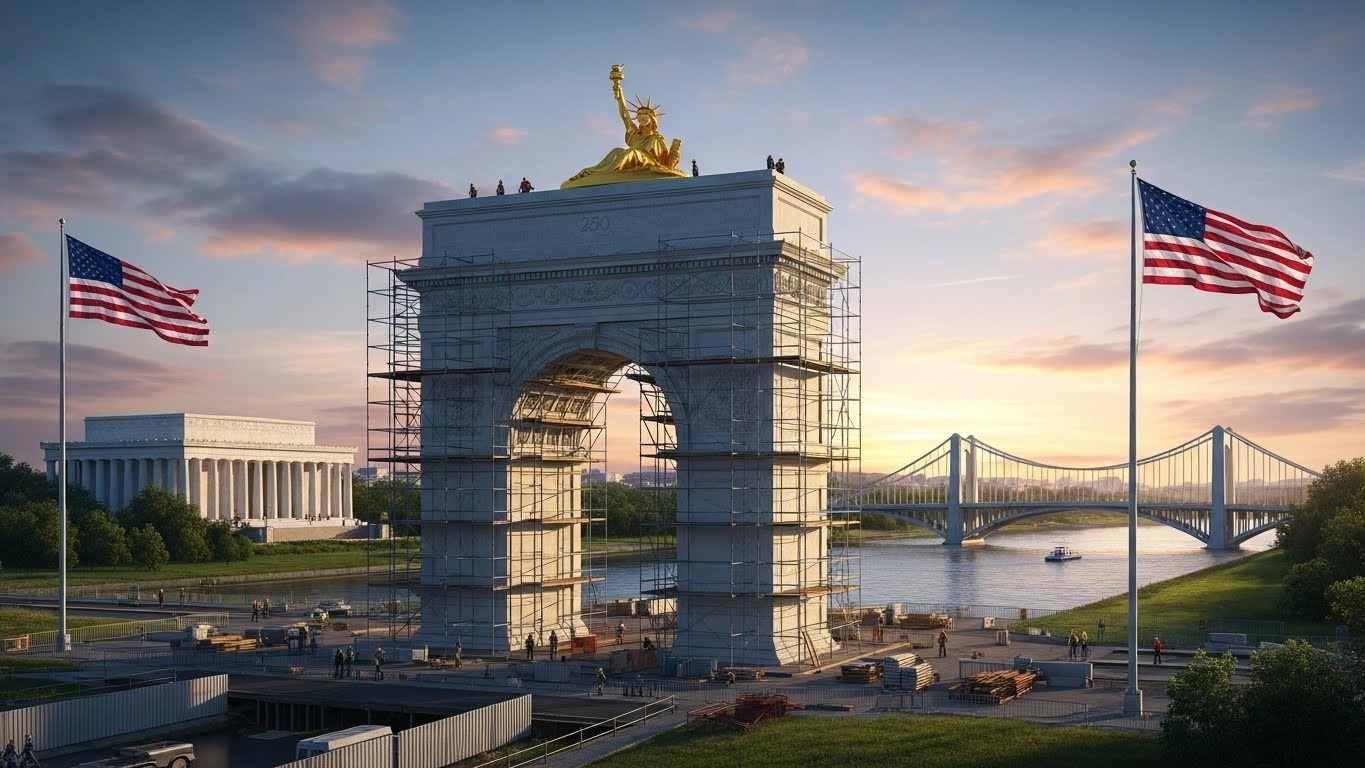
Workers in hard hats and safety vests began preliminary geotechnical surveys and topographical studies Monday at the proposed site for President Donald Trump’s controversial Arco del Triunfo (Arc de Triomphe) in Washington, D.C., marking the first physical step in a project that has already sparked legal challenges and fierce debate over its cultural and architectural impact. The 76-meter (250-foot) monument, intended to commemorate the 250th anniversary of the United States, would rise between the Lincoln Memorial and Arlington National Cemetery—an area already steeped in historical significance. The site, known as Memorial Circle, was cordoned off with pink survey flags and heavy machinery as engineers conducted soil tests and elevation mapping, according to court documents filed last week in a federal lawsuit opposing the project.
The Trump administration has framed the arc as a symbol of national pride, but critics—including a coalition of veterans, historians, and preservationists—argue it would disrupt the city’s carefully curated memorial landscape and overshadow existing monuments. The Commission of Fine Arts, a federal advisory body, approved the design in early 2026, though its members were appointed by the president, raising questions about impartiality. Meanwhile, the National Park Service, which would oversee construction, has not yet issued a formal environmental assessment, a step required before breaking ground.
“This is not just a building project—it’s a statement about what America values,” said Dr. Eleanor Whitmore, a historian at George Washington University and lead plaintiff in the lawsuit challenging the arc’s placement. “Washington’s memorials were designed to reflect centuries of national consensus. Adding a 250-foot monument to a president’s second term sets a dangerous precedent.” Whitmore’s legal team cited violations of the National Park Service Organic Act, which mandates that new memorials must align with the city’s “historical and cultural significance.” The lawsuit, filed in April, seeks an injunction to halt further site work until an independent review is completed.
Why the Project Is Sparking Backlash
Opposition to the arc stems from three key concerns:
- Architectural Overreach: The proposed site is adjacent to the Reflecting Pool, a central feature of the National Mall. Critics argue the arc’s height and scale would dominate the skyline, overshadowing the Washington Monument and other iconic structures. “This isn’t about aesthetics—it’s about power,” said Architectural Digest editor James Carter in a recent interview. “Washington’s memorials were designed to be timeless, not tied to a single administration.”
- Historical Precedent: No U.S. President has ever commissioned a permanent monument in their lifetime. The closest parallel is the Jefferson Memorial, built decades after his death. The arc’s timing—during Trump’s second term—has led some to compare it to authoritarian regimes erecting statues of themselves.
- Environmental and Logistical Hurdles: The site sits on unstable soil, requiring costly foundation work. The arc’s design includes a museum component, raising questions about funding and maintenance in an era of federal budget constraints.
The White House has not commented on the legal challenges, but administration officials have emphasized the arc’s symbolic importance. “This will be a monument to American resilience, not to any one leader,” said a senior aide, speaking on condition of anonymity. The project’s estimated cost—ranging from $1.2 billion to $1.8 billion, according to internal documents—would make it one of the most expensive public works projects in U.S. History, funded through a combination of private donations and federal appropriations.
Legal Battles and Next Steps
The federal lawsuit, Whitmore v. United States, is currently before Judge Richard P. Sullivan of the U.S. District Court for the District of Columbia. The plaintiffs argue that the National Park Service bypassed standard review processes to fast-track the project. In response, the government has filed motions to dismiss, citing the president’s authority over federal lands.
A hearing on the preliminary injunction is scheduled for June 10, 2026, with a decision expected within 30 days. If the lawsuit succeeds, construction could be delayed for years while environmental impact studies and public hearings are conducted. Meanwhile, the Trump administration has accelerated other memorial-related projects, including a proposed Statue of Liberty restoration fund and a $1.8 billion compensation program for allies claiming political persecution—a move that critics say is politically motivated.
| Date | Event | Status |
|---|---|---|
| January 2025 | President Trump announces the arc’s design during State of the Union address. | Official proposal |
| March 2026 | Commission of Fine Arts approves preliminary design (controversial due to Trump-appointed members). | Approved |
| April 2026 | Federal lawsuit filed by veterans and historians challenging site selection and environmental review. | Ongoing litigation |
| May 11, 2026 | Geotechnical surveys begin at Memorial Circle site. | Active |
| June 10, 2026 | Court hearing on preliminary injunction to halt construction. | Pending |
What Happens Next?
The outcome of the lawsuit will hinge on three factors:
- Judicial Ruling: If Judge Sullivan upholds the injunction, the project could face delays of two to five years while environmental assessments and public input are gathered. The Trump administration has signaled it will appeal any adverse ruling to the U.S. Court of Appeals for the D.C. Circuit.
- Public and Political Pressure: Polling suggests mixed reactions—with 42% supporting the arc as a symbol of national pride and 51% opposing it as a vanity project. Congressional Republicans have largely backed the initiative, while Democrats and independent groups like the National Trust for Historic Preservation have condemned it.
- Funding and Feasibility: The project’s budget remains unclear, with estimates varying widely. If construction proceeds, it would require Congressional approval for additional federal funding, a politically volatile proposition in an election year.
The next critical deadline is the June 10 hearing. In the meantime, the National Park Service has directed visitors to avoid the cordoned-off area near Memorial Circle, citing “ongoing archaeological and geological evaluations.” For updates on the lawsuit, court filings are available on the U.S. District Court for D.C. website.
Reader Questions: What You Need to Know
Q: Is this the first time a U.S. President has proposed a personal monument?
A: No, but it is unprecedented in scale and timing. Past presidents like Theodore Roosevelt and Lyndon B. Johnson have had memorials built after their deaths, but never during their tenure. The closest modern comparison is the Reagan Presidential Library, which was funded privately during his presidency but not on federal land.
Q: How would the arc affect tourism?
A: The National Mall already attracts over 25 million visitors annually. Proponents argue the arc would draw more tourists, while critics warn it could overwhelm the area’s infrastructure, particularly near the Lincoln Memorial and Vietnam Veterans Memorial.
Q: Could the project still move forward if the lawsuit fails?
A: Yes, but significant hurdles remain. Even if the court rules in the administration’s favor, the National Park Service would still need to conduct an environmental impact statement, a process that typically takes 12–18 months. Congress would need to allocate funds, which is unlikely before the 2028 election.
Share your thoughts: Should Washington, D.C., prioritize monuments to living leaders, or preserve its historical integrity? Comment below or join the discussion on our Sports & Culture forum.
Worth a look