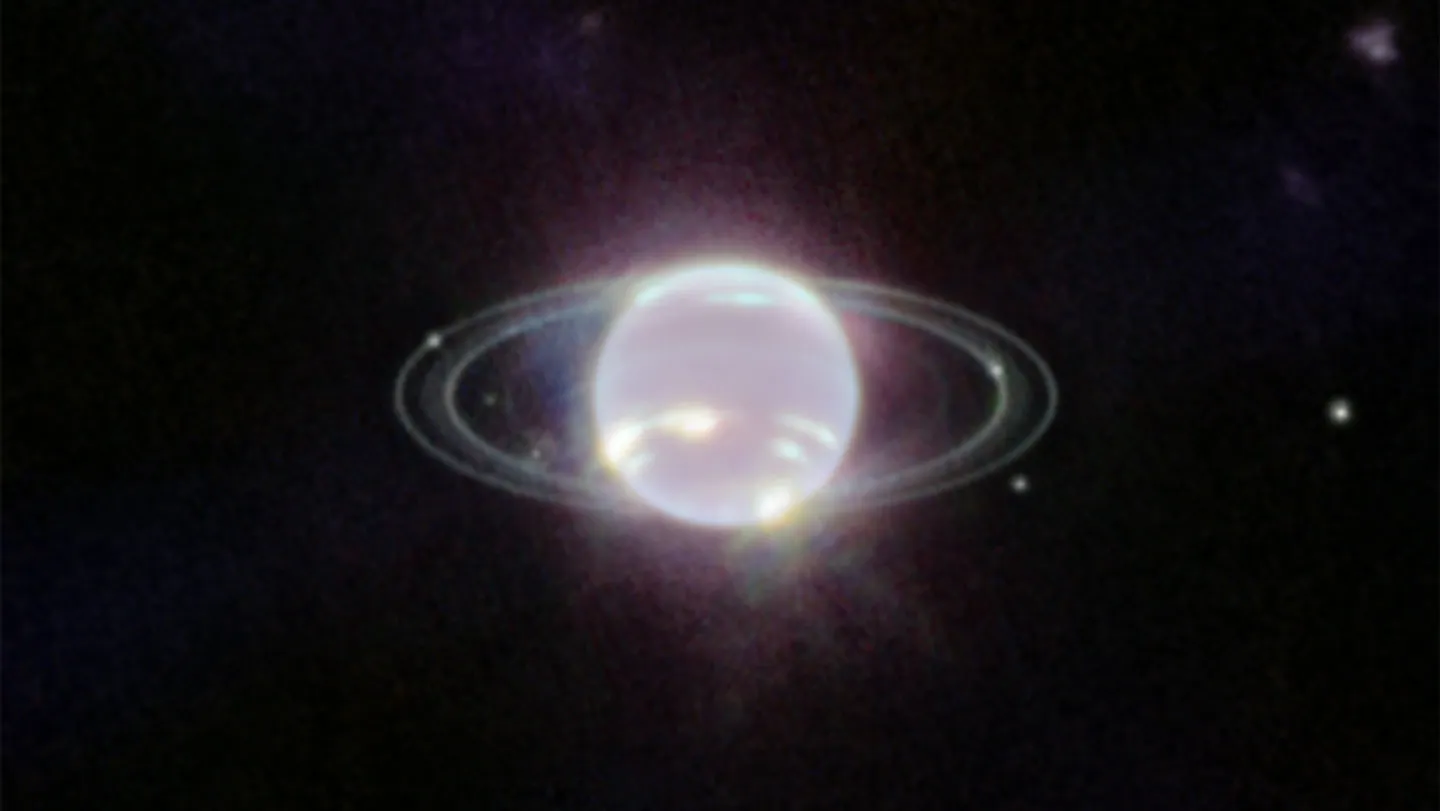
As we continue to peer into the furthest reaches of our solar system, Neptune remains one of the most enigmatic subjects in planetary science. Orbiting more than 30 times further from the Sun than Earth, this ice giant has long challenged our understanding of how planetary systems evolve. Among its many mysteries, the moon Nereid stands out as a true celestial oddball. Recent scientific discussions have reignited interest in the theory that this peculiar satellite might be the sole remnant of an earlier system, potentially formed in close proximity to the planet rather than being a captured object from the outer solar system.
Understanding the history of Nereid is essential for those of us tracking the evolution of the solar system. Neptune, the eighth and most distant major planet from the Sun, was famously the first planet located through mathematical prediction rather than direct observation, according to NASA’s official planetary data. Because of its immense distance, the planet cannot be seen with the unaided eye, making the study of its moons a feat of both technological and mathematical precision.
The Mystery of the Outer Moons
Nereid was discovered by Gerard Kuiper in 1949 and its orbit remains one of the most eccentric in the solar system. While most moons follow relatively circular paths around their host planets, Nereid’s orbit is highly elongated, leading many astronomers to speculate that it was captured by Neptune’s gravity long after the planet formed. However, the “moonpocalypse” hypothesis suggests a more violent, localized history.
If Nereid was indeed formed near Neptune, rather than being a nomadic object trapped by the planet’s gravitational pull, it implies that Neptune’s original satellite system was far more robust than what we see today. The theory posits that a catastrophic event—a literal moonpocalypse—could have decimated the original collection of inner moons, leaving Nereid as the only surviving witness to that ancient era. This would explain its unique orbital characteristics and its distinct composition compared to the other 16 known moons of Neptune, as noted in Britannica’s comprehensive guide to the planet.
Observations from the Voyager Era
Our most intimate look at the Neptunian system came in the summer of 1989, when NASA’s Voyager 2 spacecraft performed its historic flyby. This mission provided the first, and to date only, close-up images of the planet and its moons. The data returned by Voyager 2 confirmed that Neptune is a dynamic world, whipped by supersonic winds and characterized by cold, dark conditions. These findings remain the baseline for all current models of the ice giant’s environment, as documented by NASA Science.

The discovery of Neptune’s moons has been a slow, methodical process. While William Lassell identified Triton—the largest of the moons—just 17 days after Neptune itself was discovered in 1846, others have been identified over the subsequent century and a half. The total count of moons now stands at 16, each offering a tiny piece of the puzzle regarding how this distant world maintains its gravitational hold on its neighbors.
Why the Nereid Hypothesis Matters
Why does the potential origin of a single, distant moon matter to us here on Earth? From a medical and scientific perspective, understanding the formation of planetary systems informs our broader knowledge of the conditions necessary for stability in space. Just as we study the history of infectious diseases to understand modern public health, astrophysicists study the “history” of solar systems to understand how planets and their satellites interact over billions of years.
The “moonpocalypse” theory is not merely a story of destruction; This proves a theory of evolution. If Nereid is a remnant, it provides a unique archaeological record of the materials and conditions present during the birth of Neptune. By analyzing its orbit and physical properties, researchers hope to determine whether the ice giant once hosted a more orderly system that was later disrupted by the chaotic migration of outer solar system bodies.
Looking Ahead: The Future of Neptune Exploration
As of May 2026, We find no active spacecraft currently en route to Neptune, and our understanding of the planet relies on long-term ground-based observations and data synthesized from previous missions. The scientific community continues to leverage tools like the “Eyes on the Solar System” platform, which uses data from NASA missions to provide simulated views of the Neptunian environment, as reported by NASA’s official mission resources.

For those interested in the latest updates on planetary science, the best resources remain the official archives of major space agencies. These organizations periodically release new analyses based on ongoing data re-processing. While we wait for the next generation of deep-space probes to visit the outer solar system, our understanding of Nereid will remain a subject of active debate and modeling.
Do you find the history of our solar system’s most distant corners as fascinating as I do? The story of Nereid is a powerful reminder that even in the cold, dark reaches of space, there is a history of violence and resilience waiting to be uncovered. I invite you to share your thoughts in the comments below or join the conversation on our social channels. We will continue to track any new developments or peer-reviewed findings regarding Neptune’s moon system as they are released by the global scientific community.
- AI Reveals How Disrupted 3D DNA Architecture Triggers Alzheimer’s Disease
- How to Maintain Thick, Full Hair Naturally: Tips for Maximum Volume
- Severe Weather Hits Sioux Falls, SC, as Storm System Moves East (news-usa.today)
- Stryker SYK Focuses on Mako RPS System Launch for Total Knee Arthroplasty (world-today-news.com)