
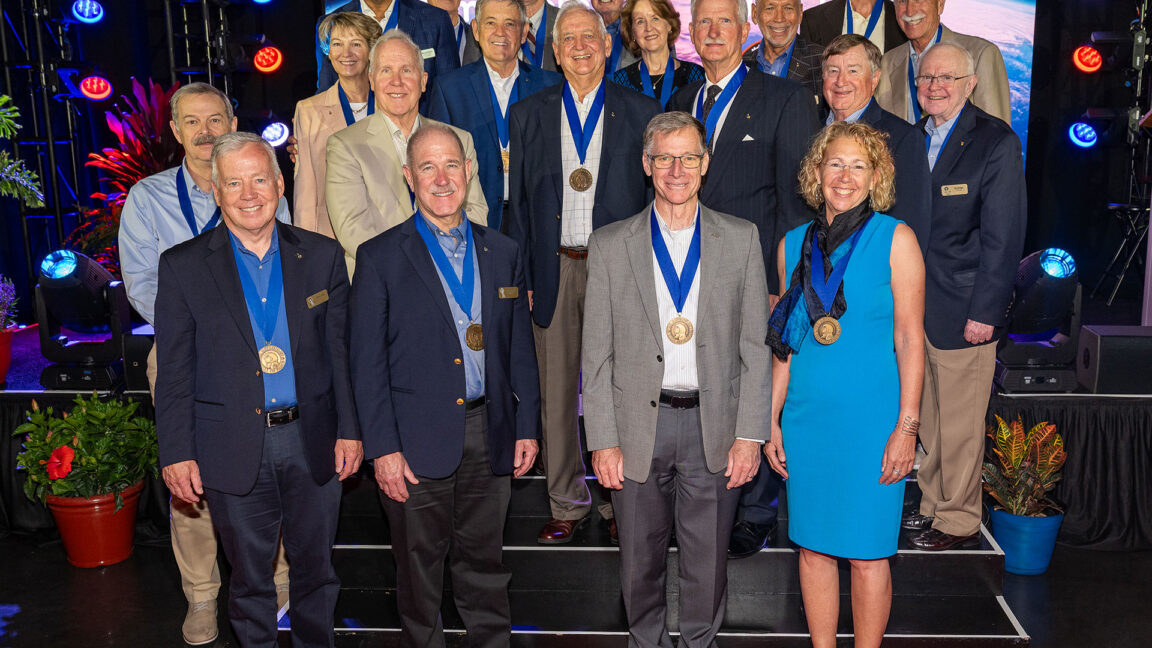
Space Shuttle Era Veterans Tom Akers and Joe Tanner Inducted into US Astronaut Hall of Fame
In a ceremony honoring the pioneers of human spaceflight, two distinguished veterans of the Space Shuttle era, Tom Akers and Joe Tanner, were officially inducted into the US Astronaut Hall of Fame on May 16. The induction recognizes their significant contributions to space exploration and their technical mastery during one of the most intensive periods of orbital operations in history.
The induction, managed by the National Space Society, serves as a permanent tribute to those who have pushed the boundaries of human capability in the cosmos. For Akers and Tanner, the honor marks a career-spanning legacy that transitioned from the high-stakes maneuvers of the Space Shuttle program to the lasting impact of their technical expertise on NASA’s mission success.
While both men reached the pinnacle of astronautics, their paths to the stars were separated by a narrow margin of timing. Though they now share a place in the Hall of Fame, a slight shift in the historical timeline nearly saw them entering the NASA astronaut corps as classmates. This “near miss” in their selection years adds a layer of professional symmetry to their joint induction.
The “Near Miss” of NASA Selection Groups
The professional intersection of Akers and Tanner is a fascinating study in the timing of NASA’s recruitment cycles. Tom Akers was selected as part of NASA’s 12th astronaut group in 1984. During this era, the Space Shuttle program was rapidly expanding, requiring a surge of highly skilled mission specialists and pilots.
Joe Tanner’s trajectory followed a slightly different course. In 1984, Tanner reported to the Johnson Space Center (JSC) to serve as an instructor pilot. Rather than joining the immediate 1984 selection class, he applied for the subsequent group, eventually joining NASA as part of the 13th astronaut class in 1985. Had his transition from instructor pilot to candidate occurred just one cycle earlier, the two would have trained and progressed through the agency as a single cohort.
Instead, they navigated the complexities of the Shuttle era as colleagues from different selection groups, eventually becoming two of the most respected figures in extravehicular activity (EVA) and mission specialist operations.
Tom Akers: A Legacy of Precision and Spacewalks
Tom Akers is widely recognized for his exceptional skill in extravehicular activity—commonly known as spacewalking. His career was defined by high-pressure missions where technical precision was not merely a requirement but a necessity for mission survival and success.
One of the most significant milestones in Akers’ career was his involvement in the critical repair missions for the Hubble Space Telescope. During the STS-61 mission, Akers was part of the specialized crew tasked with restoring the telescope’s functionality, a feat that saved one of humanity’s most crucial scientific instruments from obsolescence. His ability to perform complex mechanical tasks in the vacuum of space cemented his reputation as a premier mission specialist.
Throughout his tenure, Akers participated in multiple shuttle missions, including STS-41, STS-49, STS-61, STS-71, STS-78, STS-80, STS-89, STS-94, and STS-106. His work spanned various objectives, from satellite servicing to the early stages of the Shuttle-Mir program, contributing to the foundational knowledge required for the eventual construction of the International Space Station (ISS).
Joe Tanner: From Flight Instruction to Orbital Science
Joe Tanner’s contribution to spaceflight was characterized by a deep integration of flight expertise and scientific support. Following his time as an instructor pilot, Tanner transitioned into the role of a mission specialist, where he played a vital part in the diverse scientific payloads carried by the Space Shuttle.
Tanner’s mission history includes STS-56, STS-63, and STS-72. His work often involved supporting Spacelab missions, which were dedicated to conducting microgravity research. These missions were essential for understanding how physical and biological processes behave in an orbital environment, providing data that continues to influence scientific research on Earth today.
The technical discipline Tanner brought to the Johnson Space Center and subsequently to orbit helped bridge the gap between complex orbital mechanics and the practical execution of scientific experiments. His career reflects the versatility required of the Shuttle-era astronaut, moving seamlessly between flight operations and scientific mission management.
Comparative Career Overview
The following table provides a brief comparison of the career trajectories of the two newly inducted astronauts:
| Feature | Tom Akers | Joe Tanner | |
|---|---|---|---|
| NASA Selection Year | 1984 (Group 12) | 1985 (Group 13) | |
| Primary Role | Mission Specialist | Mission Specialist | |
| Key Expertise | Extravehicular Activity (EVA) | Flight Instruction & Science Support | |
| Notable Mission Impact | Hubble Space Telescope Repair (STS-61) | Spacelab Scientific Operations | |
| Hall of Fame Induction | May 2026 | May 2026 |
The Significance of the US Astronaut Hall of Fame
The induction of Akers and Tanner is more than a personal accolade; This proves a recognition of the era they helped define. The Space Shuttle program was a period of immense technical risk and unprecedented discovery. The astronauts of this era were tasked with operating a reusable spacecraft that was, in many ways, a flying laboratory, a cargo ship, and a construction platform all at once.
The US Astronaut Hall of Fame seeks to preserve this history by honoring those who demonstrated the courage, technical proficiency, and leadership necessary to sustain long-term human presence in space. By inducting veterans like Akers and Tanner, the Hall of Fame ensures that the lessons learned during the Shuttle era—lessons in orbital repair, microgravity science, and complex EVA—are honored as the bedrock of modern space exploration.
As NASA moves deeper into the Artemis era and looks toward Mars, the achievements of the Shuttle-era astronauts serve as a critical reference point. The ability to maintain complex systems in orbit, a skill honed by Akers and Tanner, remains a cornerstone of current and future deep-space mission planning.
The next scheduled update regarding the National Space Society’s upcoming commemorative events and further Hall of Fame recognitions is expected in late 2026.
What do you think about the legacy of the Space Shuttle era? Share your thoughts in the comments below and share this article with your fellow space enthusiasts.