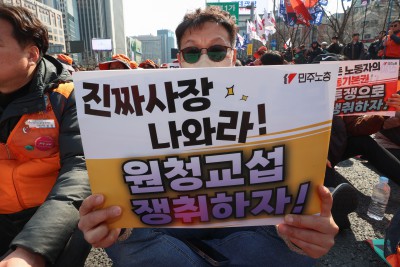
South Korea’s Labor Movement Mobilizes for Protests After Supreme Court Ruling on ‘False Principal-Contractor Relationships’
South Korea’s labor movement is preparing for a week of coordinated protests across the country following a landmark Supreme Court ruling that has reignited debates over worker protections and corporate accountability. The ruling, delivered last month, declared that certain labor contracts—particularly those used by universities, large corporations, and government agencies—do not meet the legal definition of a “principal-contractor relationship,” effectively stripping non-regular workers of key protections under the country’s Labor Standards Act. Labor advocates argue the decision undermines the spirit of the Yellow Envelope Law, a 2021 reform aimed at reducing precarious employment by requiring companies to classify workers properly.
The Supreme Court’s decision, announced on May 15, 2024, has sparked outrage among labor unions, which accuse the government and major institutions of exploiting loopholes to avoid responsibility for non-regular workers—including part-time employees, dispatch workers, and temporary staff. Protests planned for this week, involving unions from education, manufacturing, and service sectors, aim to pressure lawmakers to amend the ruling or introduce new legislation to close perceived gaps in labor protections.
At the heart of the controversy is the distinction between “true” and “false” principal-contractor relationships. Under South Korean law, companies are required to treat workers as direct employees if they exercise significant control over their work—such as setting hours, tasks, or compensation. However, the Supreme Court’s ruling has created ambiguity, allowing institutions to argue that certain contracts (e.g., those used by universities for adjunct professors or hospitals for temporary nurses) do not qualify as “true” employment relationships. Critics warn this could enable widespread misclassification, leaving hundreds of thousands of workers without benefits like severance pay, overtime protections, or union representation.
Why This Ruling Matters: 5 Critical Implications
- Erosion of Non-Regular Worker Protections: The ruling could lead to increased misclassification of workers, particularly in sectors like education and healthcare where temporary staffing is common.
- Government and Corporate Accountability: Labor groups allege that universities and large firms (e.g., Samsung, Hyundai) have used the decision to avoid paying benefits to non-regular workers, including adjunct professors and dispatch employees.
- Undermining the Yellow Envelope Law: The 2021 reform required companies to disclose labor contracts transparently; the Supreme Court’s interpretation may weaken enforcement of this transparency.
- Sector-Specific Risks: Education and healthcare sectors are most vulnerable, where non-regular workers often perform core functions but lack job security.
- Political Pressure: Opposition parties and labor unions are demanding legislative action, including potential amendments to the Labor Standards Act.
Who Is Affected—and How Are They Responding?
Labor unions, including the Korean Confederation of Trade Unions (KCTU) and the Federation of Korean Trade Unions (FKTU), have been at the forefront of the backlash. The KCTU, representing over 1.2 million workers, announced a three-day strike and rally series starting June 11, with demonstrations planned in Seoul, Busan, and Daegu. “This ruling is a direct attack on the dignity of non-regular workers,” said Han Sang-gyun, KCTU president, in a statement last week. “It allows corporations to treat workers as disposable while avoiding all legal and moral responsibilities.”
/supreme-court-west-entrance-564091971-crop-595477603df78cdc29d6e89e.jpg "Supreme Court")

Corporate responses have been muted, with major conglomerates like Samsung and LG avoiding direct comment on the protests. However, industry groups such as the Korean Chamber of Commerce and Industry have argued that the ruling reflects “necessary legal clarity” for businesses operating in a competitive global economy. Critics counter that the decision prioritizes corporate flexibility over worker rights, particularly in an economy where non-regular employment accounts for nearly 37% of the workforce, according to the International Labour Organization (ILO).
Government officials have also remained tight-lipped, with the Ministry of Employment and Labor stating that it is “reviewing the legal implications” of the ruling. However, labor activists point to a pattern of inaction: the Yellow Envelope Law itself has faced limited enforcement, with only 12% of reported violations resulting in penalties as of 2023, according to government data.
The Yellow Envelope Law and the Fight for Labor Rights
The Yellow Envelope Law, formally the Act on the Improvement of Work Environment for Workers with Non-Standard Employment Relationships, was passed in 2021 under President Moon Jae-in’s administration. Named after the yellow envelopes used to hand-deliver labor contracts, the law sought to address the widespread practice of misclassifying workers as “independent contractors” to avoid benefits and protections. The legislation required companies to:
- Disclose labor contracts transparently.
- Provide equal pay for equal work.
- Offer severance and overtime protections to non-regular workers.
Yet, the Supreme Court’s ruling has created a loophole by narrowing the definition of a “principal-contractor relationship.” Legal experts warn this could reverse progress made under the law. “The court’s interpretation essentially allows employers to argue that if a worker is paid per project or has some degree of autonomy, they are not truly ’employed,'” explained Professor Lee Ji-hoon of Seoul National University’s Law School. “This is a step backward for labor rights in South Korea.”
The ruling also highlights systemic challenges in South Korea’s dual labor market, where regular workers enjoy strong protections but non-regular workers—often women, young adults, or migrants—face precarious conditions. A 2023 report by the OECD found that non-regular workers in South Korea earn 20–30% less than their regular counterparts, with limited access to training or career advancement.
Protests and the Path Forward
This week’s protests are expected to escalate pressure on the government ahead of the National Assembly’s summer session, which begins on June 17. Labor unions have outlined three key demands:
- Amend the Labor Standards Act to explicitly define “principal-contractor relationships” and close loopholes.
- Strengthen enforcement of the Yellow Envelope Law, including penalties for misclassification.
- Increase transparency in labor contracts, particularly in sectors like education and healthcare where non-regular employment is rampant.
Opposition parties, including the Democratic Party of Korea, have signaled support for labor demands, with lawmaker Park Jung-ki proposing a parliamentary hearing on the Supreme Court’s ruling. However, the ruling party, the People Power Party, has not yet committed to legislative action.
Labor activists are also looking to the courts for relief. The KCTU has announced plans to file constitutional challenges against the Supreme Court’s interpretation, arguing it violates the country’s Constitution, which guarantees equal protection under labor laws. “We will exhaust all legal avenues to ensure that no worker is left behind,” said Han.
How Does South Korea Compare to Other Countries?
South Korea’s struggle with non-regular employment is not unique. Countries like Japan, Germany, and the United States have also grappled with misclassification issues, though their legal frameworks differ significantly:

| Country | Key Legal Framework | Non-Regular Employment Rate (2023) | Recent Reforms |
|---|---|---|---|
| South Korea | Labor Standards Act (Yellow Envelope Law) | 37% | 2021: Stricter contract disclosure rules |
| Japan | Labor Contract Act | 40% | 2022: Expanded protections for part-time workers |
| Germany | Part-Time and Fixed-Term Employment Act | 28% | 2021: Ban on “zero-hours” contracts |
| United States | Fair Labor Standards Act | 15% (gig economy included) | 2023: Crackdown on misclassification in California |
While South Korea’s non-regular employment rate is higher than in many OECD nations, its legal challenges mirror global trends. The key difference lies in enforcement: unlike in Germany or Japan, where labor inspections are more robust, South Korea’s workplace inspections have declined by 12% since 2018, according to OECD data.
What’s Next: Key Dates and Actions
The next critical checkpoint is the June 17 opening of the National Assembly’s summer session, where labor unions will push for legislative action. Here’s what to watch:
- June 11–13: Nationwide protests and strikes organized by the KCTU and FKTU, targeting government buildings and corporate headquarters in Seoul, Busan, and Daegu.
- June 17: Parliamentary debate on potential amendments to the Labor Standards Act. Opposition parties are expected to introduce bills to clarify the definition of “principal-contractor relationships.”
- July 1: Deadline for the Ministry of Employment and Labor to release a formal review of the Supreme Court’s ruling and propose policy responses.
- Ongoing: Labor unions will continue filing constitutional challenges and lobbying for stricter enforcement of the Yellow Envelope Law.
For workers and employers seeking updates, the following resources provide official guidance:
- Ministry of Employment and Labor (South Korea) – Official labor law updates and complaint procedures.
- Korean Confederation of Trade Unions – Protest schedules and labor rights resources.
- ILO Korea – Reports on non-regular employment trends.
This story is developing rapidly. For real-time updates on protests and legislative actions, follow World Today Journal’s Business section or subscribe to our newsletter for alerts on labor policy changes in Asia. We welcome your insights—share your experiences or questions in the comments below, and join the discussion on how corporate accountability and worker protections can be strengthened in South Korea and beyond.
Related reading