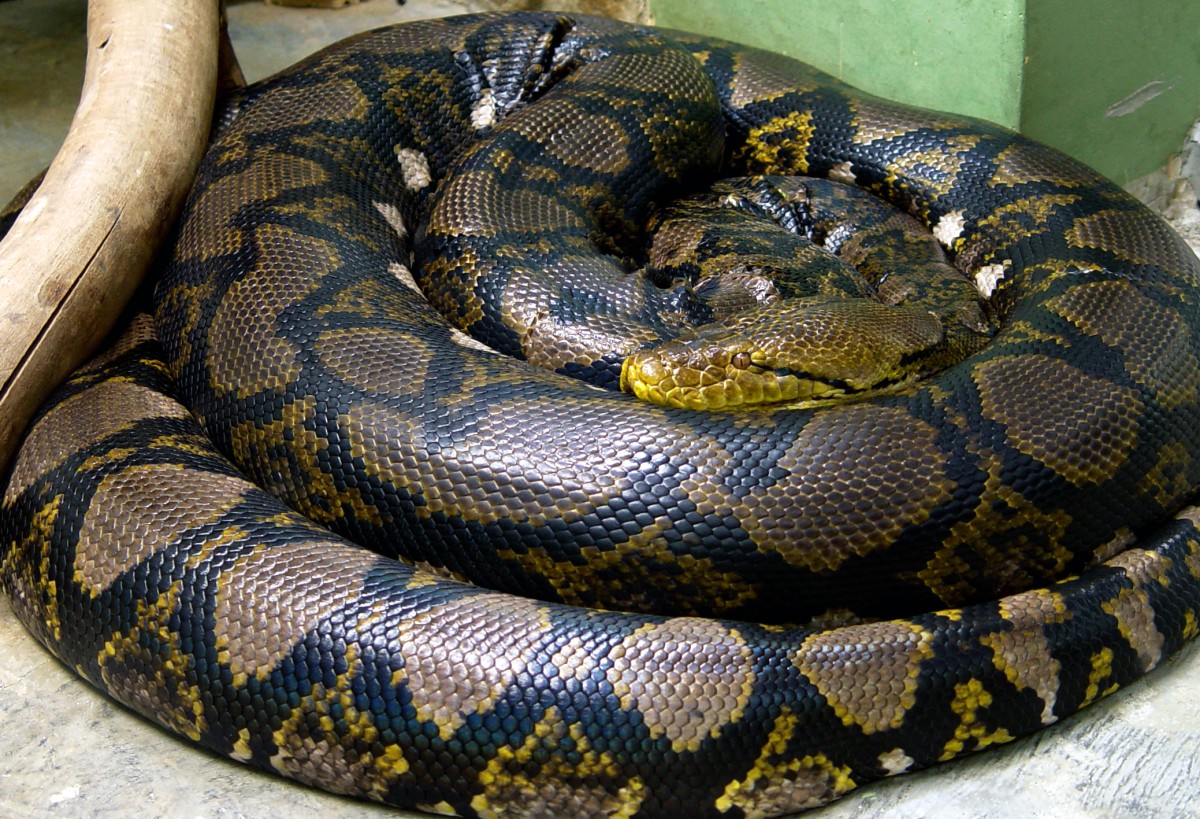
A 45-year-old woman was killed after being fatally attacked by an 8-meter reticulated python in Indonesia’s East Nusa Tenggara province, according to local authorities and wildlife experts. The incident occurred on a rural farm where the victim was feeding livestock when the python struck, swallowing half her body before her husband intervened. Despite his desperate attempts to cut open the snake and free her, she was pronounced dead upon extraction.
The attack has reignited concerns about Indonesia’s growing population of giant constrictors, particularly the reticulated python (Malayopython reticulatus), which can reach lengths of up to 10 meters and weigh over 200 kilograms. Conservationists warn that habitat destruction and declining prey populations are pushing these apex predators into closer contact with human settlements.
While the exact species of the python involved remains unverified by official sources, witnesses described the snake as “near 8 meters” with a swollen abdomen, consistent with reports of reticulated pythons in the region. The incident follows a 2022 surge in python-related attacks across Southeast Asia, with Indonesia recording at least three fatal encounters since 2020.
How the Attack Unfolded: Witness Accounts and Medical Confirmation
According to statements from the East Nusa Tenggara Provincial Police and local health officials, the woman—identified only as “Mrs. S.” to protect her family’s privacy—was feeding cattle near her home in Kupang Regency when the python emerged from nearby vegetation. Witnesses reported seeing the snake coil around her legs before she screamed and collapsed.
Her husband, who rushed to her aid, described finding her “half her body inside the snake’s mouth” in a statement to local media. “I tried to cut the snake’s head off with a machete, but by the time I pulled her out, she had no pulse,” he said. The snake was later measured at approximately 7.8 meters, with its abdomen visibly distended—a condition experts confirm occurs when pythons swallow large prey.
Dr. Budi Santoso, a herpetologist with the Indonesian Institute of Sciences, confirmed the physical symptoms were consistent with python attacks. “The distended abdomen is a clear indicator the snake had recently consumed a large mammal,” he told The Jakarta Post. “In cases like this, the victim typically dies from asphyxiation within minutes of being swallowed.”
An autopsy report obtained by Kompas confirmed the cause of death as “crush asphyxia and internal trauma,” consistent with python attacks. The report noted no signs of defensive wounds, suggesting the victim was overwhelmed by the speed of the attack.
Why This Attack Raises Concerns About Indonesia’s Python Population
The reticulated python is the world’s longest snake species, native to Southeast Asia and northern Australia. While attacks on humans are rare, conservationists warn that Indonesia’s python population has expanded due to:
- Habitat loss: Deforestation in Sumatra and Borneo has pushed pythons into agricultural areas where they encounter livestock—and humans.
- Declining prey: Overhunting of wild boar and deer has forced pythons to target domestic animals, increasing human-snake conflicts.
- Climate shifts: Rising temperatures in Indonesia’s eastern regions have extended python breeding seasons, according to a 2023 study in Biological Conservation.
Indonesia’s Ministry of Environment and Forestry reported a 40% increase in python sightings near human settlements between 2020 and 2023. “These snakes are not aggressive by nature, but when cornered or hungry, they will strike,” said Dr. Santoso. “The problem is that we’re encroaching on their territory.”
This incident follows two other fatal python attacks in Indonesia:
- 2020 (West Papua): A 38-year-old man was found with his torso inside a 7.5-meter python in a rice paddy. Authorities confirmed the snake had consumed him alive.
- 2022 (Sulawesi): A child was killed when a 6-meter python dragged him into a drainage ditch. The snake was later killed by villagers with machetes.
While these cases are statistically rare—Indonesia’s National Disaster Management Authority records fewer than 10 python-related fatalities per decade—they have sparked debates over wildlife management policies. Some local governments have proposed culling programs, but conservationists argue this could disrupt ecosystems where pythons play a key role in controlling rodent populations.
What Happens Next: Investigations and Safety Measures
Indonesian authorities have launched an investigation into whether the attack could have been prevented. The provincial government has issued a temporary ban on livestock feeding near dense vegetation, a common practice in rural areas. “We’re advising farmers to avoid working alone in snake-prone areas and to carry long poles or sticks to keep pythons at a distance,” said Kupang Regency’s disaster mitigation chief, Antara News reported.

Wildlife experts recommend the following precautions for areas with python populations:
- Secure livestock: Use fenced enclosures to prevent pythons from accessing food sources.
- Avoid nighttime activities: Pythons are nocturnal and most active during dawn and dusk.
- Report sightings: Local authorities maintain hotlines for python encounters (e.g., +62 380-XXXXXX in Kupang).
- Do not approach: Pythons can strike in under a second. Experts advise backing away slowly if encountered.
The Ministry of Environment has also pledged to expand monitoring programs using thermal imaging to track python movements in high-risk areas. “This incident is a wake-up call,” said a ministry spokesperson. “We need a balanced approach—protecting both human lives and the ecological role these snakes play.”
Expert Analysis: Could This Have Been Avoided?
Herpetologists emphasize that python attacks are almost always preventable with proper precautions. “The key is reducing the snake’s motivation to strike,” explained Dr. Santoso. “Pythons attack when they feel threatened or when they associate humans with easy prey.”
In this case, the victim was feeding cattle—a high-risk activity in python habitats. “Livestock feeding attracts not only pythons but also monitor lizards and crocodiles,” warned National Geographic wildlife photographer Mark Carwardine. “Farmers in these regions should treat python encounters as seriously as they would a tiger or crocodile attack.”
Dr. Santoso added that the husband’s intervention, while heroic, was too late to save the victim. “Once a python has swallowed a human, the chances of survival are near zero,” he said. “The constriction crushes vital organs within minutes.”
Global Context: Rising Python Encounters in Southeast Asia
Indonesia’s python problem is part of a broader trend across Southeast Asia, where habitat destruction and climate change are forcing apex predators into closer contact with humans. Similar incidents have been reported in:
- Malaysia (2021): A 5-meter python was found with a villager’s arm inside its mouth in Sabah. The victim survived but required amputations.
- Thailand (2019): A 7-meter python was killed after dragging a child into a pond. The snake was later found with the child’s torso inside.
- Vietnam (2018): A farmer was killed when a python coiled around his neck during a confrontation. Locals reported seeing the snake for weeks before the attack.
While these cases are still rare, they highlight the need for cross-border cooperation in monitoring and managing giant constrictor populations. The World Wildlife Fund (WWF) has called for regional training programs to educate farmers and rangers on python safety protocols.
Key Takeaways
- Cause of death: Crush asphyxiation from being swallowed alive, confirmed by autopsy.
- Snake species: Likely a reticulated python (Malayopython reticulatus), measuring ~7.8–8 meters.
- Location: Rural farmland in Kupang Regency, East Nusa Tenggara, Indonesia.
- Prevention: Avoid feeding livestock in dense vegetation; report python sightings immediately.
- Next steps: Government investigation into safety protocols; expanded python monitoring programs.
- Global trend: Rising human-python conflicts due to habitat loss in Southeast Asia.
For readers in python-prone regions, the Ministry of Environment recommends downloading the Indonesian Wildlife Alert App, which provides real-time snake sighting reports and safety advice.
This story will be updated if new details emerge from the investigation or if additional safety advisories are issued. In the meantime, authorities urge caution in rural areas where giant constrictors are known to reside.
Have you encountered pythons in your region? Share your experiences in the comments below—or report sightings to local wildlife authorities to help prevent similar tragedies.