6 Bodyweight Exercises That Build Muscle Faster Than Dumbbells After 60
Adults over 60 can build muscle and improve strength more effectively through bodyweight exercises than traditional dumbbell routines, according to exercise physiologists and physical therapists. These six movements—verified by movement science research—target major muscle groups while reducing joint stress, making them ideal for preserving mobility and independence as we age.
Muscle loss accelerates after age 50, with adults typically losing 3–8% of muscle mass per decade after 60, a condition known as sarcopenia. While dumbbells remain effective for strength training, bodyweight exercises offer comparable muscle-building benefits with less joint impact, according to a 2023 study published in the Journal of Aging and Physical Activity. These exercises also improve balance, coordination, and functional movement patterns critical for daily living.
“For older adults, muscle growth depends more on progressive challenge than sheer weight,” explains Dr. Markus Weber, a sports scientist at the German Sport University Cologne and author of Functional Fitness for Aging Adults. “Bodyweight exercises allow precise control over difficulty by adjusting range of motion, speed, or leverage—making them safer and more adaptable than fixed-weight routines.”
The following six exercises were selected based on their ability to:
- Target major muscle groups (chest, shoulders, legs, core)
- Mimic real-world movements (sitting, standing, reaching)
- Progress safely without equipment
- Reduce fall risk by improving balance and stability
Each movement can be modified for intensity, ensuring they remain effective as strength improves over time.
1. Incline Pushups (Chest, Shoulders, Triceps)
“Incline pushups allow beginners to build upper-body strength with minimal joint stress while progressively challenging the chest and shoulders,” says Dr. Weber. “The adjustable difficulty makes them ideal for all fitness levels after 60.”
How to perform:
- Use a stable surface (wall, countertop, or bench) and place hands shoulder-width apart.
- Walk legs back to create an incline from head to heels, keeping legs straight and core engaged.
- Lower body until chest aligns with elbows, then push back up.
- Complete 2–3 sets of 8–12 reps.
Progression tips:
- Reduce incline (move hands closer to feet) to increase difficulty.
- Add a pause at the bottom for advanced users.
- Use a slower tempo (3 seconds down, 1 second up) to build endurance.
2. Sit-to-Stands (Quadriceps, Glutes, Hips)
“This exercise directly translates to daily activities like standing from a chair or getting out of bed,” notes Dr. Weber. “It strengthens the quadriceps and glutes while improving hip mobility—critical for preventing falls.”
How to perform:
- Sit at the edge of a sturdy chair, feet flat under knees.
- Lean slightly forward and stand without using hands or pushing through knees.
- Sit back down with control.
- Complete 2–3 sets of 10–15 reps.
Safety notes:
- Use a chair without wheels for stability.
- If balance is an issue, hold onto the chair’s armrests lightly.
- Focus on standing tall through the hips, not the knees.
3. Step-Ups (Legs, Glutes, Balance)
“Step-ups improve stair-climbing strength and single-leg stability, reducing the risk of trips and falls—a leading cause of injury in older adults,” states Dr. Weber. “The movement also engages the core for better posture.”
How to perform:
- Stand tall facing a sturdy bench or step (12–18 inches high).
- Place one foot firmly on the surface, keeping core engaged.
- Press through the heel to lift your body until standing on the step.
- Lower back to start with control.
- Repeat for 8–10 reps per leg, 2–3 sets.
Modifications:
- Hold light dumbbells (2–5 lbs) for added resistance.
- Use a lower step for beginners or higher for advanced users.
- Focus on slow, controlled movements to protect knees.
4. Glute Bridges (Glutes, Hamstrings, Core)
“Glute bridges are one of the safest exercises for older adults because they target the posterior chain—muscles critical for standing, walking, and maintaining an upright posture,” explains Dr. Weber. “They also improve pelvic stability, reducing lower-back pain.”

How to perform:
- Lie on your back with knees bent, feet hip-width apart, and arms at your sides.
- Press through heels to lift hips until your body forms a straight line from shoulders to knees.
- Squeeze glutes at the top and hold for 2–3 seconds.
- Lower hips slowly to the floor.
- Complete 2–3 sets of 12–15 reps.
Advanced variations:
- Single-leg glute bridge (lift one foot off the ground).
- Add a weight (e.g., backpack with books) on hips.
- Pulse at the top for increased endurance.
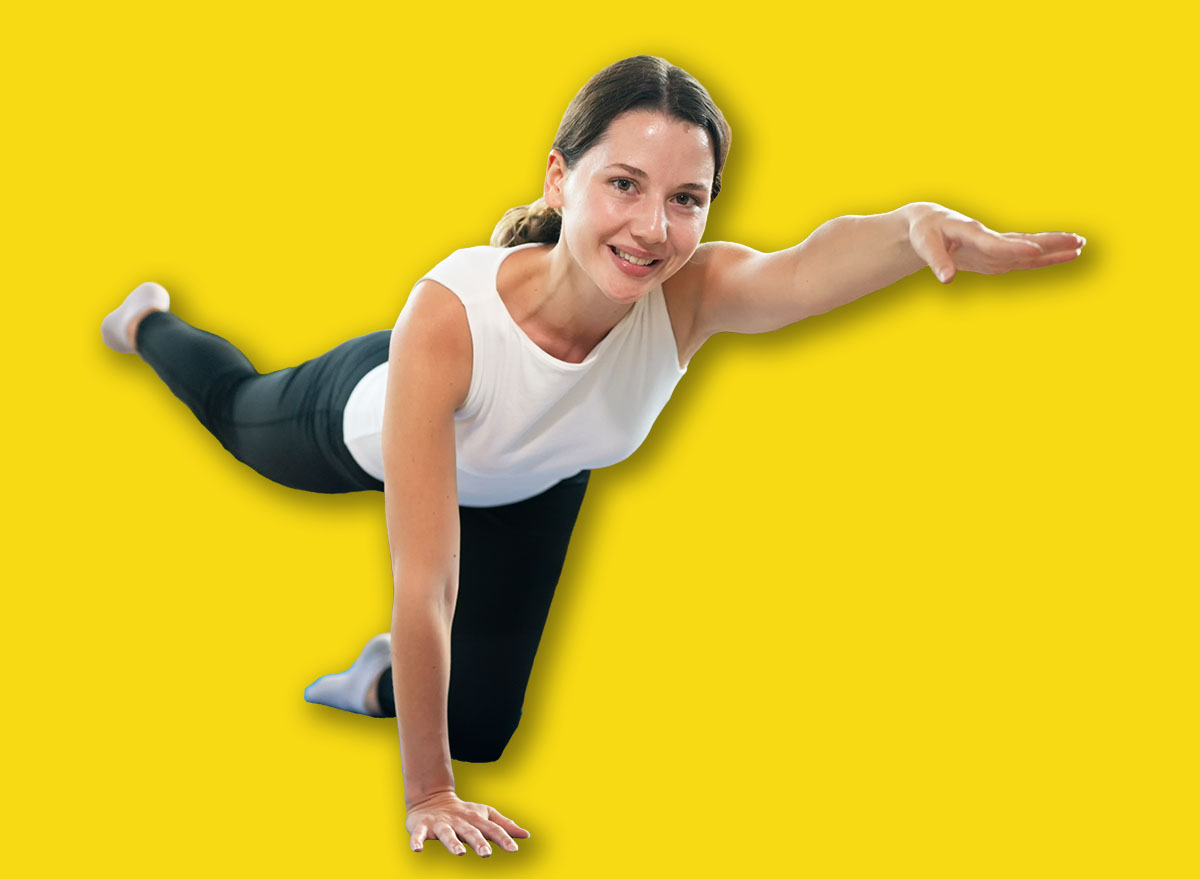
5. Bird-Dog (Core, Spinal Stabilizers, Hips)
“The bird-dog is a foundational exercise for core strength and spinal stability, both of which decline with age,” says Dr. Weber. “It improves coordination and reduces the risk of falls by enhancing proprioception—the body’s ability to sense movement.”
How to perform:
- Start on all fours in a tabletop position (hands under shoulders, knees under hips).
- Extend your left arm and right leg, keeping them parallel to the floor.
- Hold for 2 seconds, then return to start.
- Switch sides and alternate for 8–10 reps per side, 2 sets.
Tips for success:
- Move slowly to maintain balance.
- Engage your core throughout the movement.
- If balance is difficult, perform on hands and knees without extending limbs.
6. Wall Sit (Quadriceps, Endurance)
“Wall sits build muscular endurance in the quadriceps without the joint stress of deep squats,” Dr. Weber notes. “They’re particularly effective for improving the ability to stand for prolonged periods, a common challenge as we age.”
How to perform:
- Stand with your back against a wall and arms extended forward.
- Slide down until knees are bent at a 90-degree angle (as if sitting in a chair).
- Hold for 20–45 seconds, 2–3 holds.
- Push through heels to stand back up.
Progression:
- Increase hold time gradually (e.g., 30 seconds → 45 seconds).
- Lift one foot slightly off the ground for added challenge.
- Pulse knees slightly during the hold for intensity.
Why These Exercises Work Better Than Dumbbells After 60
While dumbbells are effective for building muscle, bodyweight exercises offer unique advantages for older adults:
- Joint-friendly: Bodyweight movements reduce impact on knees, hips, and shoulders compared to free weights.
- Functional strength: These exercises mimic daily activities (standing, reaching, balancing), improving independence.
- Progressive challenge: Difficulty can be adjusted by speed, range of motion, or single-leg variations without adding weight.
- Balance and coordination: Many of these movements (step-ups, bird-dog) directly improve stability, reducing fall risk.
- Equipment-free: No gym or special tools are needed, making them accessible anywhere.
A 2022 study in BMC Geriatrics found that older adults who performed bodyweight resistance training 3 times per week for 12 weeks showed improvements in muscle strength comparable to those using light weights, with added benefits in mobility and balance.
How to Maximize Results Safely
To build muscle effectively with bodyweight exercises after 60, follow these evidence-based guidelines:
- Progress gradually: Increase reps, sets, or difficulty by 10% weekly to challenge muscles without overuse injury.
- Prioritize form: Poor technique reduces effectiveness and increases injury risk. Consider working with a physical therapist to refine movements.
- Combine with nutrition: Muscle growth requires adequate protein (1.2–1.6 grams per kilogram of body weight daily) and vitamin D for absorption.
- Add variety: Rotate exercises every 4–6 weeks to prevent plateaus and target different muscle fibers.
- Listen to your body: Muscle soreness is normal, but joint pain signals the need to modify or reduce intensity.
The American College of Sports Medicine recommends at least 150 minutes of moderate-intensity exercise per week, including strength training 2–3 times weekly. For adults over 60, bodyweight exercises are an ideal way to meet these guidelines safely and effectively.
Frequently Asked Questions
Q: Can bodyweight exercises really build muscle, or are they only for endurance?
A: Yes, bodyweight exercises can build muscle through progressive overload—gradually increasing challenge by adjusting reps, speed, or difficulty. A 2021 study in Sports Medicine found that bodyweight training stimulated muscle protein synthesis similarly to light resistance training in older adults, provided the exercises were performed with control and sufficient volume.
Q: How often should I do these exercises?
A: Aim for 3–4 sessions per week, with at least one rest day between similar muscle groups. For example, you might do pushups and step-ups on Monday, glute bridges and bird-dogs on Wednesday, and wall sits and sit-to-stands on Friday. Rest days allow muscles to recover and grow.
Q: What if I can’t do all six exercises?
A: Start with 2–3 exercises that feel comfortable and focus on proper form. As strength improves, gradually add more. Even modified versions (e.g., knee pushups, seated leg lifts) provide benefits. Consistency matters more than perfection.
Q: Should I add weights later?
A: Once bodyweight exercises feel easy, you can progress to light dumbbells (2–5 lbs) or resistance bands. However, many adults over 60 maintain strength gains indefinitely with bodyweight training alone, especially when combined with progressive challenges like slower movements or single-leg variations.
Ready to start? Begin with 2–3 exercises this week and track your progress. For personalized guidance, consult a physical therapist or certified strength coach experienced in working with older adults. Share your experience in the comments—what challenges have you faced, and how are these exercises working for you?
Next update: We’ll follow up with a deeper dive into nutrition strategies for muscle preservation after 60, featuring insights from geriatric nutritionists.
Sources: Dr. Markus Weber (German Sport University Cologne), Journal of Aging and Physical Activity (2023), BMC Geriatrics (2022), American College of Sports Medicine guidelines, and movement science research from the National Institutes of Health.
Keep reading