
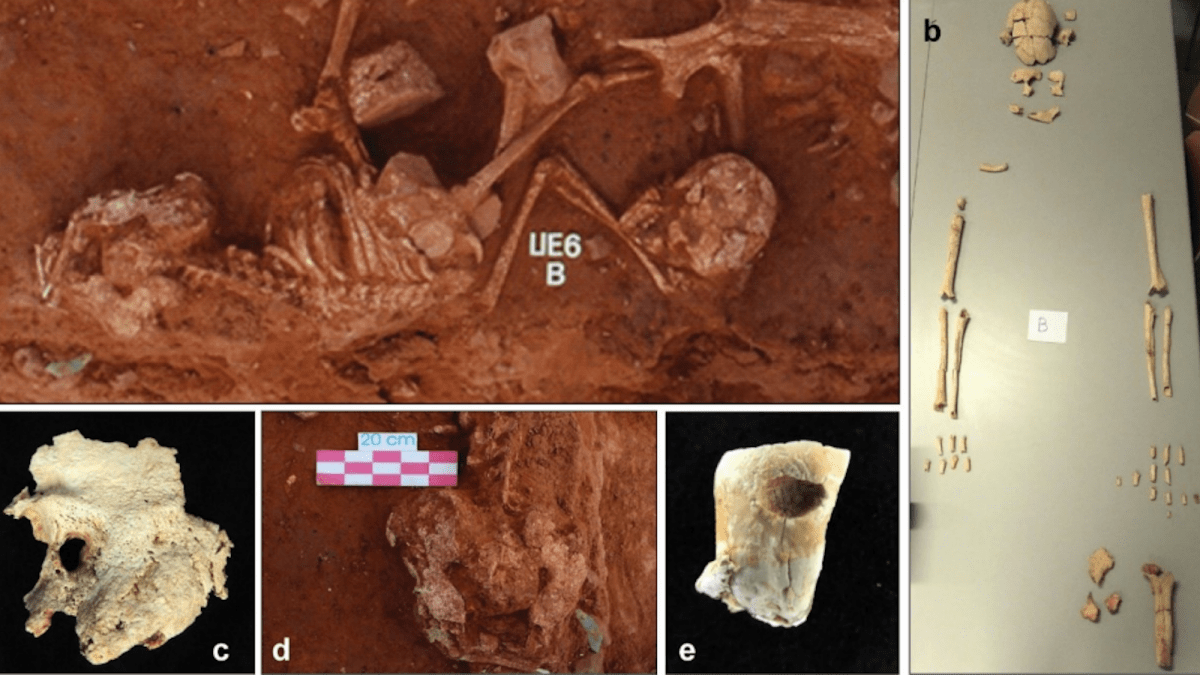
Archaeologists investigating the Iron Age site of Cerro de las Cabezas in central Spain have uncovered the remains of two men who appear to have suffered violent, non-natural deaths over 2,200 years ago. The discovery, which includes evidence of decapitation and dismemberment alongside a ritualistic arrangement of red deer antlers, provides a rare look at what researchers describe as a “bad death” in the late 2nd or early 3rd century BCE. The remains were found outside the settlement’s southeastern defensive wall, suggesting a disposal method that deviated significantly from the standard cremation practices of the period.
The site, located approximately 115 miles south of Madrid, was originally excavated in 2010. While Iberian populations during this era typically cremated their dead and interred the ashes in urns—often accompanied by items signaling social status—these two individuals were buried without coffins or formal grave markers. The lack of burial context, combined with the nature of the injuries, has led researchers to categorize these events as a “bad death.”
Evidence of Violent Demise
Analysis of the skeletal remains indicates that both men died from traumatic injuries rather than natural causes. According to the research findings, the first individual, estimated to be between 35 and 45 years old at the time of death, sustained a significant blow to the front of his skull several weeks prior to his passing. While that initial injury did not prove fatal, he later suffered a deep laceration across his lower right femur, which investigators suggest likely caused death through blood loss.

The second individual, who was between 40 and 59 years old, showed clear evidence of decapitation. The absence of formal burial rites for both men, coupled with their placement outside the defensive perimeter of the oppidum, suggests they were treated differently than other members of the community. Archaeologists have noted that the disposal of the bodies appears hurried, though the precise circumstances surrounding their execution or final moments remain a mystery.
The Role of Red Deer Antlers
A distinctive feature of this gravesite is the presence of six red deer antlers, positioned both above and below the human remains. Some of these antlers measured more than three feet in length. In the context of Iron Age Iberian culture, deer antlers were highly valued for both their practical utility and their symbolic significance. Previous archaeological work has documented antlers in various ritualistic settings across the Iberian Peninsula, including sanctuary spaces and votive deposits.
The study’s authors hypothesize that the bodies, placement, and antler accessories suggest they were potentially part of a protective or settlement ritual. While the exact meaning of this association is not yet fully understood, it aligns with broader patterns of ritual behavior observed in ancient Iberian sites.
Ongoing Research and Limitations
Despite the findings, researchers do not possess enough information to fully understand this macabre Iron Age scene. Isotopic analysis could not pinpoint whether the men were local residents, foreign enemies, or prisoners. The lack of further context means that their executions remain a mystery.

The post Decapitation, dismemberment, and deer antlers come together in one brutal Iron Age gravesite appeared first on Popular Science.