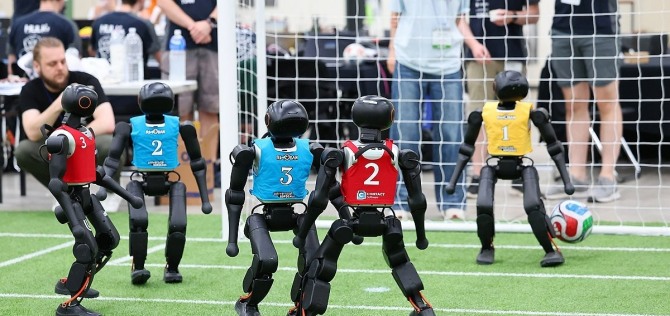
By focusing on standardized robot platforms, the focus is on the development of software algorithms. According to the RoboCup Federation, these competitions are designed to foster research in multi-agent systems and AI, with the goal of creating robots capable of operating in dynamic, real-world settings.
The Shift Toward Software-Centric Robotics
The humanoid robotics industry is seeing a shift where software is now the primary differentiator. When robots share identical physical specifications, the winner is determined by the “AI brain”—the integrated software stack that controls movement, vision, and strategic planning.

This trend mirrors broader developments in the commercial robotics sector. The IEEE Robotics and Automation Society has noted that software-defined robotics allows for faster iteration cycles, as updates can be deployed over-the-air to existing hardware, significantly reducing development costs.
Strategic Advantages in AI Research
In the context of robotics, this means the difference between a robot that successfully tracks a ball or navigates a field and one that stalls due to processing latency.

The transition toward software-led robotics also impacts the global supply chain. As hardware becomes more modular, manufacturers are focusing on standardizing components—such as actuators and sensors—to lower costs, while software developers treat the robot as a programmable platform. According to the International Federation of Robotics (IFR), the global market for service robots is expected to grow as these software-heavy platforms become more capable of performing complex service tasks in logistics and healthcare settings.
What This Means for the Future of Humanoids
The implications of this shift are twofold. First, it lowers the barrier to entry for software-focused startups that do not need to manufacture their own hardware from scratch. Second, it accelerates the timeline for humanoid robots to leave controlled environments like laboratories and enter public spaces. When the “brain” of a robot can be updated via software, the functional lifespan of the hardware increases, as the machine becomes more intelligent over time.

Observers of the humanoid robotics market expect that the next few years will see a competition to build the most robust foundation models for physical movement. As seen in the recent progress reported at major robotics conferences, the integration of Large Language Models (LLMs) with physical control systems is the new frontier. This allows robots to understand human instructions in natural language and translate them into physical actions, a capability that will likely define the next generation of humanoid technology.
The next major milestone for the robotics community will be the upcoming RoboCup 2025, where teams are expected to debut further refinements in autonomous decision-making and collaborative swarm behavior. Researchers and industry stakeholders can monitor updates through the official RoboCup 2025 portal as the organization prepares for the next phase of competition. Readers are encouraged to share their thoughts on the evolution of AI-driven robotics in the comments section below.