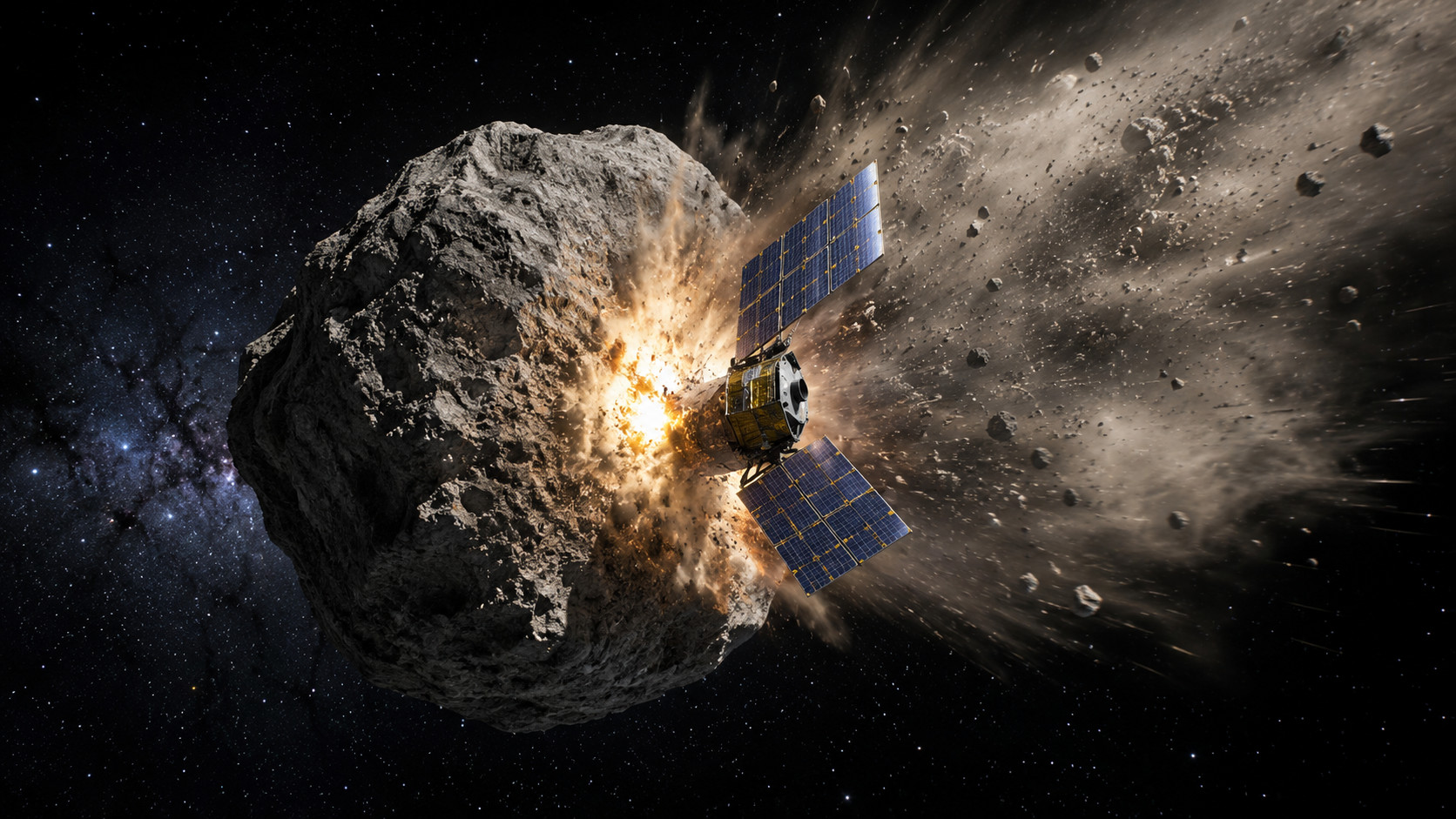
China is developing a planetary defense mission aiming to impact an asteroid at approximately nine kilometres per second—roughly 20,000 miles per hour or 26 times the speed of sound—sometime before the end of the decade. The proposed campaign seeks to alter an asteroid’s trajectory or, according to the South China Morning Post, even break up its structure. This mission would be integrated with a new space-ground monitoring network currently under a feasibility study, designed to detect near-Earth objects that could pose a future threat.
Mission Objectives and Impact Mechanics
The proposed Chinese mission aims to push beyond the scope of previous international efforts. While NASA’s Double Asteroid Redirection Test (DART) successfully demonstrated the basic idea on September 26, 2022, by crashing into the 160-metre-wide moonlet Dimorphos, China’s plan involves a higher-velocity impact. DART struck its target at 6.1 kilometres per second, successfully altering the moonlet’s 11-hour and 55-minute orbit by 32 minutes. A study published in 2026 estimated that the debris ejected during the DART collision roughly doubled the effective force of the impact, acting much like air escaping from a balloon.
China’s proposed mission, outlined in a paper currently under peer review by the Journal of Deep Space Exploration, aims for an impact speed of over 9 kilometres per second. According to a team led by Li Mingtao, the China National Space Administration’s (CNSA) chief scientist for planetary defense, the mission intends to alter an asteroid’s orbit relative to Earth or potentially fragment its structure during a close approach to Earth in 2029 or 2030. The target would pass approximately seven million kilometres—or 4.3 million miles—from the planet. Researchers note that while a faster impact could deliver a larger push, the asteroid’s internal structure, the collision angle, and the resulting behavior of debris remain variables that could influence the final result. Fragmentation, in particular, raises questions, as breaking a threatening asteroid into several large pieces would not necessarily eliminate the danger to Earth.
Integrated Surveillance and Early-Warning Infrastructure
The kinetic impact test is one component of a broader, space-ground integrated surveillance network. Li Mingtao, who also serves as the chief scientist at the asteroid monitoring and early-warning research centre under the CNSA, announced the plan on International Asteroid Day, observed annually on June 30. The system aims to eliminate monitoring blind spots by coordinating observations from ground-based, large-aperture optical telescopes with a constellation of space-based satellites. This dual-layer approach is intended to provide continuous monitoring, particularly of objects approaching from the direction of the sun, which are often obscured from ground-based sensors by atmospheric scattering and sunlight.
For more on this story, see China’s Reusable Rocket Breakthrough: Closing the Gap With SpaceX.
Li Mingtao emphasized that while no immediate threats have been identified, the system is a necessary precaution. No asteroid has so far been identified that will definitely collide with Earth in the foreseeable future, but concerns over impact risks are not unfounded. Many near-Earth asteroids remain undetected,
Li said. He added, We must never let our guard down, but there is also no need for excessive anxiety.
Strategic Comparison of Planetary Defense Approaches
China’s strategy aims to combine the impact and the forensic investigation into a single campaign. In the U.S.-led DART mission, the impactor did not remain to study the target, necessitating the launch of the European Space Agency’s Hera mission in October 2024 to map the impact site and probe beneath the surface. China’s proposal would allow scientists to know what the asteroid looked like before the crash, see how the collision unfolded, and measure how its structure and orbit changed in one sequence.

Li Mingtao also outlined two possible approaches to planetary defense: a kinetic impact mission for high-speed orbital deflection, and techniques such as gravity tractors, ion beams, and laser ablation, which require significantly more advanced warning to be effective. Currently, more than 40,000 near-Earth asteroids have been discovered and catalogued globally, but many smaller or faint objects remain undetected, representing the biggest hurdle for planetary defense efforts.
While the plans are detailed, the mission remains a proposal. CNSA officials have not yet announced a final launch date or a specific target asteroid.
Sources: Zmescience, South China Morning Post.