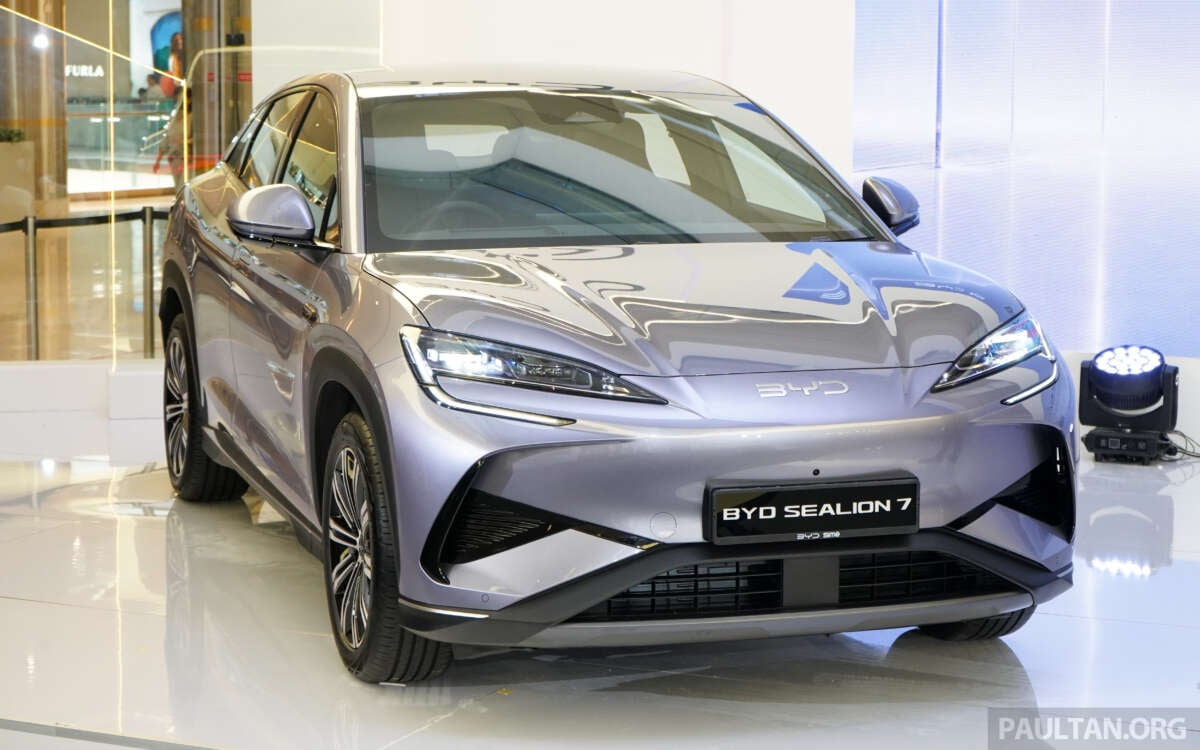
BYD Malaysia launched the updated 2026 BYD Sealion 7 electric crossover on July 30, 2026, introducing a new entry-level Dynamic variant and an 800-volt architecture for higher trims. The refreshed lineup starts at RM163,800, with significant upgrades to battery capacity and DC fast-charging speeds for the Premium and Performance models. The launch was confirmed by Sime Motors to take place on Thursday, July 30, 2026, and the model is the second refreshed BYD vehicle to launch in Malaysia following the Atto 3 Facelift released the previous month.
The 2026 refresh of the Sealion 7 focuses on expanding the model’s accessibility while pushing the technical ceiling for power users. BYD described the update as being Redefined further for tomorrow,
according to reporting from Paultan.
Dynamic, Premium, and Performance Pricing
The most immediate change is the introduction of the Dynamic variant, a baseline model designed to reach a wider audience. However, pricing data varies slightly between sources. Paultan reports the Dynamic starts at RM163,800, while AutoBuzz.my lists the price as RM164,700 on the road without insurance.
The higher-tier variants have seen price increases since their November 2024 debut. The Premium (RWD) now costs between RM188,800 and RM189,835, up from its November 2024 price of RM183,800. The Performance (AWD) is priced between RM203,800 and RM205,465, compared to its previous RM199,800 tag.
| Variant | Paultan Price | AutoBuzz.my Price | Drivetrain |
|---|---|---|---|
| Dynamic | RM163,800 | RM164,700 | RWD |
| Premium | RM188,800 | RM189,835 | RWD |
| Performance | RM203,800 | RM205,465 | AWD |
800V Architecture and Battery Upgrades
For the Premium and Performance trims, the shift to an 800-volt electrical architecture is the primary technical leap. This update replaces the 400V e-Platform 3.0 used in previous Malaysian models with the 800V e-Platform 3.0 Evo, a configuration previously available for the Sealion 7 Excellence AWD in the European market, according to SoyaCincau.
This architecture enables a jump in DC fast charging from 150 kW to 230 kW (or up to 240 kW as seen in Europe). The real-world impact is a reduction in charge time; the top-up from 10 to 80% now takes 24 minutes, down from 32 minutes on the older 400-volt models. Additionally, the 800V architecture allows for 11 kW of AC charging.
Battery capacities have also increased for the top two tiers. Both now feature a 91.3 kWh (or 91.39 kWh per AutoBuzz.my) Blade LFP battery, up from the previous 82.5 kWh. This translates to a WLTP range of 553 km for the Premium and 502 km for the Performance AWD. In terms of NEDC ratings, the Premium offers up to 650 km, while the Performance is rated at 600 km per AutoBuzz.my.
Dynamic Variant Technical Specifications
The new Dynamic variant operates on a different scale, utilizing a smaller 71.8 kWh Blade LFP battery. It provides a range of 520 km on the NEDC cycle, which Paultan notes translates to roughly 440 km on the WLTP cycle. To juice it up, the Dynamic supports up to 7 kW of AC charging and 110 kW of DC fast charging.
Performance figures for the Dynamic are lower than its siblings. It uses a single rear motor producing 245 PS (241 hp, or 170 kW) and 380 Nm of torque, according to Paultan, while AutoBuzz.my cites 231 hp and 380 Nm. There is a discrepancy in acceleration timing: Paultan reports a 0-100 km/h sprint of 7.3 seconds, while AutoBuzz.my claims 7.9 seconds.
For the higher trims, power figures remain unchanged from the previous iteration. The Premium (RWD) delivers 313 PS (308 hp, or 230 kW) and 380 Nm of torque, with a 0-100 km/h sprint time of 6.9 seconds (noted by Paultan as 0.2 seconds higher than the 6.7 seconds quoted for the earlier iteration). The all-wheel drive Performance retains a 218 PS (215 hp, or 160 kW) and 310 Nm front motor paired with the Premium’s rear motor for a total system output of 523 hp (530 PS, or 390 kW) and 690 Nm, maintaining a 4.5-second zero to 100 km/h sprint.
Interior and Cargo Adjustments
While the exterior remains largely unchanged—aside from a new Ultraviolet color available for the Premium—the interior retains the 15.6-inch rotating centre touchscreen and a 10.25-inch digital instrument cluster. All three variants are available in Cosmos Black, Aurora White, Atlantis Grey, and Shark Grey. Standard exterior equipment includes LED headlights, taillights, daytime running lights (DRL), a rear LED lightbar, flush door handles, electronically heated and adjustable side mirrors, and double-glazed windshield and front door windows.

Wheel sizes differ by trim: the Dynamic and Premium variants use 19-inch alloy wheels, while the Performance variant features 20-inch wheels with red brake callipers. The Premium and Performance models also gain a hands-free open/close tailgate and auto-tilt side mirrors.
Cargo capacity varies by trim:
- Dynamic: 500 liters (expandable to 1,769 liters).
- Premium & Performance: 520 liters (expandable to 1,789 liters).
Audio experiences are also split. The Dynamic uses a 10-speaker in-house system, whereas the Premium and Performance variants are equipped with a 12-speaker Dynaudio system.
Market Position and Warranty
The 2026 Sealion 7 arrives as a CBU (completely built-up) release. This follows a period of uncertainty regarding local assembly, as SoyaCincau reports that BYD had reportedly cancelled or put on a long pause its original plan to build a local assembly (CKD) plant in Tanjung Malim due to unfavorable terms from the Ministry of Investment, Trade, and Industry (MITI), though potential operations in Kulim were mentioned.

To support the launch, BYD provides a tiered warranty package: a six-year/150,000 km vehicle warranty, alongside eight-year/160,000 km warranties for both the drive unit and the high-voltage blade battery, according to AutoBuzz.my.
For the first 300 bookings of the Dynamic variant, AutoBuzz.my notes a limited-time RM4,000 rebate is available, which would effectively lower its price to RM160,700 on the road without insurance.
Keep reading