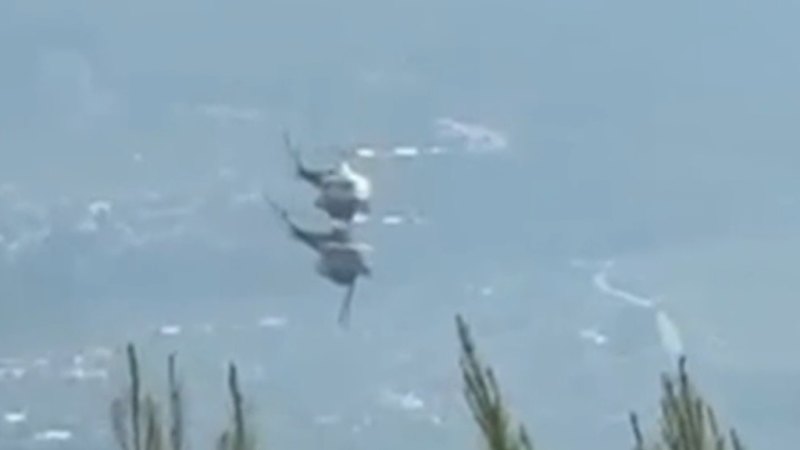
Two people died on Tuesday when a firefighting helicopter crashed on the Greek island of Samos during an aerial firefighting operation, according to state-backed and international news reports. The rotorcraft went down into the sea amid strong winds while battling a wildfire that had broken out in the Vourliotes area.
The fatal crash underscores the severe hazards emergency crews face as they combat intense seasonal blazes across southern Europe. Greek authorities launched an immediate rescue and recovery operation following the accident, deploying coast guard vessels and local emergency teams to the site off the island’s northern coast.
Emergency responders and local officials confirmed that the aircraft was involved in active suppression efforts against the fast-moving flames. High-velocity winds in the region had heavily complicated aerial and ground-based containment strategies before the disaster occurred.
Details of the Samos Island Firefighting Helicopter Crash
The aircraft crashed into the sea off Samos at approximately mid-afternoon on Tuesday, according to the Athens-Macedonian News Agency (AMNA). Local emergency services and coast guard units responded swiftly, pulling individuals from the water.
Greek public broadcaster ERT reported that the helicopter had been carrying a multi-national crew of four people when it went down. Search and rescue operations successfully recovered two crew members alive, while the remaining two occupants were later found dead by rescue divers.
The incident occurred as ground crews and aerial units battled a rugged, forest fire in the northern sector of Samos. Meteorological agencies had issued high-risk wind warnings for several parts of the Aegean Sea, complicating firefighting sorties across multiple islands.
Emergency Response and Investigation Underway
Following the crash, transport and aviation safety authorities mobilized teams to secure the wreckage and retrieve flight data recorders. Officials from the Hellenic Air Accident Investigation and Aviation Safety Board opened a formal inquiry to determine the precise sequence of mechanical or environmental factors leading to the descent.
Greek civil protection ministries expressed condolences to the families of the deceased crew members, praising the ongoing dedication of emergency personnel deployed to protect vulnerable communities from seasonal wildfires. Prime Minister Kyriakos Mitsotakis and other senior government officials issued statements acknowledging the extreme risks undertaken by air crews during the high-stress fire season.
Wider Context of Seasonal Wildfires in Greece
Greece faces severe wildfire threats each summer, driven by prolonged dry spells, high temperatures, and arid landscape conditions. Aerial firefighting fleets, comprising both fixed-wing aircraft and rented or state-owned helicopters, play a central role in halting blazes before they reach populated settlements or vital infrastructure.
Safety analysts note that operating rotorcraft in heavy smoke, reduced visibility, and turbulent winds places immense physical demands on flight crews. Tuesday’s tragedy adds to historical tallies of operational accidents recorded during intense Mediterranean fire campaigns over past decades.
Official updates regarding the ongoing investigation are expected from the Hellenic Air Accident Investigation and Aviation Safety Board as technical recovery of the wreckage concludes. Readers seeking verified updates can monitor announcements published directly by the Greek Ministry of Climate Crisis and Civil Protection.
Worth a look