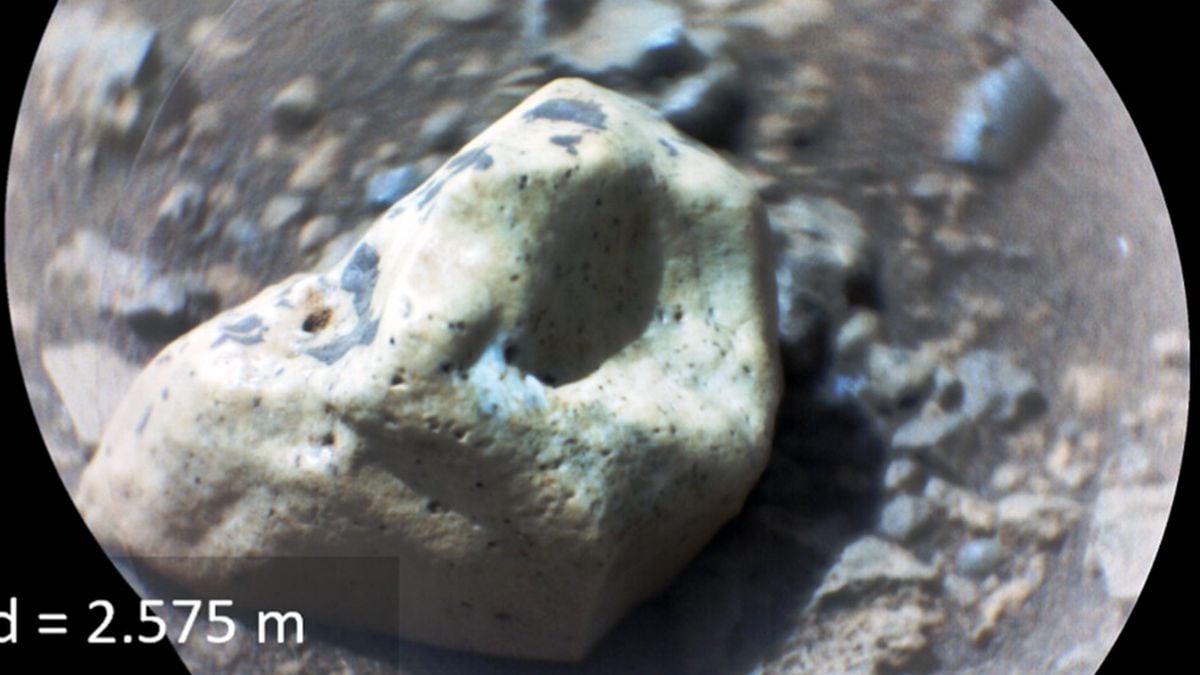
NASA’s Perseverance rover discovered rare chromium-bearing corundum—the mineral that forms rubies and sapphires—inside three plagioclase-rich float rocks along the Jezero Crater rim in 2025. Researchers published their complete spectral analysis in Geophysical Research Letters, noting that the aluminum-rich, silicon-depleted gemstones present an unexpected geological puzzle on Mars.
When NASA’s Perseverance rover targeted pale rocks scattered across the Jezero Crater in 2025, scientists anticipated standard rocks rather than mineral treasure. Instead, instrument analysis revealed microscopic grains of corundum, the crystalline form of aluminum oxide that constitutes precious gems on Earth. The find marks the first time corundum has been identified in a Martian setting.
Laser Spectroscopy Reveals Martian Gemstone Signatures
Perseverance examined three separate float rocks—named Hampden River, Coffee Cove, and Smiths Harbour—between March, April, and July of 2025. Because these rocks were unattached to local bedrock, they served as transportable messengers from elsewhere on the planet. Using time-resolved luminescence spectroscopy, the rover fired its SuperCam instrument to excite mineral atoms and measure the characteristic light they emitted.
The resulting spectral data surprised researchers by matching the telltale profiles of terrestrial rubies and sapphires. These exact peaks occur when chromium atoms substitute for aluminum inside a corundum crystal lattice, giving rubies their characteristic pinkish-red hue.
“Very unexpectedly, SuperCam’s TRL analysis of three plagioclase-rich float rocks in the crater rim were found to exhibit clear signatures of chromium-bearing corundum.”
The research team, led by Ann Ollila of Los Alamos National Laboratory, detailed their findings in Geophysical Research Letters.
The Chemical Paradox of Aluminum and Silicon on Mars
The discovery forces planetary geologists to rethink past Martian conditions because corundum formation defies simple chemical explanations. On Earth, corundum requires bulk compositions heavily enriched in aluminum and severely depleted in silicon. When silica is abundant, it monopolizes available aluminum to form silicate minerals like plagioclase feldspar instead.
Finding corundum embedded directly inside plagioclase-rich rocks creates a geological puzzle. Ollila and her co-authors noted that such minerals typically form at high temperatures or alongside tectonic processes—neither of which characterizes modern Mars.
While ancient Mars possessed ample volcanic heat, its surface chemistry heavily favored silicates. Researchers analyzing the data suggest the crystals may have formed when hot water moved through cracks in the rock millions or billions of years ago. Alternatively, the colossal impact that carved out the Jezero Crater itself could have provided the necessary conditions to forge the unusual minerals.
Deep Impact Modeling and the Search for Martian Mantle Rock
Understanding how Jezero Crater formed remains central to interpreting these mineral discoveries. Around 3.9 billion years ago, an immense collision gouged out the nearby Isidis basin, spanning more than 930 miles across and raining debris over Northeast Syrtis. A subsequent impact punched out the 30-mile-wide Jezero Crater.

Recent physics modeling led by Alexander Trowbridge of the SETI Institute demonstrates that planet-scale impacts can excavate material far beneath the Martian crust. Simulations tracking rock parcels through virtual impacts show that shock pressures ranging between 6.5 and 8.7 million pounds per square inch identify debris originating from the dense Martian mantle.
These extreme pressures deform and fracture crystal structures in ways that persist for billions of years. By providing a reliable pressure marker to identify mantle rocks, the modeling work helps researchers differentiate between shallow volcanic crust and deep interior fragments.
Curiosity Uncovers a Sea of Polygons in Valle Grande
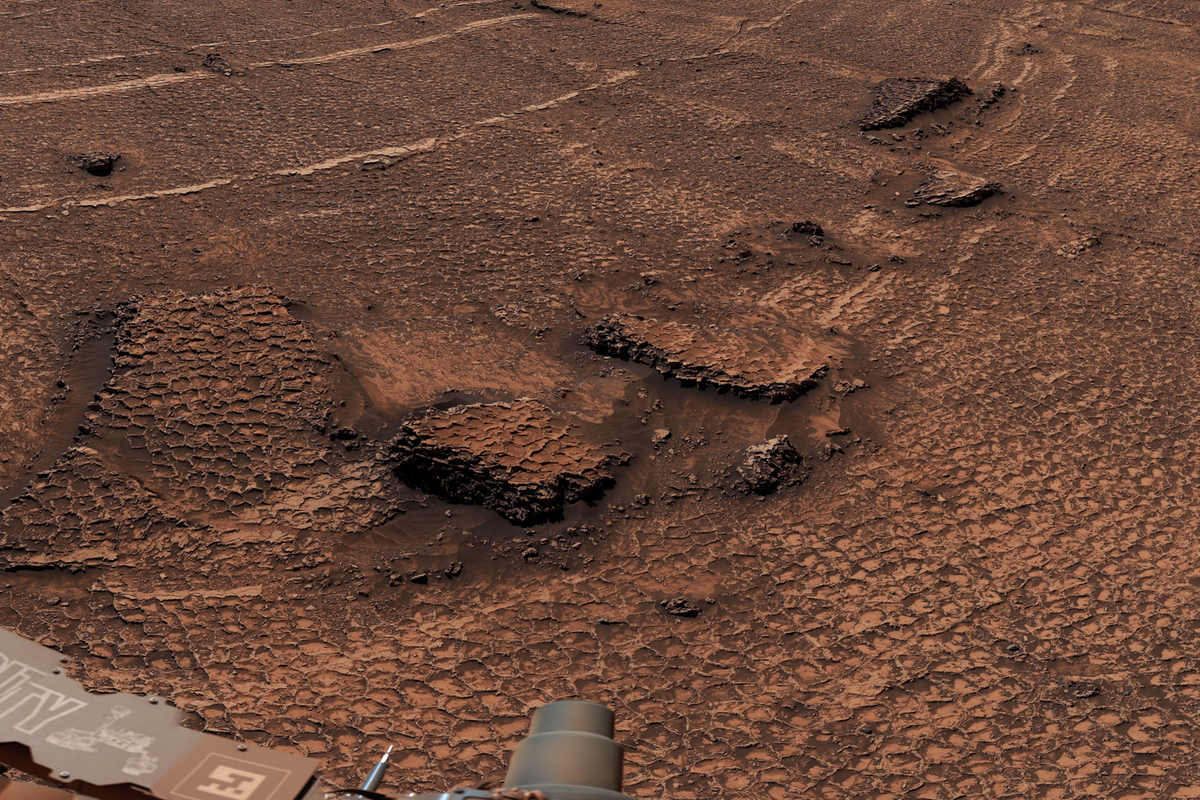
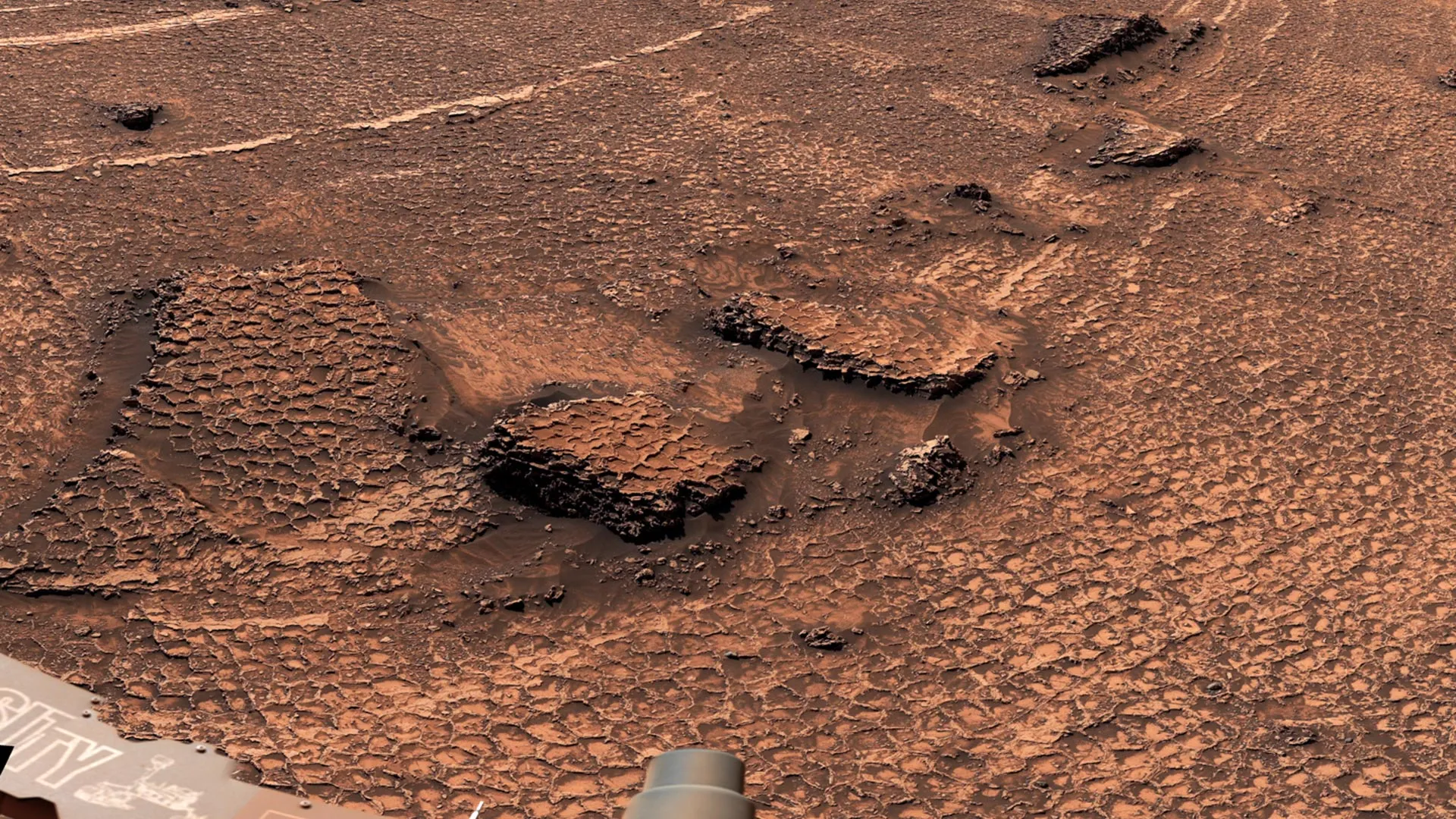
While Perseverance investigates the crater rim, the Curiosity rover has documented an entirely different geological spectacle elsewhere on the planet. Climbing through a valley nicknamed Valle Grande, Curiosity encountered an extensive honeycomb landscape of polygonal fractures measuring roughly 1.5 to 3 inches across.
Captured in panoramic images on June 19 and 20—marking sols 4,930 and 4,931 of the mission—the polygon field blankets the terrain and climbs the sides of a 20-foot-tall butte named Miraflores. Ashwin Vasavada, Curiosity project scientist at NASA’s Jet Propulsion Laboratory, expressed astonishment at the scale of the formation.
Scientists continue to investigate whether these geometric shapes formed through repeated thermal contraction from warming and cooling, or via compression as buried sediments forced trapped water outward. Previous sightings of similar patterns provided critical clues about ancient wet-dry cycles that supported molecular evolution on early Mars.
Keep reading