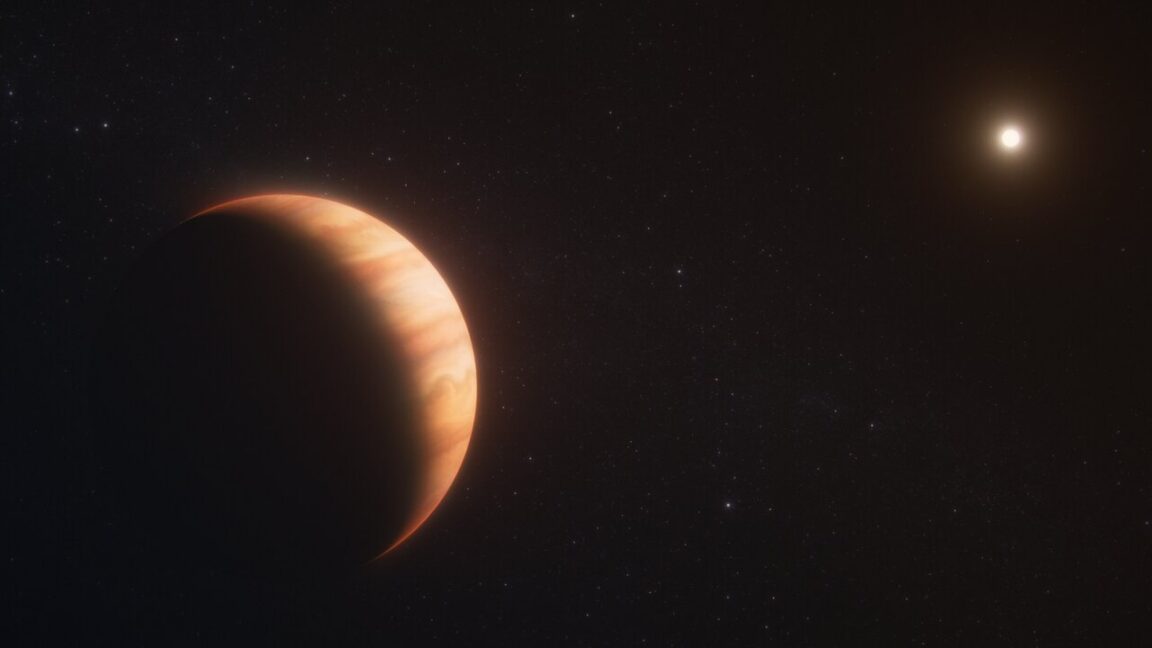
Astronomers have confirmed that the exoplanet WD 1856 b remains a unique case in planetary science: a Jupiter-sized gas giant that survived the transformation of its host star into a white dwarf. New data from the James Webb Space Telescope (JWST) has provided researchers with a closer look at this system, revealing details that continue to challenge existing theories regarding how such massive worlds survive the violent death of a Sun-like star.
The Discovery of an Unexpected Gas Giant
The existence of WD 1856 b was first identified in 2020 through observations from NASA’s Transiting Exoplanet Survey Satellite (TESS). Astronomers were originally scanning a sample of approximately 2,000 white dwarfs, looking for small, rocky debris—such as asteroids or comets—that might transit across the face of these dense, Earth-sized stellar remnants. Instead, they detected a periodic dimming of the star WD 1856+534, which indicated the presence of a much larger body, later confirmed to be roughly the size of Jupiter.

The survival of the planet is the primary subject of ongoing scientific inquiry. Theoretical astrophysicist Christopher O’Connor, a co-author of research regarding the system, noted the immediate scientific surprise surrounding the find, describing the system as "weird" due to the unlikely survival of a gas giant so close to its host's final state.
Insights from the James Webb Space Telescope
Recent investigations using the James Webb Space Telescope have allowed researchers to peer into the atmosphere and composition of WD 1856 b with greater precision than previously possible. Because white dwarfs are the cooling, exposed cores of former Sun-like stars—primarily composed of carbon and oxygen—the environment surrounding them is extreme.
Implications for Planetary Survival
The study of WD 1856 b provides a glimpse into the potential fate of our own solar system.

Astronomers are looking for signatures of heavy elements in the white dwarf’s atmosphere, which would indicate that the star is currently "feeding" on rocky material from the system. These findings are foundational for the broader search for exoplanets, as white dwarfs are common throughout the galaxy.
Future Observations and Scientific Milestones
The scientific community expects further updates as the James Webb Space Telescope completes additional cycles of observation on the WD 1856 system.
As the study of this unique exoplanet continues, the findings serve as a reminder of the dynamic nature of our universe. The case of WD 1856 b remains a primary benchmark for researchers modeling the final stages of stellar and planetary life cycles. Please share your thoughts on the implications of this discovery in the comments section below.
Worth a look