
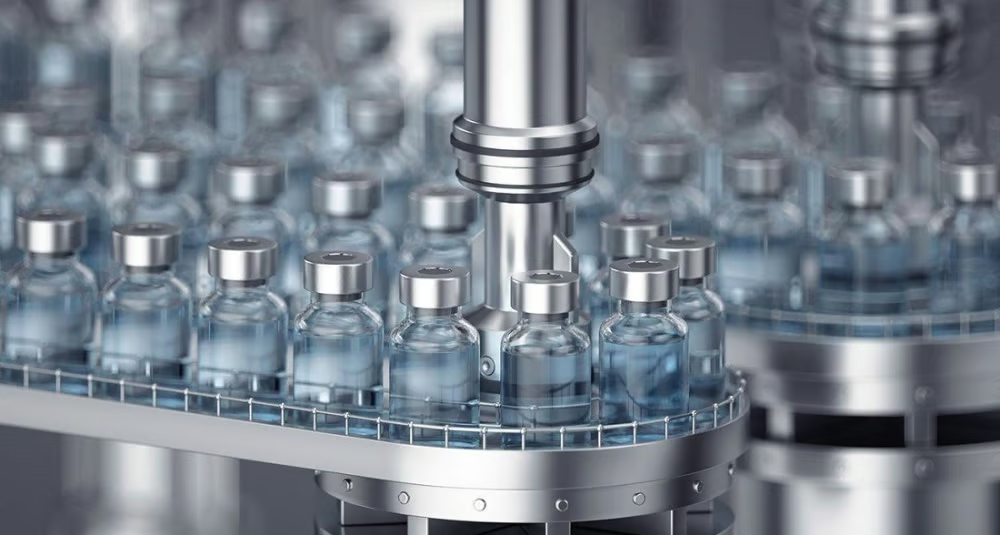
For decades, the Global South has navigated a precarious dependence on overseas pharmaceutical supply chains, a vulnerability that became painfully evident during the COVID-19 pandemic. Now, South Africa is taking a decisive step toward dismantling that dependency. The launch of the continent’s first integrated vaccine “mega-factory” in Pretoria represents more than just an industrial expansion; We see a strategic pivot toward health sovereignty for the entire African continent.
From my perspective as a physician and public health journalist, this development is a critical milestone. The ability to manufacture vaccines locally—not just the final “fill-and-finish” stage, but the entire production process—changes the fundamental calculus of pandemic preparedness. By integrating the production of active pharmaceutical ingredients (APIs) with final formulation and packaging, South Africa is positioning itself as a primary hub for infectious disease prevention in the Southern Hemisphere.
This ambitious project is the result of a high-level collaboration between the South African government, the pharmaceutical group Biovac, and the European Investment Bank (EIB). The partnership aims to create a sustainable ecosystem where vaccines are developed, tested, and produced on African soil, reducing the lead time between the emergence of a pathogen and the deployment of a life-saving vaccine.
The scale of this facility is designed to address a chronic gap in the African healthcare landscape. Historically, Africa has imported the vast majority of its vaccines, leaving the region susceptible to “vaccine nationalism” and supply chain disruptions. The Pretoria facility is engineered to break this cycle, providing a scalable platform that can be pivoted to address various public health threats, from routine childhood immunizations to emerging zoonotic diseases.
The Architecture of Vaccine Sovereignty
What distinguishes this “mega-factory” from previous pharmaceutical ventures in the region is its integrated nature. In the pharmaceutical world, “integrated” means the facility handles the entire value chain. Many existing plants in developing nations are limited to “fill-and-finish” operations, where the bulk vaccine is imported from Europe or North America and simply put into vials. This leaves the most critical part of the process—the creation of the vaccine itself—in the hands of foreign entities.

The new Pretoria plant is designed to produce the actual vaccine substance. This capability is essential for true health independence. When a country can synthesize its own antigens and stabilizers, it gains the autonomy to prioritize its own public health needs without waiting for global shipping priorities or diplomatic concessions. This shift is a cornerstone of the broader African Union goals to increase local vaccine production across the continent.
Beyond the physical infrastructure, the project emphasizes the transfer of “know-how.” The collaboration with the EIB and Biovac includes components for workforce training and the development of local scientific expertise. For the facility to be sustainable, South Africa must cultivate a generation of biotechnologists and quality-control experts who can maintain the rigorous standards required by global regulatory bodies.
Strategic Funding and Global Partnerships
The financial framework supporting this project underscores the international recognition of Africa’s need for pharmaceutical autonomy. The involvement of the European Investment Bank provides not only the necessary capital but also a layer of institutional credibility that helps attract further private investment into the region’s biotech sector.
While the specific financial disbursements are managed through complex loan and grant structures, the investment is targeted at creating a facility that meets World Health Organization (WHO) Great Manufacturing Practices (GMP). Achieving GMP certification is the “gold standard” in pharmaceutical production; without it, vaccines produced in the facility could not be exported or used in international health programs. The funding is therefore strategically allocated toward high-grade clean-room technology and advanced bioreactors.
This investment does not exist in a vacuum. It complements other regional efforts, most notably the WHO mRNA vaccine technology transfer hub based in South Africa. While the mRNA hub focuses on the cutting-edge science of genetic vaccines, the Biovac-led mega-factory provides the industrial muscle needed to scale those innovations for millions of people. Together, these initiatives create a comprehensive pipeline from laboratory discovery to mass distribution.
Impact on Global Health Equity
The implications of this facility extend far beyond the borders of South Africa. For too long, the global health architecture has been characterized by a “hub-and-spoke” model, where a few wealthy nations held the intellectual property and manufacturing capacity, while the rest of the world acted as recipients. The Pretoria mega-factory challenges this imbalance.
By decentralizing production, the global community reduces the risk of a single point of failure in the supply chain. If a pandemic were to strike a primary manufacturing hub in the Northern Hemisphere, the existence of a fully integrated facility in Africa ensures that a critical portion of the global population still has access to production capabilities. What we have is the essence of global health equity: ensuring that the tools for survival are distributed geographically, not just financially.
local production allows for “disease-specific tailoring.” Vaccines developed in Africa can be more easily optimized for the specific strains of diseases prevalent on the continent. Whether addressing malaria, tuberculosis, or regional outbreaks of viral hemorrhagic fevers, having the manufacturing capacity next door allows for a more agile and responsive public health strategy.
Key Strategic Goals of the Facility
- Reduction of Import Reliance: Shifting from a model of vaccine procurement to one of vaccine production.
- End-to-End Integration: Moving beyond fill-and-finish to full-scale API synthesis.
- Regulatory Alignment: Ensuring all production meets WHO and South African Health Products Regulatory Authority (SAHPRA) standards.
- Regional Export Hub: Serving as a primary supplier for neighboring African nations to stabilize regional health security.
Overcoming the Challenges of Scale
Despite the optimism, the road to full operational capacity is fraught with challenges. Pharmaceutical manufacturing is one of the most highly regulated industries in the world. The transition from a construction project to a certified production facility requires months—sometimes years—of validation studies, stability testing, and rigorous audits.

There is also the challenge of raw material procurement. Even an integrated factory requires specific precursors, specialized glass vials, and cold-chain logistics. South Africa will need to develop a secondary industry of local suppliers to ensure that the “mega-factory” isn’t simply trading a dependence on finished vaccines for a dependence on imported raw chemicals.
From a clinical standpoint, the most critical hurdle will be the “regulatory bridge.” For these vaccines to be accepted globally, the facility must prove that its output is bioequivalent to existing gold-standard vaccines. This requires a commitment to transparency and an openness to international inspection, a process that Biovac and the South African government have signaled they are prepared to embrace.
The Path Forward
The launch of this facility is a statement of intent. It signals that the era of Africa as a passive consumer of medical innovation is ending. As we look toward the future of infectious disease management, the integration of science, finance, and political will in Pretoria serves as a blueprint for other regions of the world seeking to secure their own health futures.
For the residents of South Africa and the wider continent, this means more than just cheaper vaccines; it means a more resilient healthcare system. It means that in the next health crisis, the decision of who gets a vaccine and when will be made in African boardrooms and clinics, not just in distant capitals.
The next critical milestone for the project will be the commencement of the first full-scale production runs and the subsequent regulatory review by the South African Health Products Regulatory Authority (SAHPRA) to certify the initial batches for public use.
Do you believe local manufacturing is the only way to ensure global health equity, or should the focus remain on international donation programs? Share your thoughts in the comments below and share this analysis with your network.