
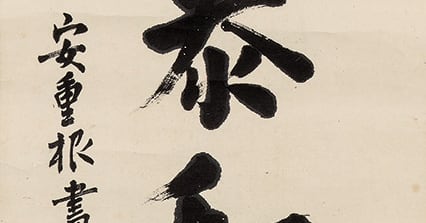
A rare piece of calligraphy by Korean independence activist Ahn Jung-geun, designated as a national treasure, is set to appear at public auction for the first time with a starting price of 1.6 billion Korean won (approximately $1.2 million USD). The work, which features the phrase “Baekindangjungyu-taehwa” (百忍堂中有泰和)—meaning “peace and harmony dwell in a home where one practices patience a hundred times”—was written by Ahn during his final days in the Lushun prison in 1910, following his death sentence for the assassination of Ito Hirobumi.
The upcoming auction, managed by Seoul Auction, marks a significant moment for collectors of Korean historical artifacts. According to the Cultural Heritage Administration of Korea, Ahn’s calligraphy works are highly prized for their historical significance and the insight they provide into his philosophical outlook during his imprisonment. The specific scroll in question is recognized as a formal designated treasure, a status that imposes strict regulations on its trade, preservation, and potential export under the Cultural Heritage Protection Act of South Korea.
Historical Context of Ahn Jung-geun’s Calligraphy
Ahn Jung-geun is widely revered in Korea for his role in the anti-colonial movement against the Japanese Empire. Following the assassination of Ito Hirobumi at the Harbin railway station in 1909, Ahn was detained in the Lushun prison. During the months leading up to his execution in March 1910, he produced numerous pieces of calligraphy to express his convictions and moral philosophy to his captors and fellow prisoners.

The phrase “Baekindangjungyu-taehwa” reflects the Confucian values that defined much of Ahn’s intellectual life. Historians note that despite his militant anti-colonial stance, his writings during this period often focused on themes of peace, patience, and the cultivation of personal virtue. The Ahn Jung-geun Memorial Association maintains that these works serve as primary documents of his final mental state and remain integral to understanding the cultural identity of early 20th-century Korea.
Auction Dynamics and Market Valuation
The starting price of 1.6 billion won reflects both the scarcity of Ahn’s authenticated works and the high demand among private collectors and institutions. Auction experts state that the value of such items is determined by the clarity of the seal, the condition of the paper (hanji), and the historical provenance attached to the specific piece. Because this piece is an officially designated treasure, the auction house must comply with national oversight regarding the transfer of ownership.

While the market for Korean cultural assets has seen fluctuations, items associated with major national figures like Ahn Jung-geun consistently command premium prices. The Seoul Auction house has confirmed that the bidding process will be subject to standard protocols for high-value cultural assets, ensuring that the transaction remains transparent and documented for the national registry.
Legal Status and Preservation Requirements
Under the Cultural Heritage Protection Act, the owner of a designated treasure is legally obligated to maintain the artifact in a manner that prevents deterioration. Any attempt to transport the item outside of South Korea requires explicit government approval. These regulations are designed to keep significant markers of national history within the country, balancing the rights of private ownership with the public interest in historical preservation.
Potential bidders are required to undergo verification processes to ensure they are capable of meeting these storage and preservation standards. This legal framework ensures that even as the artifact moves from one private collection to another, its status as a protected national asset remains intact. The auction serves as a venue for the transfer of responsibility as much as the transfer of the physical object.
What Happens Next
The auction is scheduled to take place in the coming weeks, with the final bid price serving as a benchmark for the current valuation of Ahn’s surviving works. Observers expect significant interest from both private museums and individual collectors. The Cultural Heritage Administration will monitor the proceedings to record the change in ownership in the national database, which is a mandatory step for all registered cultural treasures in the country.
Readers interested in the outcome of the sale or the broader history of Ahn Jung-geun’s life can monitor updates through official announcements from the Cultural Heritage Administration of South Korea. As this story develops, please share your thoughts or questions in the comments section below.