
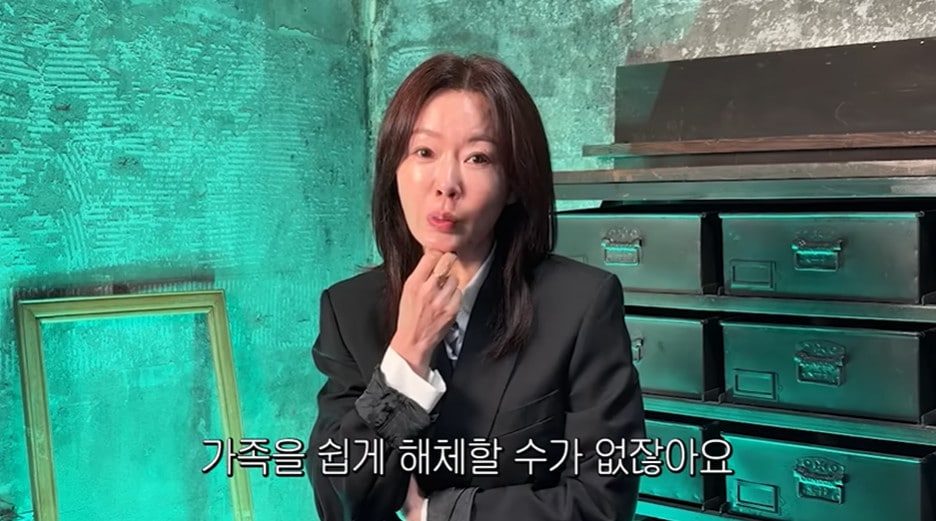
For many parents, the idea of living apart from their children is an unthinkable sacrifice. However, for South Korean entertainer and broadcaster Ahn Sun-young, the decision to move her son to Canada was not about separation, but about a strategic reconfiguration of the family unit. In a candid discussion regarding her current domestic arrangements, Ahn revealed a non-traditional approach to parenting that challenges conventional notions of the “nuclear family.”
Ahn has described her current family dynamic as a “double life,” a term that reflects the logistical and emotional complexity of maintaining a household across two continents. Rather than opting for a total family relocation or risking the perceived “dissolution” of the family structure through permanent separation, Ahn and her husband have implemented a rotating presence system to support their son’s education and growth in Canada.
The arrangement is designed to ensure the child is never without a parent while allowing Ahn to continue her professional commitments in South Korea. Under this system, when Ahn is working in Korea, her husband remains in Canada with their son. Conversely, when her husband has business or obligations that require his attention elsewhere, Ahn travels to Canada to take over the primary caregiving role. This “tag-team” approach allows the family to remain connected despite the thousands of miles separating their primary bases of operation.
Ahn characterizes this experience as living “separately yet together,” emphasizing that the goal is to provide the best possible environment for their child without sacrificing the professional identities or the marital bond of the parents. This revelation offers a glimpse into the evolving nature of modern parenting among high-profile individuals in East Asia, where the pressure to provide global educational opportunities often clashes with the demands of a high-intensity career.
Redefining the Family Structure in a Globalized Era
The decision to move a child abroad for education is a well-documented phenomenon in South Korea, often driven by a desire to escape the hyper-competitive domestic education system and foster a more globalized perspective. However, the logistical execution of such a move varies wildly. While some families relocate entirely, others adopt the “split-living” model that Ahn Sun-young has embraced.

This model is a response to the modern professional landscape. For a public figure like Ahn, whose career is rooted in the South Korean media market, relocating permanently to North America would signify the conclude of her professional trajectory. By treating the family’s presence in Canada as a rotating responsibility, she manages to bridge the gap between maternal duty and professional ambition.
Sociologically, this reflects a shift in how “family wholeness” is defined. Traditionally, a family was viewed as a single unit inhabiting a single space. The “separately yet together” philosophy suggests that emotional cohesion and shared goals are more critical to family stability than physical proximity. By consciously deciding against “family dissolution”—a term often associated with divorce or permanent estrangement—Ahn is proposing a third way: a flexible, distributed family model.
The Logistics of “Separately Yet Together”
The practical application of this arrangement requires immense coordination and financial stability. The rotation system ensures that the child maintains a consistent parental attachment, which is crucial for developmental stability during the formative years of international schooling. The key components of this strategy include:
- Rotational Caregiving: A scheduled hand-off between parents to ensure the child is never left solely to institutional care or third-party guardians.
- Professional Continuity: Allowing the primary earner or the person with the most localized career (in this case, Ahn) to maintain their professional standing in their home country.
- Adaptive Residency: Utilizing international travel as a tool for family maintenance rather than just for leisure or business.
This arrangement, while taxing, mitigates the guilt often associated with “educational migration,” where children are sent abroad to boarding schools with little to no parental supervision. By ensuring a parent is always present, Ahn and her husband are attempting to preserve the emotional intimacy of the home while leveraging the educational advantages of the Canadian system.
The Broader Context: Education Migration in South Korea
Ahn Sun-young’s choice is not an isolated incident but part of a broader trend of South Korean families seeking alternative educational paths. Canada, in particular, is frequently cited as a top destination due to its perceived balance of academic rigor and a more holistic approach to student well-being compared to the rigorous “hagwon” (private academy) culture of Seoul.
For many, the move to Canada is an attempt to cultivate “global citizenship.” This involves not only learning English but likewise adapting to a multicultural environment that encourages critical thinking and creativity—skills that are increasingly valued in the global job market but are often sidelined in the traditional Korean rote-learning system.
However, this transition is rarely without friction. The “split-family” dynamic can lead to significant emotional strain, including loneliness for the parent left behind and a sense of instability for the child. Ahn’s openness about her “double life” serves as an acknowledgment of these challenges, framing the arrangement not as a perfect solution, but as a conscious choice made for the benefit of the next generation.
Challenges of the Distributed Family Model
While the rotational system solves the immediate problem of parental presence, it introduces other complexities. The psychological toll of constant travel and the “switching” of roles can lead to burnout. The child must adapt to a parent who is periodically absent, requiring a high level of communication and emotional maturity from all family members.
the “double life” aspect implies a constant state of transition. Living between two cultures and two homes can create a sense of “rootlessness,” where the child may feel like a visitor in both Korea and Canada. To counter this, parents in such arrangements often place a heavy emphasis on maintaining cultural ties to their homeland through frequent visits and digital communication.
Conclusion: A Modern Blueprint for Modern Parenting
Ahn Sun-young’s approach to her family’s relocation to Canada highlights a growing trend toward flexible family architectures. By rejecting the binary choice between “staying together” and “breaking apart,” she is modeling a way for modern parents to navigate the conflicting demands of global education and professional success.
The “separately yet together” philosophy suggests that the strength of a family is not measured by the walls they share, but by the effort they expend to remain present in each other’s lives, regardless of geography. As more families seek international opportunities, this distributed model may become a more common blueprint for those unwilling to sacrifice either their children’s future or their own personal aspirations.
As Ahn continues to navigate this dual existence, her experience provides a candid gaze at the trade-offs inherent in the pursuit of global excellence. The success of such an arrangement ultimately depends on the resilience of the marital partnership and the ability of the parents to synchronize their lives across time zones.
World Today Journal will continue to monitor trends in international education and the evolving dynamics of global families. For more updates on cultural shifts in East Asia, please follow our World section.
What are your thoughts on the “split-living” family model for education? Do you believe the benefits of international schooling outweigh the emotional cost of parental separation? Share your perspectives in the comments below.