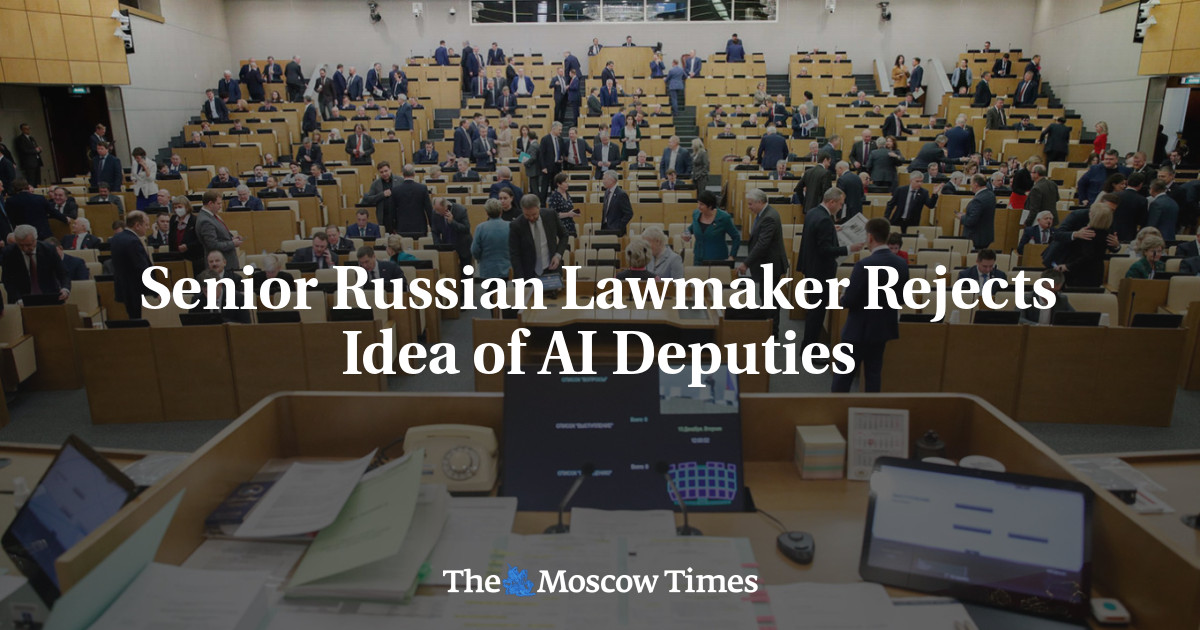
Will AI Replace Politicians? Russia’s Duma Speaker Says ‘Never’ – But the Debate Rages On
The rise of artificial intelligence is sparking debate across every sector, and politics is no exception.Could algorithms and neural networks one day occupy the seats of power currently held by elected officials? Russia’s State Duma Speaker, Vyacheslav volodin, emphatically says no. He argues that AI fundamentally lacks the qualities necessary for responsible governance: conscience and accountability.
But is this a Luddite stance, or a valid concern about the future of democracy? Let’s dive into the complexities of this rapidly evolving discussion, examining perspectives from Russia and beyond.
A Glitch and a Declaration: Volodin’s Stance
Volodin’s opposition wasn’t a carefully planned speech. It arose during a technical issue with the Duma’s electronic voting system. He seized the moment to voice his skepticism, stating that AI possesses no “conscience” – a word in Russian that also carries the meaning of “shamelessness.”
His core argument? Crucial decisions demanding ethical judgment and responsibility simply cannot be delegated to neural networks. This position is particularly noteworthy given Volodin’s past efforts to establish a legal framework governing robot-human interactions.
The Global Experiment: Albania’s AI Minister
Volodin’s comments come on the heels of a groundbreaking move by Albania. They recently appointed “diella,” the world’s first AI-generated minister, to oversee public contracts. This bold experiment is being closely watched as a potential glimpse into the future of governance.
However, it also highlights the stark contrast in approaches.While some nations are actively exploring AI’s role in public service, others, like Russia – at least through the voice of its Duma Speaker – are raising serious red flags.
A Divided Russia: Support for AI in Government
Interestingly, Volodin’s views aren’t universally shared within the Russian government.Several officials have expressed more openness to integrating AI into the public sector.
* Maksut Shadayev, Digital Minister: Believes AI could automate up to 50% of “simple and routine” bureaucratic tasks. He specifically excluded roles requiring human empathy, like doctors and teachers, from potential replacement.
* German Gref,Sberbank CEO: Has suggested AI could considerably reduce corruption in public management. However, he acknowledges the limitations of fully automated governance, citing the importance of social and emotional intelligence.
* Public Opinion: A 2021 poll revealed that over half of Russians actually support the idea of replacing lawmakers with AI. This suggests a level of public distrust in traditional politicians and a willingness to explore option solutions.
Why the Hesitation? The Core Concerns
Volodin’s concerns,and those echoed by others,center around fundamental questions about AI’s capabilities and limitations.
* Lack of Ethical Framework: AI operates based on algorithms and data. It doesn’t possess inherent moral principles or the ability to understand nuanced ethical dilemmas.
* Accountability Issues: who is responsible when an AI-driven decision leads to negative consequences? establishing clear lines of accountability is a major challenge.
* Potential for Bias: AI systems are trained on data, and if that data reflects existing societal biases, the AI will perpetuate and even amplify them.
* The Human element: Politics, at its core, is about representing the needs and values of people. Can an AI truly understand and respond to the complexities of human experience?
evergreen Insights: The Future of AI and Governance
The debate over AI in politics isn’t just about if it will happen, but how. Here are some timeless considerations as this technology continues to evolve:
* AI as a Tool, Not a Replacement: The most likely scenario isn’t a complete takeover by AI, but rather its integration as a powerful tool to assist human policymakers.
* Focus on Clarity and Explainability: If AI is used in governance, it’s crucial that its decision-making processes are transparent and understandable.”Black box” algorithms erode trust.
* Robust Regulatory Frameworks: Clear ethical guidelines and legal regulations are essential to ensure responsible AI progress and deployment.
* Continuous Monitoring and Evaluation: AI systems must be continuously monitored