AI-Powered Pathology: New System Aims to Accelerate Cancer Discovery
Berlin, Germany – A new artificial intelligence (AI) workflow, dubbed SPARK (System of Pathology Agents for Research and Knowledge), is demonstrating promising results in autonomously generating biological insights from cancer pathology data. The system, detailed in research published online April 29, 2026, by Nature Medicine, utilizes language as a universal interface to analyze complex pathology data without requiring extensive model training. This innovative approach could significantly accelerate the pace of cancer research and improve diagnostic precision, offering hope for earlier and more effective treatments.

SPARK represents a shift towards “agentic AI,” where systems are designed to independently formulate and test hypotheses, rather than simply executing pre-programmed tasks. This capability is particularly valuable in the field of pathology, where analyzing vast amounts of visual data – histopathology images – is crucial for understanding tumor development and identifying potential therapeutic targets. The development of SPARK addresses a critical require for more efficient and interpretable methods for analyzing complex biological data, potentially unlocking new avenues for personalized cancer care.
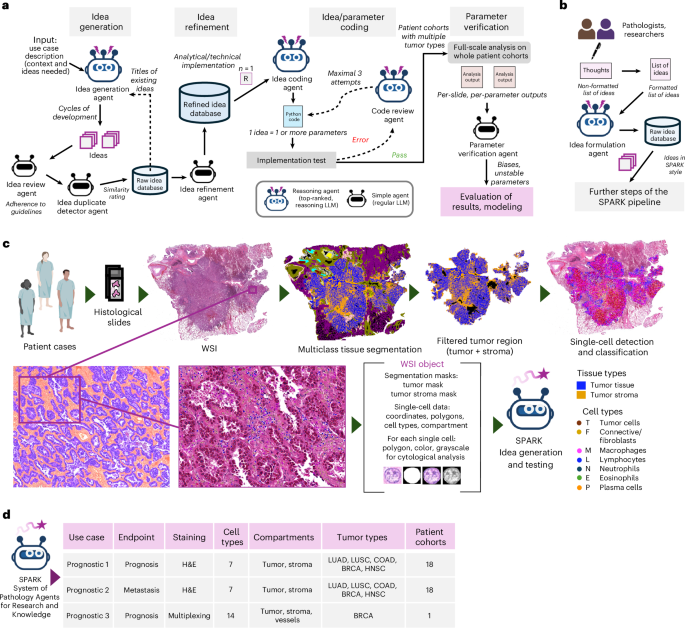
Researchers evaluated SPARK across 18 patient cohorts encompassing five cancer types: lung adenocarcinoma, lung squamous cell carcinoma, colorectal cancer, breast cancer, and oropharyngeal squamous cell carcinoma. The study involved analyzing data from over 5,400 patients, including histopathology images and clinical follow-up information. A dedicated module within SPARK also allows for human interaction, enabling pathologists and researchers to collaborate with the AI system and refine its analyses.
How SPARK Works: An Agentic Approach to Tumor Analysis
Traditional AI systems in pathology often rely on hand-crafted features, requiring significant human expertise to identify relevant patterns in images. SPARK, however, takes a different approach. It leverages large language models to translate biological concepts into analytical tools, allowing it to work directly with complex pathology data without the need for extensive pre-training. This “agentic” framework allows SPARK to autonomously generate hypotheses and explore potential relationships within the data.
The system essentially functions as a team of “agents,” each responsible for a specific aspect of the analysis. These agents communicate with each other using natural language, allowing them to share information and refine their understanding of the tumor biology. This collaborative process enables SPARK to identify clinically and biologically relevant concepts that might be missed by traditional methods. The researchers found that SPARK-generated concepts correlated with known pathological variables and predictive biomarkers, including patterns of tumor progression and temporal changes observed in static images.
According to the research, SPARK’s ability to infer temporal changes from static images is particularly noteworthy. This suggests the system can potentially identify subtle indicators of tumor evolution that might be difficult for human pathologists to detect, offering valuable insights into disease progression and treatment response.
Promising Results Across Multiple Cancer Types
The evaluation of SPARK across diverse cancer cohorts yielded encouraging results. The system demonstrated its ability to identify concepts correlated with prognosis, known pathological variables, and predictive biomarkers. For example, in breast cancer, SPARK analyzed a well-characterized spatial biology dataset involving 625 patients, successfully identifying patterns associated with disease outcome. The researchers emphasize that these findings suggest SPARK has the potential to improve diagnostic precision and deepen our understanding of tumor biology.
While the study focused on five specific cancer types, the researchers believe the SPARK framework is adaptable to other malignancies. The system’s ability to work with complex pathology data and autonomously generate biological insights makes it a versatile tool for cancer research. The open release of SPARK’s code, parameters, and results is intended to facilitate further research and development in the field, encouraging collaboration and accelerating the translation of AI-driven discoveries into clinical practice.
The Future of AI in Pathology: Challenges and Opportunities
Despite the promising results, the researchers acknowledge that further validation is needed to evaluate the clinical utility of SPARK-generated tools. Prospective studies are essential to determine whether the system can improve patient outcomes in real-world clinical settings. Addressing potential biases in the AI algorithms and ensuring the interpretability of the results are also crucial considerations.

The development of SPARK aligns with a broader trend towards the integration of AI into healthcare. AI-powered tools are increasingly being used to assist clinicians in a variety of tasks, from image analysis to drug discovery. However, the successful implementation of AI in healthcare requires careful attention to ethical considerations, data privacy, and the need for human oversight. The agentic approach exemplified by SPARK represents a significant step forward in the development of AI systems that can truly augment human intelligence and accelerate scientific discovery.
The potential impact of SPARK extends beyond cancer research. The agentic framework could be adapted to other areas of pathology, such as infectious disease diagnosis and autoimmune disorder analysis. By automating the process of hypothesis generation and data analysis, SPARK could free up pathologists to focus on more complex cases and provide more personalized care to patients.
Key Takeaways
- SPARK is a novel AI workflow that uses language as a universal interface for analyzing cancer pathology data.
- The system’s agentic approach allows it to autonomously generate biological insights without extensive model training.
- SPARK demonstrated promising results across 18 patient cohorts spanning five cancer types.
- Further validation is needed to evaluate the clinical utility of SPARK-generated tools.
- The open release of SPARK’s code and data aims to foster collaboration and accelerate research.
Researchers are continuing to refine SPARK and explore its potential applications in other areas of pathology. The next steps involve conducting prospective clinical trials to assess the system’s impact on patient outcomes and developing strategies for integrating SPARK into existing clinical workflows. The team plans to present further findings at the European Society for Medical Oncology (ESMO) Congress in October 2026. Readers interested in learning more about AI in pathology are encouraged to follow updates from leading research institutions and professional organizations.