
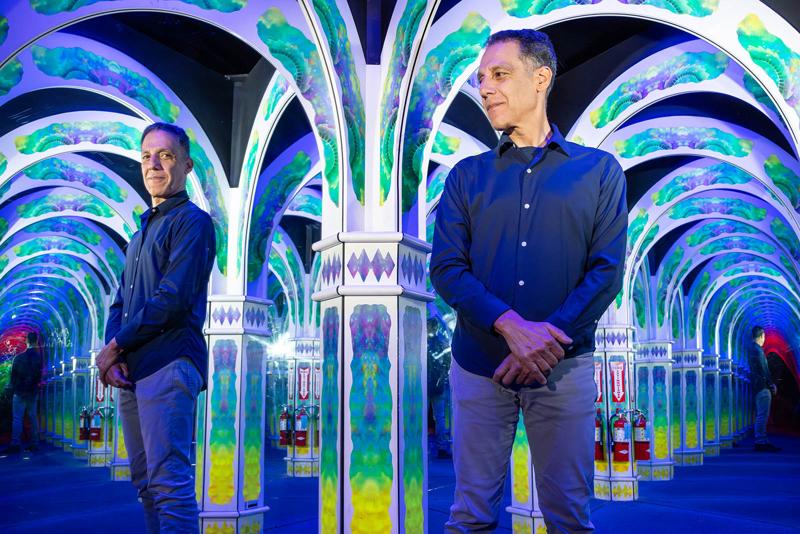
The digital landscape is currently grappling with a crisis of authenticity. As generative artificial intelligence evolves, the line between objective reality and fabricated media has blurred, giving rise to a proliferation of deepfakes
—hyper-realistic audio and visual manipulations that can make anyone appear to say or do anything. At the center of the effort to safeguard truth is Hany Farid, a professor at the University of California, Berkeley, whose career has been dedicated to the science of digital forensics.
For decades, Farid has developed the tools and methodologies used to detect manipulated images, effectively acting as a digital detective for the modern era. However, the sudden leap in AI capabilities has presented a challenge of unprecedented scale. While traditional image forgery often left traceable “fingerprints” in the pixels, modern generative AI creates content from scratch, mimicking the remarkably textures and lighting that forensic experts once relied upon for verification.
The stakes extend far beyond harmless internet memes. From the manipulation of political discourse and the erosion of trust in democratic elections to the rise of sophisticated financial fraud, the ability to fabricate reality has profound implications for global security. As a leading voice in the field, Farid is now pivoting his research to address these AI-driven threats, focusing on the intersection of human perception and algorithmic detection.
The Evolution of Digital Forgery and the AI Pivot
Digital forensics began as a quest to identify “cloning” or “splicing” in photographs—techniques where an editor would copy a piece of one image and paste it into another. Farid pioneered the field by authoring Photo Forensics
, the first comprehensive guide to authenticating digital images, which established the groundwork for detecting these anomalies. These early methods relied on analyzing the mathematical consistency of lighting and the noise patterns inherent in digital sensors.
The emergence of Generative Adversarial Networks (GANs) and diffusion models has fundamentally changed the game. Instead of modifying an existing photo, these AI systems are trained on billions of images to understand the “essence” of a human face or a specific environment. They can then generate a completely new image that is mathematically consistent, leaving few of the traditional clues that forensic experts once used to spot a fake.
Farid’s current work focuses on identifying the subtle failures of AI, such as unnatural eye reflections or irregular skin textures that the algorithms still struggle to perfect. However, he acknowledges that this is an arms race: as detectors get better, the AI models are trained to bypass those very detections, creating a continuous loop of innovation and evasion.
Combatting Political Deepfakes and Misinformation
One of the most urgent applications of Farid’s expertise is the analysis of political content. In an era of global election cycles, the potential for AI-generated audio or video to sway public opinion is significant. According to reports from UC Berkeley Public Affairs, AI-generated political content has the potential to wreak havoc and tilt elections by presenting fabricated evidence of misconduct or false statements by candidates.
Farid is frequently called upon to review high-profile media to determine authenticity. His approach involves a combination of algorithmic analysis and “human-in-the-loop” verification. He examines the physics of the scene—whether the shadows align with the light source or if the audio frequencies match the movements of the speaker’s mouth—to provide a factual basis for whether a clip is genuine.
Beyond detection, Farid is an advocate for the implementation of digital provenance. This involves “watermarking” or cryptographically signing original content at the point of creation. If every official government video or news report carried a verified digital signature, any version of that video without the signature—or with a modified one—could be immediately flagged as suspect.
From Academia to Industry: The Role of GetReal Security
Recognizing that academic research alone cannot keep pace with the speed of AI deployment, Farid expanded his impact into the private sector. He is the co-founder and Chief Science Officer of GetReal Security, a company dedicated to providing scalable tools for detecting manipulated media.
The transition from a university lab to a security firm allows for the rapid deployment of detection tools to organizations that need them most, such as newsrooms, intelligence agencies, and financial institutions. By integrating forensic analysis into the workflow of these organizations, the goal is to create a “buffer of truth” that can filter out deepfakes before they reach a mass audience.
Farid’s contributions to the field have not gone unnoticed. On February 27, 2026, he accepted the McGuire Family Prize for Societal Impact, a recognition of his trailblazing work in detecting digital fraud and deepfakes according to Dartmouth College.
Key Takeaways: How to Spot a Deepfake
- Visual Anomalies: Look for irregular blinking, unnatural skin smoothing, or “glitches” where the edge of a face meets the background.
- Lighting Inconsistencies: Check if the light on the subject’s face matches the light in the rest of the environment.
- Audio-Visual Mismatch: Pay close attention to the synchronization between the lips and the sounds being produced; AI often struggles with precise phonetic movements.
- Contextual Verification: Always check if the content is being reported by multiple reputable, independent news sources.
The Future of Truth in the AI Era
As we move forward, the challenge for digital forensics is no longer just about finding a single “smoking gun” in a file. This proves about building a systemic infrastructure of trust. Farid’s work suggests that while we may never be able to perfectly detect every single AI-generated image, we can raise the cost and difficulty of creating a “perfect” fake.

The broader implication is a shift in how society consumes media. For decades, the phrase seeing is believing
served as a baseline for truth. In the age of deepfakes, that baseline has collapsed. The new standard must be verification is believing
, where the origin and history of a piece of media are as important as the content itself.
The ongoing battle against digital deception requires a multi-pronged approach: better detection algorithms, stricter regulatory frameworks for AI developers, and a more digitally literate public that questions the authenticity of sensational content before sharing it.
The next critical checkpoint in the fight against misinformation will be the continued rollout of industry-standard content credentials (C2PA), which aim to embed provenance data directly into media files. As these standards are adopted by more camera manufacturers and software platforms, the ability to verify the “birth” of a digital image will become a primary defense against the deepfake epidemic.
Do you believe we can ever truly win the war against deepfakes, or is the technology evolving too quickly for us to keep up? Share your thoughts in the comments below and share this article to aid others stay vigilant.