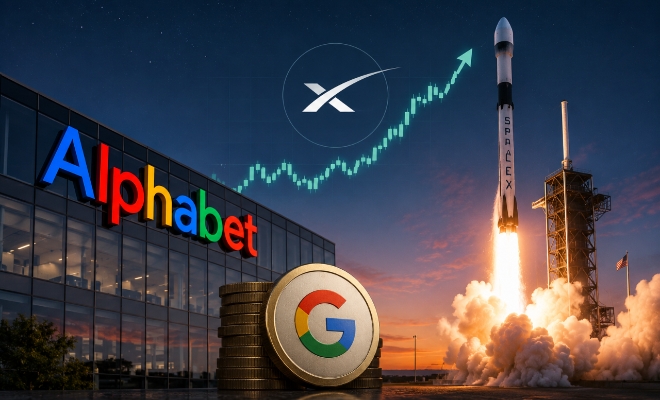
As the private space sector continues to mature, speculation regarding a potential SpaceX initial public offering (IPO) has become a recurring theme in global financial circles. While Elon Musk’s aerospace firm remains firmly under private ownership, market analysts are increasingly looking at the institutional investors holding significant stakes in the company. Among these, Alphabet Inc., the parent company of Google, has emerged as a focal point for investors seeking indirect exposure to the space exploration giant.
The interest stems from Alphabet’s long-standing strategic investments in SpaceX, which have positioned the tech conglomerate as a significant beneficiary of the latter’s rising valuation. With SpaceX’s most recent valuation rounds pushing the company toward the $200 billion threshold, the potential impact on Alphabet’s balance sheet is substantial, though the nuances of these holdings—and their effect on Alphabet’s own stock performance—require a careful examination of market dynamics.
The Strategic Connection: Alphabet and SpaceX
Alphabet’s relationship with SpaceX is not merely a passive financial play; it is rooted in long-term capital allocation. In 2015, Google and Fidelity led a $1 billion funding round for SpaceX, an investment that provided the aerospace firm with the capital necessary to accelerate the development of its reusable rocket technology and the early stages of the Starlink satellite internet constellation. According to official reports from 2015, the investment was valued at approximately $10 billion at the time, underscoring the massive appreciation in asset value over the last nine years.

For investors, the primary allure is the potential “unlocking” of value that an IPO would represent. Should SpaceX decide to go public, the transparency provided by regulatory filings would allow for a clearer assessment of the equity held by early-stage investors like Alphabet. However, it is essential for market participants to understand that SpaceX’s valuation is driven by its unique position in both launch services and global telecommunications through its Starlink division, which now operates thousands of satellites in low Earth orbit as confirmed by Federal Communications Commission (FCC) licensing records.
Market Valuation and the “Proxy” Effect
While Alphabet’s stake in SpaceX is significant in absolute terms, it represents only a fraction of its total market capitalization, which sits firmly in the multi-trillion-dollar range. Analysts often describe companies like Alphabet as “proxies” for private tech giants because they provide retail and institutional investors with a way to gain exposure to unlisted assets. However, the “SpaceX effect” on Alphabet’s stock price is often diluted by the sheer scale of Google’s core business, including its advertising revenue, cloud computing services, and investments in artificial intelligence.

The valuation of SpaceX has seen a meteoric rise, with reports in 2024 suggesting that the company reached a valuation of approximately $210 billion during a tender offer. This growth trajectory, as tracked by financial market reporting, highlights why interest in an IPO remains high. Yet, investors must be cautious: a stake in a private company is not a liquid asset. Even if SpaceX’s equity value has surged, it does not immediately translate into cash flow for Alphabet shareholders until a liquidity event, such as an IPO or a secondary market sale, occurs.
Key Considerations for Global Investors
- Asset Liquidity: Unlike public equities, private holdings like Alphabet’s stake in SpaceX are subject to restricted transferability and valuation volatility.
- Core Business Dominance: Investors should prioritize Alphabet’s performance in search and cloud computing, as these remain the primary drivers of its share price.
- Regulatory Oversight: The space industry is subject to stringent international regulations. Any future IPO would require comprehensive disclosures regarding launch safety, environmental impact, and orbital debris management as mandated by organizations like the Federal Aviation Administration (FAA).
What Happens Next?
As of late 2024, SpaceX has not filed a registration statement with the U.S. Securities and Exchange Commission (SEC) for an IPO. While Elon Musk has occasionally hinted at the possibility of spinning off Starlink as a separate entity, these remain speculative conversations rather than concrete corporate actions. The market continues to monitor the company’s quarterly launch cadence and the expansion of Starlink’s subscriber base as the primary indicators of its ongoing valuation growth.
For those tracking these developments, the best course of action is to monitor official company statements and regulatory filings. Changes in the valuation of private assets held by public companies are typically disclosed in annual reports and 10-K filings, which provide the most accurate assessment of how these holdings impact a parent company’s financial health. We will continue to track updates regarding SpaceX’s capital structure and provide analysis as new information becomes available from official corporate channels.
What are your thoughts on the potential for a public listing of aerospace giants? We invite our readers to join the discussion in the comments section below.