The United States is approaching its 250th anniversary on July 4, 2026, a milestone marking two and a half centuries since the adoption of the Declaration of Independence. As the nation prepares for this semiquincentennial celebration, federal, state, and local organizers are balancing historical commemoration with the realities of a politically polarized electorate and evolving national priorities. According to the U.S. Semiquincentennial Commission, the official body established by Congress to plan the anniversary, the goal is to create an inclusive reflection on the country’s history while looking toward its future.
The Semiquincentennial Commission, also known as America250, was authorized by the Semiquincentennial Commission Act of 2016, which mandates the planning and coordination of events across the country to commemorate the 1776 founding. While the commission has faced scrutiny regarding its leadership transitions and budget management—documented in various Government Accountability Office (GAO) reports—the planning for large-scale public initiatives remains underway. These initiatives include national service projects, educational outreach, and cultural festivals intended to engage a diverse American public.
Organizing a National Milestone
Planning for the 250th birthday involves a complex network of stakeholders. The America250 effort is supported by a mix of federal funding and private contributions. The commission’s mandate includes collaborating with state-level commissions, many of which have already begun soliciting public input on how to best represent their local history within the broader national narrative. Unlike the Bicentennial in 1976, which occurred in the wake of the Vietnam War and the Watergate scandal, the 250th anniversary arrives during a period of intense domestic debate regarding how history is taught and interpreted in public spaces.
The National Park Service (NPS) is also playing a significant role, as it maintains many of the sites central to the American Revolution. NPS officials have noted that the anniversary serves as an opportunity to rehabilitate aging infrastructure at historical landmarks, ensuring that sites like Independence Hall in Philadelphia and the battlefields of the Revolutionary War are preserved for future generations. These physical improvements are viewed as a tangible legacy of the anniversary period, extending beyond the events of 2026 itself.
Navigating a Divided Landscape
Public enthusiasm for the 250th birthday is tempered by current political divisions. Surveys from organizations like the Pew Research Center have consistently tracked a decline in public trust in government institutions over recent decades. This environment poses a challenge for organizers who aim to create a unifying message. Historians and cultural critics have argued that the 250th anniversary should not be a singular narrative of triumph, but rather a reflective assessment of the nation’s progress toward its founding ideals, such as equality and representative governance.
The tension between traditional commemorative styles—often featuring parades and fireworks—and more critical academic approaches has led to a varied programming strategy. Some state commissions are focusing on “living history” programs that emphasize the contributions of marginalized groups, including enslaved people and women, who were largely omitted from traditional 1976 celebrations. This shift reflects a broader trend in public history to incorporate multiple perspectives into the foundational story of the United States.
Economic and Logistical Realities
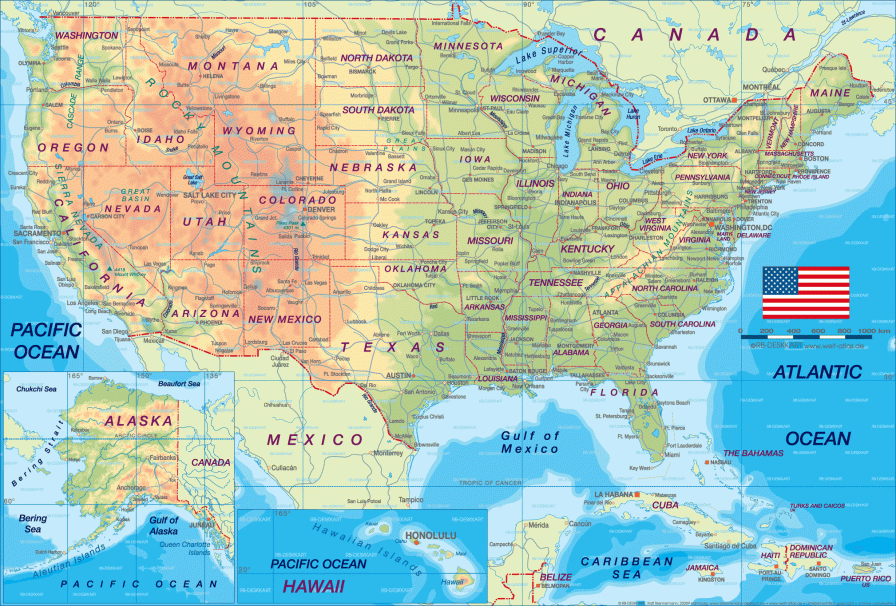
The logistical scale of the 250th anniversary is significant. With events planned in all 50 states and U.S. territories, the economic impact is expected to be substantial, particularly for the tourism and hospitality sectors. However, the reliance on private fundraising to supplement federal appropriations has caused some concern among observers regarding the influence of corporate sponsors on public celebrations. The Semiquincentennial Commission Act sets strict guidelines for the commission’s operations, but the practical application of these rules remains a subject of ongoing oversight by legislative committees.
For the average citizen, the anniversary represents a moment to consider the longevity of the American experiment. With the 250th birthday approaching, the focus remains on whether these celebrations will foster a sense of shared identity or further highlight the fractures in the current political landscape. The success of the commemoration will likely be measured by the participation of younger generations, whose engagement with history is increasingly shaped by digital platforms and interactive, rather than passive, educational experiences.
Looking Toward July 2026
As the date approaches, the next major checkpoint for the public will be the release of the final calendar of events by the America250 commission, which is expected to provide details on signature national gatherings. Interested parties are encouraged to monitor the commission’s official updates for opportunities to participate in local committees or to submit proposals for commemorative projects. The dialogue surrounding the 250th birthday is expected to intensify throughout 2025 as the official countdown begins.

Readers are invited to share their thoughts on how their communities plan to mark this historic milestone. The conversation regarding the future of the nation’s memory remains open, and public feedback continues to be a vital component of the planning process.