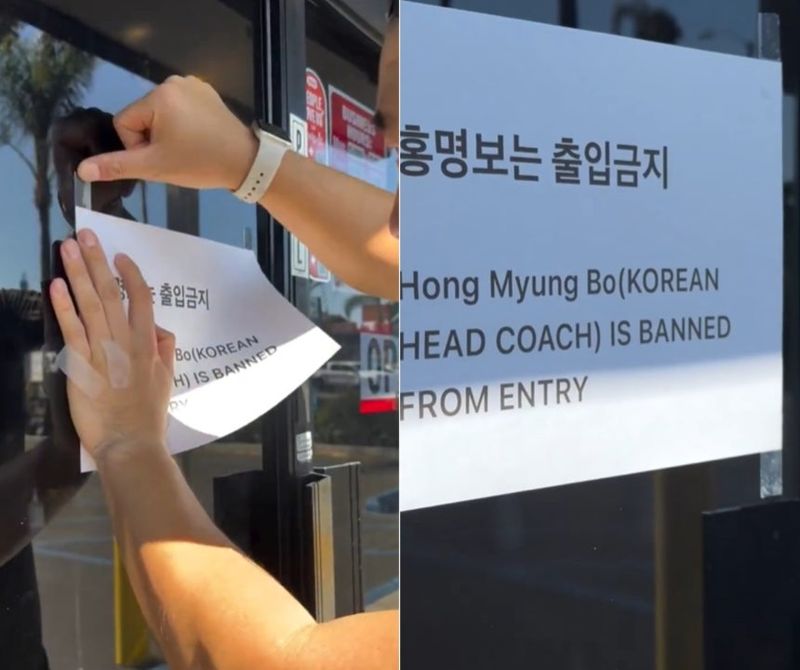
A Korean restaurant in Buena Park, California, has posted a sign banning South Korean national football team head coach Hong Myung-bo from entering the premises. The move reflects growing international frustration over the Korea Football Association’s (KFA) controversial appointment process, which has triggered widespread protests and calls for leadership resignations in South Korea.
The sign, which appeared on the door of a restaurant near Los Angeles, explicitly states that Hong Myung-bo is banned from the establishment. Images of the warning began circulating on social media platforms on Oct. 5, signaling that the backlash against the coach has extended beyond South Korean borders to the overseas Korean diaspora. The protest comes as the KFA faces intense scrutiny over the lack of transparency in how Hong was selected to lead the national team ahead of the 2026 World Cup qualifiers.
The appointment of Hong, a legendary former player and captain, was initially framed as a move toward stability. However, the process became a flashpoint for public anger after the KFA spent weeks suggesting it was seeking a high-profile foreign manager. The sudden pivot to Hong, who was coaching the Pohang Steelers at the time, led to accusations of nepotism and a disregard for proper administrative protocols.
Why a California Restaurant Banned Hong Myung-bo
The incident in Buena Park is not an isolated act of personal dislike but a symbolic protest against the governance of South Korean football. In the United States, particularly in hubs like Los Angeles and Orange County, the South Korean national team serves as a primary cultural touchstone for the diaspora. The decision to ban the coach from a local business mirrors similar protests occurring in Seoul, where fans have gathered to demand the resignation of both Hong and KFA President Chung Mong-gyu.

Critics argue that the appointment process ignored the “foreign coach” mandate that the KFA had publicly signaled. By bypassing a transparent search and allegedly fast-tracking Hong’s appointment, the KFA created a perception that the decision was predetermined. This perceived lack of integrity has turned Hong into a lightning rod for broader frustrations regarding how the KFA manages the national team’s future.
The restaurant’s sign is part of a larger trend of “civilian sanctions” seen in South Korean sports culture, where fans use public shaming or boycotts to pressure sporting bodies into accountability. Because the national team represents national identity, the perceived corruption in its leadership is often viewed as a betrayal of public trust.
The Timeline of the KFA Appointment Controversy
The friction began following the departure of previous manager Jürgen Klinsmann. The KFA had indicated a desire to move toward a more structured, tactically rigorous approach, which many fans believed required a world-class foreign coach. For several weeks, reports circulated that the KFA was in talks with various international candidates.

The situation shifted abruptly when Hong Myung-bo emerged as the primary candidate. The KFA’s subsequent explanation—that Hong was the best fit for the team’s immediate needs—did not satisfy a public that had been promised a transparent selection process. The controversy intensified when it was revealed that the KFA had not followed its own established protocols for hiring a national team manager, leading to claims that the process was a formality designed to justify a pre-selected choice.
This administrative failure has placed KFA President Chung Mong-gyu under significant pressure. Chung, who has led the association for over a decade, has become a target for fans who believe the systemic issues within the KFA—ranging from poor recruitment to flawed governance—start at the top. The demand for his resignation has grown alongside the calls for Hong to step down.
How the Controversy Affects World Cup Qualification
The timing of the appointment is particularly sensitive as South Korea navigates the third round of the FIFA World Cup 2026 qualifiers. The national team is currently competing in a high-stakes environment where tactical consistency and player morale are critical. The external chaos surrounding the coach’s legitimacy creates a volatile atmosphere for the players, who must balance their on-field performance with the knowledge that their manager is widely rejected by the fans.
Football analysts suggest that the “crisis of legitimacy” facing Hong Myung-bo could undermine his authority within the locker room. While Hong is respected as a former player, the manner of his hiring has stripped him of the “honeymoon period” typically granted to new managers. Every loss or draw is now framed not just as a tactical failure, but as a validation of the public’s belief that he was the wrong choice for the job.
Furthermore, the distraction of the protests—both in Korea and among the diaspora in the U.S.—diverts attention from the team’s preparation. The KFA has attempted to quell the unrest by focusing on match results, but the fundamental demand for an apology and a detailed explanation of the hiring process remains unmet.
The Role of the Korean Diaspora in Sports Protests
The appearance of the “Banned” sign in Buena Park highlights the interconnectedness of modern sports fandom. Social media allows the diaspora to synchronize their protests with those in the home country in real-time. When news of the KFA’s administrative lapses broke in Seoul, it was instantly digested by Korean communities in the U.S., Canada, and Europe.
For many overseas Koreans, the national team is one of the few remaining symbols of unified national pride. When the KFA is perceived as operating like a “closed shop” or a “private club,” it alienates a global fan base that expects professional standards equivalent to those seen in the English Premier League or the Bundesliga. The act of banning a coach from a restaurant is a way for these fans to exert influence over a governing body that they cannot vote for or legally challenge.
This form of protest is an extension of the “cancel culture” seen in other sectors of South Korean society, where public figures are held to a strict moral and professional standard. In this case, the “sin” is not a personal scandal, but a perceived breach of professional ethics and transparency in the management of a public institution.
What Happens Next for Hong Myung-bo and the KFA
The KFA currently faces a choice between doubling down on its support for Hong or addressing the procedural failures that led to this crisis. While the association has officially stood by the appointment, the intensity of the backlash suggests that a simple statement of support is insufficient. The public is demanding a formal audit of the selection process and a public apology from the leadership.

The immediate focus remains on the upcoming qualification matches. A string of victories could potentially silence some critics, as success on the pitch often erases administrative errors in the eyes of the general public. However, if the team struggles, the pressure on Hong Myung-bo and Chung Mong-gyu will likely reach a breaking point.
The next critical checkpoint for the KFA will be the upcoming scheduled matches in the World Cup qualifying cycle. The results of these games will determine whether the “ban” signs in places like Buena Park remain as symbols of protest or fade as the team secures its path to the 2026 tournament.
World Today Journal will continue to monitor the developments regarding the KFA leadership and the South Korean national team’s progress. Share your thoughts on the KFA’s appointment process in the comments below.