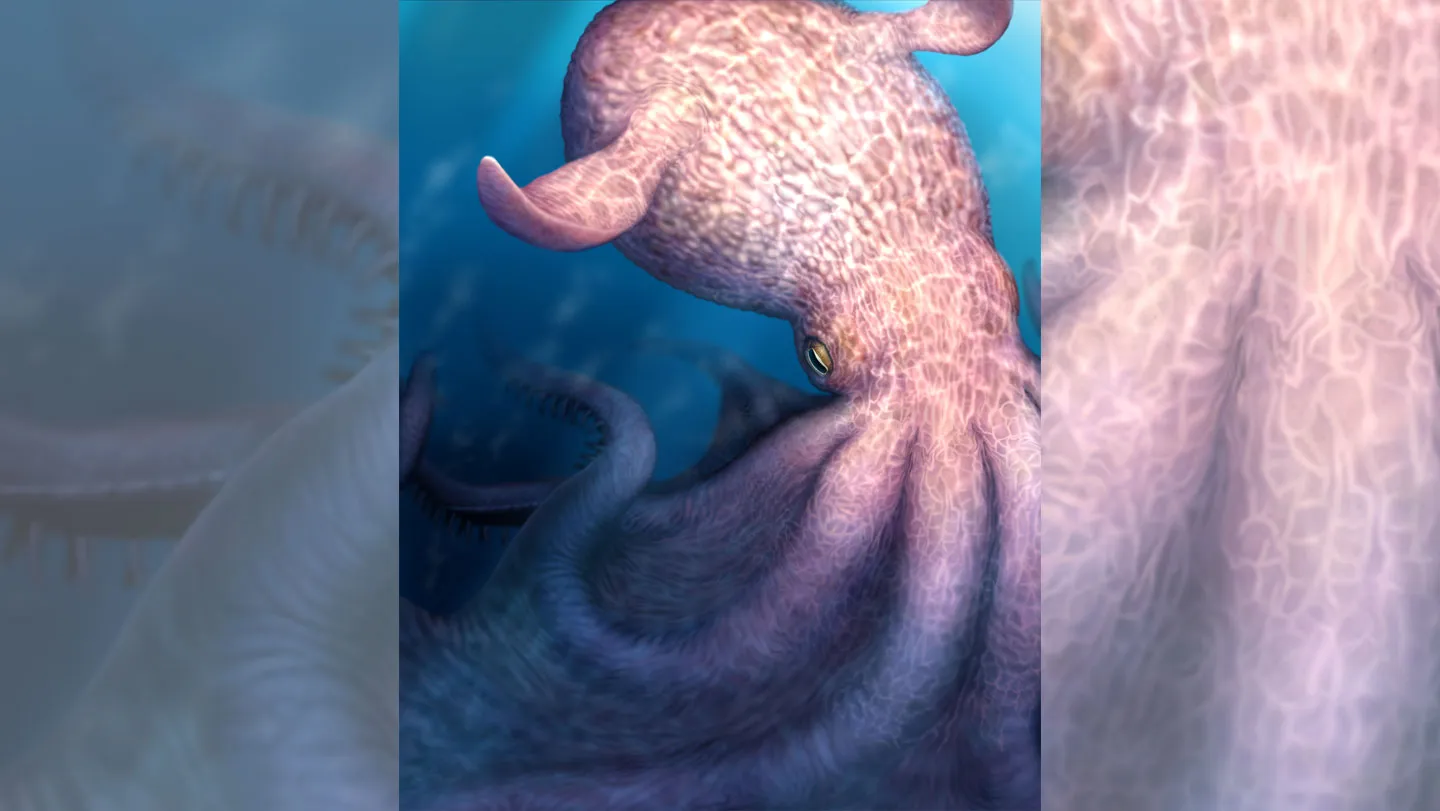
In a remarkable discovery that reshapes our understanding of ancient marine ecosystems, paleontologists have identified fossil evidence suggesting that giant, kraken-like octopuses once dominated the Cretaceous seas. These colossal invertebrates, some reaching lengths comparable to modern sperm whales, may have been the largest invertebrates ever to inhabit Earth’s oceans.
The findings stem from a detailed analysis of fossilized jaws—rare hard parts that occasionally fossilize in otherwise soft-bodied cephalopods—collected from sites in Japan and Canada’s Vancouver Island. Researchers from Hokkaido University in Japan examined more than two dozen Late Cretaceous-era specimens, using advanced imaging techniques to measure and compare the jaws with those of living and extinct octopus and squid species. Their work, published in the journal Science on April 23, 2026, reveals that these ancient predators likely grew up to 19 meters (62 feet) long, placing them among the top marine predators of their time.
“These octopuses may represent the largest invertebrates thus described, rivaling contemporaneous giant marine reptiles,” states the research team led by Shin Ikegami and Yasuhiro Iba. The wear patterns observed on the fossil jaws indicate heavy utilize in crushing hard prey, suggesting these creatures actively hunted and consumed vertebrates such as fish and possibly even marine reptiles like mosasaurs, which shared their environment during the twilight of the dinosaur era.
Because octopuses lack bones and their soft tissues rarely fossilize, scientists have historically faced significant challenges in studying their deep evolutionary past. The preservation of beaklike jaws offers a rare window into the size and ecological role of these elusive animals. By applying known tooth-to-body-size ratios from modern cephalopods, researchers were able to estimate the full body dimensions of these ancient giants with greater confidence.
Size and Scale in the Ancient Ocean
At up to 19 meters in length, these Cretaceous octopuses would have matched or exceeded the size of many large marine predators known from the fossil record, including pliosaurs and early whales. Their dimensions place them in the same size range as today’s sperm whales, which typically measure between 11 and 18 meters for females and up to 20 meters for large males.
This scale implies a formidable presence in the Late Cretaceous oceans, a period spanning from about 100 to 66 million years ago when sea levels were high and warm, shallow seas covered much of the continents. In these waters, the giant octopuses would have competed with other apex predators such as mosasaurs—large, lizard-like marine reptiles that could reach similar lengths—and possibly even preyed upon them.
The discovery challenges long-held assumptions about the ecological limits of invertebrates. While modern cephalopods like the giant Pacific octopus (Enteroctopus dofleini) reach impressive sizes of up to 5 meters, and the colossal squid (Mesonychoteuthis hamiltoni) may grow to 10–12 meters, none approach the estimated dimensions of these Cretaceous forms. If confirmed, these ancient octopuses would not only be the largest known invertebrates but also represent a remarkable case of convergent evolution, where cephalopods independently evolved traits associated with vertebrate apex predators—such as large size, powerful jaws, and high metabolic demands.
Fossil Evidence and Scientific Method
The study’s breakthrough lies in its innovative approach to overcoming the inherent difficulties of cephalopod paleontology. Rather than relying solely on rare soft-tissue fossils—which are exceptionally uncommon due to rapid decomposition—the team focused on the more durable chitinous beaks and jaw structures. These elements, made of resilient organic compounds, are more likely to withstand the fossilization process under the right conditions.
Using a technique called serial sectioning, researchers ground down fossil-bearing rock samples layer by layer, photographing each stage to create a three-dimensional record of embedded jaw fossils. This method allowed them to identify 12 previously undocumented specimens within rocks from Japan, significantly expanding the dataset beyond the original 15 jaws analyzed. By comparing morphological features such as curvature, thickness, and wear patterns, the scientists were able to distinguish these fossils from those of ammonites, belemnites, and other cephalopod relatives.
The geological context of the finds further supports their interpretation. The fossil-bearing strata date to the Late Cretaceous Period, approximately 72 to 100 million years ago—a time when dinosaurs dominated terrestrial ecosystems but marine reptiles ruled the oceans. The presence of these large cephalopod jaws in marine sedimentary deposits indicates a pelagic (open-ocean) lifestyle, consistent with active predation in deep or mid-water environments.
Ecological Role as Apex Predators
Beyond mere size, the functional morphology of the jaws provides insight into the animals’ feeding behavior. The observed wear—characterized by polishing and pitting consistent with repeated contact with hard materials—suggests these octopuses regularly crushed the shells or bones of their prey. This places them at the top of the Cretaceous marine food web, occupying a niche similar to that of modern killer whales or large sharks.
Such a role would have required sophisticated hunting strategies, potentially involving ambush tactics, complex maneuvering, and the use of tentacles to subdue large, struggling prey. While direct evidence of behavior cannot be fossilized, the combination of large body size, powerful jaws, and inferred intelligence (based on brain-to-body ratios in modern cephalopods) supports the hypothesis of active predation rather than scavenging.
The researchers note that these findings align with broader evolutionary trends observed in the Cretaceous oceans, where multiple lineages—including reptiles, fish, and now cephalopods—appeared to converge on large body sizes and predatory lifestyles. This phenomenon may have been driven by high productivity in Cretaceous seas, reduced competition in certain niches, or evolutionary arms races between predators and prey.
Implications for Understanding Cephalopod Evolution
The discovery prompts a reevaluation of the evolutionary potential within the cephalopod lineage. Historically viewed as primarily small to medium-sized, short-lived invertebrates with limited fossil records, cephalopods may have periodically evolved giant forms under specific ecological conditions. The extinction of these forms—likely linked to the Cretaceous-Paleogene (K-Pg) mass extinction event 66 million years ago—may have removed a significant branch of cephalopod diversity that left no direct descendants.

Today’s nautiluses, which retain external shells, and coleoids (octopuses, squid, and cuttlefish), which have internalized or lost their shells, represent the surviving branches of a once far more diverse group. The existence of giant, predatory cephalopods in the deep past suggests that the lineage has experimented with a wider range of body plans and ecological roles than previously appreciated.
Future research will focus on locating additional fossil sites with exceptional preservation conditions, such as Konservat-Lagerstätten, where soft tissues might occasionally be preserved. Advances in geochemical analysis could also help determine the diet and habitat of these animals through isotopic signatures in their jaw elements.
As new technologies and exploration techniques emerge, scientists remain hopeful that further fragments of this lost world will arrive to light—offering deeper insight into the true diversity and adaptability of life in Earth’s ancient oceans.
For readers fascinated by the intersection of paleontology, marine biology, and evolutionary science, this discovery serves as a powerful reminder that the fossil record continues to yield surprises—especially when researchers look beyond the most obvious clues and dare to imagine what might have lurked in the depths.
Stay informed about the latest developments in science and natural history by following trusted sources and engaging with ongoing research. Share your thoughts and questions in the comments below, and help spread awareness of the wonders still hidden in our planet’s past.
Worth a look