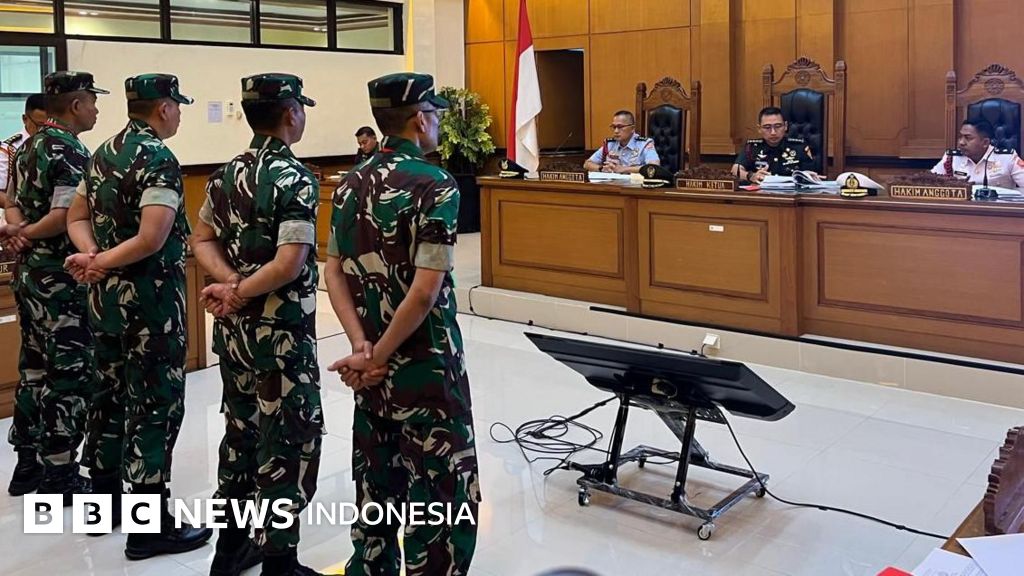
The first hearing in the trial of four Indonesian military officers accused of a brutal acid attack on human rights activist Andrie Yunus opened Wednesday at Jakarta’s Military Court II-08. Whereas the defendants were presented to the public for the first time, the courtroom was marked by a glaring absence: the legal representatives of the victim, who boycotted the proceedings in a pointed rejection of military jurisdiction.
Andrie Yunus, the deputy coordinator of the Commission for Missing Persons and Victims of Violence (KontraS), was targeted in a coordinated assault on March 12, 2026. The attack, which occurred after a press conference in Jakarta, left Yunus with permanent scarring and severe injuries, including heavy damage to his right eye. The case has since evolved into a flashpoint for debates over military impunity and the expanding role of the armed forces in Indonesia’s civilian government.
The proceedings on April 29, 2026, saw military prosecutors seek a maximum sentence of 12 years in prison for the four officers, who are charged with serious premeditated assault under the Indonesian criminal code according to court documents. The defendants—identified as Captain Nandala Dwi Prasetia, Sergeant Edi Sudarko, Lieutenant Budhi Hariyanto, and Lieutenant Sami Lakka—are members of the military’s strategic intelligence unit, BAIS TNI.
A Crisis of Jurisdiction: Why the Victim’s Team Boycotted
The Advocacy Team for Democracy (TAUD), which represents Yunus, explicitly refused to attend the first hearing. This boycott is not merely a protest against the defendants, but a systemic challenge to the Indonesian legal framework that allows military personnel to be tried in military courts rather than civilian ones for crimes committed against civilians.
TAUD representative Alif Fauzi confirmed the boycott, stating that Yunus and his supporters have rejected the transfer of the law enforcement process to a military court from the outset. For human rights advocates, the use of military tribunals often results in lighter sentences and a lack of transparency, effectively shielding soldiers from the full weight of the law when they target civil society members.
The legal team is pushing for the case to be processed in a civil court to ensure an impartial trial. This demand is echoed by members of the DPR Commission III, including Safaruddin, who has indicated a push for civilian jurisdiction in this specific case to maintain public trust in the judicial process.
The Anatomy of the Attack
The violence visited upon Andrie Yunus was calculated and severe. On March 12, two assailants on a motorcycle approached Yunus and threw a chemical mixture—later identified by military prosecutor Mohammad Iswadi as a combination of car battery acid and rust remover—directly at him.

Medical reports indicate that Yunus suffered burns to approximately 20% to 24% of his face and body, specifically affecting his arms and facial features per reporting on the injuries. The attack was designed to maim, leaving the activist with lifelong physical scars and significant visual impairment.
The perpetrators were apprehended shortly after. On March 18, 2026, Major General Yusri Nuryanto, the Commander of the TNI Military Police, confirmed that four personnel from the BAIS TNI ground and naval forces had been detained by the Military Police of the Jakarta Military Command (Pomdam Jaya).
Institutional ‘Affront’ vs. Human Rights
Perhaps the most disturbing element of the case is the alleged motive. During the hearing, military prosecutor Mohammad Iswadi stated that the officers targeted Yunus because they felt “affronted” by his public advocacy. Yunus had been a vocal critic of legal changes that allow more military officers to be appointed to civilian government posts, a move he argued undermines democratic reforms.
According to the prosecution, the suspects believed that Yunus had “insulted and stomped on the military as an institution.” This framing suggests that the attack was not a random act of violence, but a targeted attempt to silence a critic of the military’s expanding public role. The prosecution claims the assault was intended to provide a “deterrent effect” to others who might challenge the institution.
This motive has led TAUD to argue that the attack cannot be viewed as the act of “rogue” soldiers. The legal team has urged the Indonesian National Police (Polri) to expand the investigation to include high-ranking officials, including the Minister of Defense, the Commander of the TNI, and the head of BAIS TNI. TAUD contends that the status of the perpetrators as intelligence personnel suggests a potential chain of command and control, implying the attack may have been a structured operation carried out with the knowledge or secret approval of superiors.
Legal Framework and Charges
The defendants are facing a complex set of charges designed to reflect the premeditated nature of the crime. Colonel Chk Andri Wijaya, Head of the Military Prosecutor’s Office II-07 Jakarta, noted that the officers are being charged under multiple layered articles of the Criminal Code, including:
- Article 469 paragraph (1) in conjunction with Article 20 letter c.
- Article 468 paragraph (1) in conjunction with Article 20 letter c.
- Article 467 paragraph (1) and (2) in conjunction with Article 20 letter c.
These articles specifically deal with aggravated assault and the intent to cause permanent disability or severe injury. The panel of judges overseeing the case consists of Colonel Chk Fredy Ferdian Isnartanto, Lieutenant Colonel Kum Irwan Tasri, and Major of the Navy (H) M. Zainal Abidin.
Key Case Timeline
| Date | Event | Significance |
|---|---|---|
| March 12 | Acid Attack | Yunus sustains 20-24% burns after a Jakarta press conference. |
| March 18 | Arrests Made | Four BAIS TNI personnel detained by Pomdam Jaya. |
| April 29 | First Hearing | Trial begins at Military Court II-08; TAUD boycotts the session. |
What So for Indonesian Democracy
The Andrie Yunus case is more than a criminal trial; it is a litmus test for the “Reformasi” era’s promise to remove the military from political and civilian administration. The alleged motive—punishing an activist for opposing military infiltration into civilian roles—suggests a regression toward an era where the armed forces operated above the law.
For the global community and human rights observers, the outcome of this trial will signal whether Indonesia is committed to civilian supremacy or if the military intelligence apparatus still possesses the autonomy to silence dissent through violence. The demand for the investigation of the TNI Commander and the Minister of Defense highlights a growing insistence that accountability must reach the top of the hierarchy, not just the foot soldiers who execute the orders.
As the trial continues, the tension between the military’s desire for internal discipline and the civilian demand for transparent justice remains unresolved. The boycott by TAUD ensures that the trial itself becomes a piece of evidence in the larger argument against military jurisdiction in civilian crimes.
The court is expected to continue hearings to examine the evidence and testimony regarding the chain of command. The next confirmed checkpoint will be the subsequent evidentiary hearings, where the prosecution will attempt to prove the premeditated nature of the assault and the specific orders given to the four defendants.
World Today Journal will continue to monitor this case as it develops. We invite our readers to share their perspectives on military jurisdiction in the comments below.