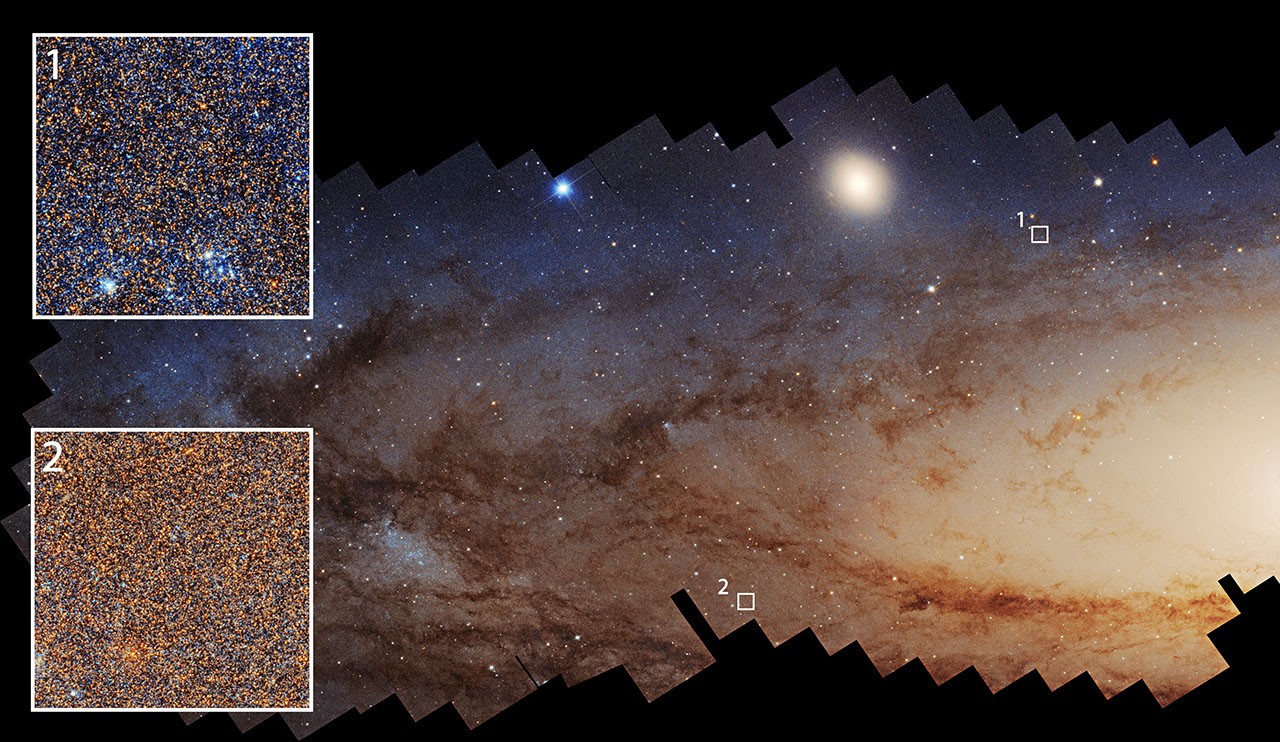
Data from the Livescience reveals that star formation in the nearby Andromeda galaxy has steadily declined over the past 500 million years. Researchers combining two major surveys measured roughly 200 million stars, concluding the galactic neighbor is naturally winding down its stellar production before a possible future collision with the Milky Way.
Our galactic next-door neighbor is slowing down. New findings built on archival data from the Hubble Space Telescope indicate that star formation in the Andromeda galaxy, also known as M31, has experienced a steady deceleration over the past 500 million years, with an even steeper drop recorded over the last 40 million years.
Mapping Two Hundred Million Stars in Andromeda
Located roughly 2.5 million light-years away in the constellation Andromeda, the giant spiral galaxy is close enough to be visible to the naked eye under dark skies, as noted by the space agency’s mission reporting. Because it matches the Milky Way in size and structure while possessing about twice its mass, Andromeda serves as a vital laboratory for astronomers studying how large spiral galaxies evolve over cosmic time.
To reconstruct the galaxy’s stellar history, researchers combined information from two major observational initiatives: the Panchromatic Hubble Andromeda Treasury and the Panchromatic Hubble Andromeda Southern Treasury. Together, these projects mapped roughly two-thirds of the galaxy’s disk in ultra-sharp detail. The international research team measured approximately 200 million individual stars, dividing the resulting images into thousands of squares measuring 300 light-years on each side to trace stellar birth rates across different regions.
“We need to measure the individual stars because they are the fossil record of the galaxy’s formation. Hubble is the only telescope that can give you high enough spatial resolution over a large enough area to be able to do that in Andromeda.”
Ben Williams, astronomer at the University of Washington
Tracing the Star Formation Decline and the Ring of Activity
Previous research established that Andromeda underwent a massive surge in star creation roughly 2 billion years ago, an event widely attributed to a past interaction or merger with another galaxy, likely the compact elliptical companion M32. That ancient starburst generated about one-fifth of all the stars in the galaxy.
Since that peak, however, production has tapered off significantly. Calculations show that 500 million years ago, Andromeda converted gas and dust into stars at a rate of approximately one solar mass per year. By 40 million years ago, that rate had been cut in half, and the outlet reported that current production has fallen to just one-fifth of a solar mass annually.
Rather than running out of raw material entirely, the galaxy appears to be experiencing a natural cool-down period. It’s just like after running a marathon, sometimes you’ve got to take a bit of a breather,
observed Tobin Wainer, lead author of the study from the University of Washington, via NASA’s published findings. Most recent stellar activity is concentrated in a distinct ring positioned about 32,000 light-years from the galaxy’s center, and diminishing activity within this specific ring drives the overall decline.
Investigating Potential M32 Interactions and Future Observations
Researchers also examined whether the nearby satellite galaxy M32 influenced the slowdown. Although M32 sits about 16,000 light-years from Andromeda in the plane of the sky, its precise three-dimensional position remains uncertain, making past gravitational interactions difficult to date conclusively.
Data from the southern survey allowed astronomers to analyze stellar history directly around M32. Co-author Zhuo Chen noted that this region displayed signs of reduced star formation beginning roughly 60 million years ago, offering a potential timeframe for when the satellite galaxy may have interacted with Andromeda’s disk.
While scientists continue to mine archival Hubble data, future research will incorporate ground-based observatories and upcoming space instruments. Astronomers plan to utilize NASA’s Nancy Grace Roman Space Telescope—scheduled to launch on a SpaceX Falcon Heavy rocket as soon as August 30—which possesses a field of view more than 100 times larger than Hubble’s to survey the entire Andromeda galaxy and its surrounding halo in unprecedented detail.
Keep reading