
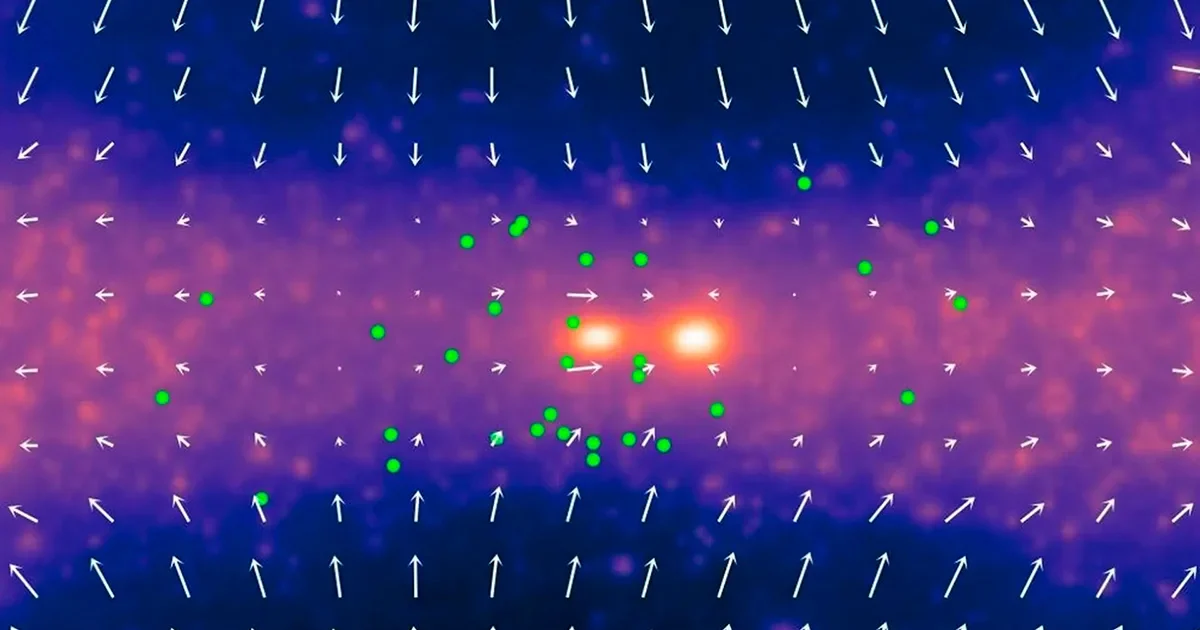
For decades, we have viewed the Milky Way as a shimmering spiral of stars, nebulae, and cosmic dust—a majestic city of light floating in the void. However, recent astrophysical research continues to reveal that the visible portion of our galaxy is merely the tip of a colossal iceberg. The Milky Way is actually encased in a gargantuan, invisible halo of matter that extends far beyond the edges of the stellar disk, fundamentally altering our understanding of how galaxies live, breathe, and evolve.
This “invisible” envelope is not a single substance but a complex duality of components: a massive scaffolding of dark matter and a sprawling reservoir of diffuse, hot gas known as the circumgalactic medium (CGM). While these elements remain hidden from traditional optical telescopes, their gravitational and chemical signatures provide a blueprint of the universe’s hidden architecture. For scientists, mapping this invisible matter is no longer a matter of curiosity—it is the key to solving the “missing baryon problem,” one of the most enduring mysteries in modern cosmology.
As we refine our detection methods using next-generation observatories, the scale of this surrounding matter is proving to be far more vast than previously estimated. This invisible shroud does not just sit passively around the galaxy; it acts as a cosmic lung, cycling gas in and out of the galactic disk to fuel the birth of new stars. Without this invisible reservoir, the Milky Way would have likely run out of the raw materials needed for star formation billions of years ago.
The Invisible Architecture: Dark Matter vs. The Circumgalactic Medium
To understand the “invisible matter” surrounding our galaxy, it is essential to distinguish between the two primary components that make up the galactic halo. While both are invisible to the naked eye, they are fundamentally different in nature and function.
First is the dark matter halo. Dark matter does not emit, absorb, or reflect light, making it entirely invisible across the electromagnetic spectrum. We know it exists only because of its gravitational influence on visible stars and gas. According to NASA’s analysis of dark matter, this mysterious substance makes up approximately 85% of the total matter in the universe. In the case of the Milky Way, the dark matter halo acts as the gravitational “glue” that prevents the galaxy from flying apart as it rotates at high speeds.
The second component is the circumgalactic medium (CGM). Unlike dark matter, the CGM consists of “normal” baryonic matter—mostly hydrogen and helium gas. However, this gas is so incredibly diffuse and heated to millions of degrees that it becomes nearly transparent, escaping detection by standard imaging. The CGM serves as the interface between the galaxy and the intergalactic medium, acting as a storage facility for the gas that eventually falls into the galactic disk to form stars.
The interplay between these two is critical. The dark matter halo provides the gravitational well that traps the hot gas of the CGM, creating a stable environment where the galaxy can grow. Without the dark matter halo’s immense pull, the hot gas of the CGM would simply drift away into the cosmic void, leaving the Milky Way a sterile, dead galaxy.
Mapping the Unseen: How Astronomers Detect the Invisible
Since this surrounding matter cannot be photographed in the traditional sense, astronomers rely on “proxy” detection methods. One of the most effective techniques involves using quasars—extremely bright, distant galactic nuclei—as cosmic flashlights.
When light from a distant quasar travels toward Earth, it must pass through the Milky Way’s invisible halo. As the light traverses the circumgalactic medium, the atoms in the diffuse gas absorb specific wavelengths of that light. By analyzing the resulting “absorption lines” in the quasar’s spectrum, scientists can determine the composition, temperature, and density of the invisible gas. This method allows researchers to map the extent of the halo even though they cannot see the gas itself.
X-ray telescopes are used to detect the “glow” of the hottest parts of the CGM. Because the gas is heated to millions of degrees, it emits soft X-rays. While this signal is incredibly faint and often drowned out by other cosmic noise, advanced processing allows astronomers to glimpse the outermost reaches of the galaxy’s gaseous envelope. The European Space Agency’s X-ray missions have been instrumental in identifying these high-energy signatures in galactic halos.
Gravitational lensing provides the primary tool for mapping the dark matter component. Because mass bends light, the way light from distant galaxies is distorted as it passes through our halo allows scientists to calculate the exact distribution and mass of the dark matter. These observations consistently show that the dark matter halo extends hundreds of thousands of light-years beyond the visible stars of the Milky Way.
Solving the ‘Missing Baryon’ Mystery
The discovery and measurement of the Milky Way’s invisible halo are central to solving the “missing baryon problem.” In cosmology, baryons are the particles that make up ordinary matter (protons and neutrons). When astronomers calculate how many baryons should exist based on the conditions of the early universe (as seen in the Cosmic Microwave Background), they find a significant discrepancy: a large portion of the expected ordinary matter is simply missing from the visible galaxies.
For years, scientists wondered where this matter had gone. Recent research suggests that the “missing” baryons are not actually missing; they are simply hiding in the circumgalactic medium. The diffuse, hot gas surrounding the Milky Way and other galaxies contains a massive amount of baryonic mass—potentially as much as, or more than, the mass of all the stars in the galaxy combined.
Understanding the mass of the CGM is vital because it dictates the “star formation history” of the galaxy. If the CGM is massive and dense, the galaxy has a steady supply of fuel to create new suns. If the CGM is depleted, the galaxy enters a period of “quenching,” where star formation slows and eventually stops. By quantifying the invisible matter surrounding the Milky Way, astronomers can predict the future lifespan of our galaxy and determine how long it will continue to produce new stars.
Why This Matters for Our Understanding of the Universe
The realization that the Milky Way is wrapped in a colossal invisible envelope shifts our perspective of the galaxy from an isolated object to a dynamic system integrated into the “cosmic web.” The cosmic web is the largest-scale structure of the universe, consisting of filaments of dark matter and gas that connect galaxies across millions of light-years.

The Milky Way’s invisible halo is essentially the point where the galaxy connects to these intergalactic filaments. Gas flows along these dark matter highways, feeding into the CGM and eventually into the galactic disk. This process, known as “galactic accretion,” is the primary way galaxies grow over billions of years. By studying the invisible matter, we are essentially studying the umbilical cord that connects our galaxy to the rest of the universe.
this research has profound implications for the search for extraterrestrial life. The stability of a galaxy’s star formation—and thus the likelihood of planets forming around stable stars—depends heavily on the regulation of gas by the CGM. A galaxy with a well-balanced invisible halo is more likely to maintain the long-term stability required for biological evolution to occur on a planetary scale.
Key Takeaways on the Milky Way’s Invisible Halo
- Dual Composition: The invisible surroundings consist of a dark matter halo (providing gravity) and the circumgalactic medium (providing gas).
- Detection Methods: Astronomers use quasar absorption spectra, X-ray emissions, and gravitational lensing to “see” these invisible structures.
- The Baryon Solution: The diffuse gas in the halo likely accounts for the “missing” ordinary matter predicted by cosmological models.
- Galactic Fuel: The CGM acts as a reservoir, cycling gas into the galaxy to sustain the birth of new stars.
- Cosmic Connectivity: The halo links the Milky Way to the larger cosmic web of filaments that span the universe.
As we look forward, the next phase of discovery will be driven by the James Webb Space Telescope (JWST) and the upcoming Vera C. Rubin Observatory. These instruments will allow us to probe the CGM with unprecedented precision, potentially revealing the chemical signatures of the very first generation of stars that enriched the halo with heavy elements.
The next major checkpoint for this field of research will be the release of new high-resolution mapping data from the JWST’s spectroscopic instruments, which are expected to provide a more detailed chemical inventory of the Milky Way’s outer envelope over the coming year.
What do you think about the invisible forces shaping our galaxy? Do you believe we will ever directly detect a dark matter particle? Share your thoughts in the comments below or share this article with your fellow space enthusiasts.