
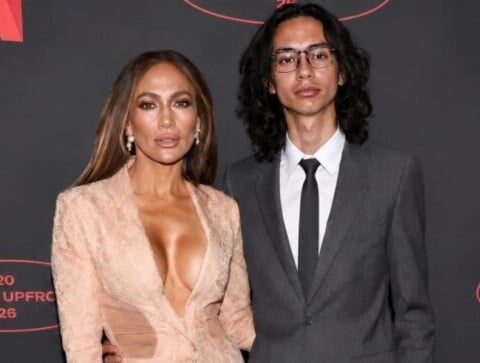
In the era of instant digital scrutiny, the boundary between private family life and public spectacle has become increasingly porous. This tension recently reached a fever pitch following the circulation of a photograph featuring global superstar Jennifer Lopez and her son, Max Muñiz. While the image was intended as a snapshot of maternal affection, it quickly evolved into a catalyst for a wider, often polarizing debate across social media platforms regarding the young man’s physical appearance.
For those accustomed to the curated perfection of the “JLo” brand, the appearance of Max Muñiz—who generally maintains a lower profile than his mother—offered a rare glimpse into the family’s private dynamic. However, the reaction from the internet was swift and divided. While many users praised the warmth and bond evident between mother and son, a significant volume of commentary shifted toward an unsolicited critique of Max’s physique and overall look, sparking conversations about the toxicity of celebrity culture and the pressures placed on the children of the world’s most famous figures.
As a journalist who has spent over 13 years covering the high-stakes world of international sports, I have seen firsthand how the public can be ruthless when an athlete’s body does not fit a specific, idealized mold. The scrutiny facing Max Muñiz is not fundamentally different from the critiques leveled at Olympic athletes or football stars. it is the same impulse to analyze, judge, and quantify a human being based on a single frozen moment in time. When the world treats a person’s appearance as public property, the human element is often lost in the noise.
The discourse surrounding the image highlights a recurring theme in modern celebrity: the “genetic expectation.” Because Jennifer Lopez and Marc Anthony are both celebrated for their striking appearances and rigorous fitness regimes, the public often projects those same expectations onto their children. When reality diverges from these imagined standards, the internet often reacts with “concern” that is frequently a thin veil for judgment.
The Viral Moment and the Social Media Backlash
The controversy began when a photo of Jennifer Lopez and Max Muñiz began circulating on platforms like Instagram and X (formerly Twitter). The image captured a candid moment, showing the singer and her son in a relaxed setting. Almost immediately, the comment sections became a battleground. One faction of users expressed genuine happiness to see Max in public, noting that he looks like a healthy young man growing into his own identity.
Conversely, another group of commenters focused heavily on his physical appearance, with some claiming he looked “different” or expressing unfounded “concern” about his health. This type of commentary is common in celebrity circles, where any deviation from a perceived norm is treated as a news event. The debate quickly spiraled, with users arguing over whether it is acceptable to comment on the appearance of a non-public figure who happens to be related to a celebrity.
This phenomenon is a textbook example of the “parasocial relationship,” where fans feel they have a personal stake in the lives of celebrities and their families. By treating Max Muñiz as an extension of the Jennifer Lopez brand, commenters stripped him of his individuality, reducing him to a set of physical traits to be debated by strangers.
The Weight of the Spotlight: Children of Superstars
Max Muñiz occupies a challenging position. As the son of two music icons, Jennifer Lopez and Marc Anthony, he was born into a world of immense privilege but also immense visibility. Unlike his mother, Max has not sought the global limelight, often choosing to stay out of the press to focus on his personal growth and education.
The pressure to maintain a certain image is a burden shared by many “nepo babies” or children of high-profile parents. In the sports world, we see this with the children of legendary athletes who are expected to mirror their parents’ physical prowess and discipline from a young age. When a child of a superstar does not fit the “perfect” image projected by their parents’ PR teams, the public often perceives it as a failure or a cause for alarm.
This scrutiny can have profound psychological effects. The transition from adolescence to adulthood is already a period of significant physical and emotional volatility. To undergo this process while being dissected by millions of strangers can lead to increased anxiety and a desire for further isolation. The “debate” over Max’s appearance is not a harmless observation; it is a form of public surveillance that ignores the human right to privacy and bodily autonomy.
Analyzing the Toxicity of “Concern-Trolling”
Much of the debate surrounding the photo fell into the category of “concern-trolling”—the act of criticizing someone under the guise of being worried about their well-being. Comments suggesting that Max looked “unhealthy” or “worrisome” are often framed as empathy, but they serve the same purpose as direct insults: they enforce a societal standard of what a “healthy” or “attractive” person should look like.
From a professional editorial perspective, this trend is alarming. It mirrors the way the media often handles athletes who struggle with weight or injury, framing a physical change as a moral or professional failing. In reality, human bodies change. Weight fluctuates, styles evolve, and aging happens. To demand that a young man remain a static version of a childhood photo—or a mirror image of his famous parents—is an unrealistic and harmful expectation.
the debate ignores the diversity of genetics. While Max shares DNA with two incredibly fit parents, genetic expression is complex. The assumption that he should look exactly like a blend of Jennifer Lopez and Marc Anthony ignores the basic biological reality that children are unique individuals, not composite sketches of their parents.
The Role of Digital Literacy in Celebrity Consumption
The reaction to the photo of Max Muñiz serves as a reminder of the need for greater digital literacy. A single photograph is not a medical report, a biography, or a complete representation of a person’s health. Lighting, angles, clothing, and timing all play a role in how a person appears in a snapshot. To draw conclusions about a person’s life or health based on one image is a logical fallacy that the internet commits daily.

As consumers of celebrity news, there is a responsibility to distinguish between public interest and voyeurism. There is a legitimate interest in the career moves of a global star like Jennifer Lopez, but there is little legitimate public interest in the waistline or facial structure of her adult son. When the line between these two is blurred, the result is an environment where privacy is treated as a luxury rather than a right.
The defense of Max Muñiz by many fans—those who called out the bullies and reminded others that he is a human being—shows a positive shift in online culture. There is a growing recognition that the “right to comment” does not outweigh the “right to be left alone.”
Moving Forward: Privacy in the Age of Virality
The debate triggered by the photo will eventually fade, as most viral controversies do, only to be replaced by the next target. However, the underlying issue remains. The intersection of fame and family creates a unique set of vulnerabilities. For Jennifer Lopez, protecting her children from the volatility of the internet is likely a constant struggle, balancing her own public presence with her role as a protective parent.
In my experience managing sports coverage, the most respected athletes are often those who maintain a firm boundary between their public performance and their private sanctuary. The same principle applies here. Max Muñiz’s choice to avoid the spotlight is a strategic move for his own mental health, and the public’s attempt to drag him into the center of a debate is an infringement on that boundary.
the “debate” over Max’s appearance says more about the people commenting than it does about Max himself. It reveals a society obsessed with aesthetic perfection and a digital culture that struggles with empathy. The most important “image” in that photograph is not the physical appearance of the individuals, but the evident love and support between a mother and her son.
As we continue to navigate the complexities of the digital age, the goal should be to move toward a culture of respect. Whether it is a professional athlete in the middle of a career slump or the son of a celebrity simply existing in a photo, every individual deserves the grace to grow, change, and live without the crushing weight of global judgment.
There are currently no official statements from Jennifer Lopez or her representatives regarding the social media discourse. The family continues to maintain their usual level of privacy regarding Max’s personal life.
Do you think the children of celebrities should be exempt from public critique, or is their visibility an inevitable part of their parents’ fame? Share your thoughts in the comments below.