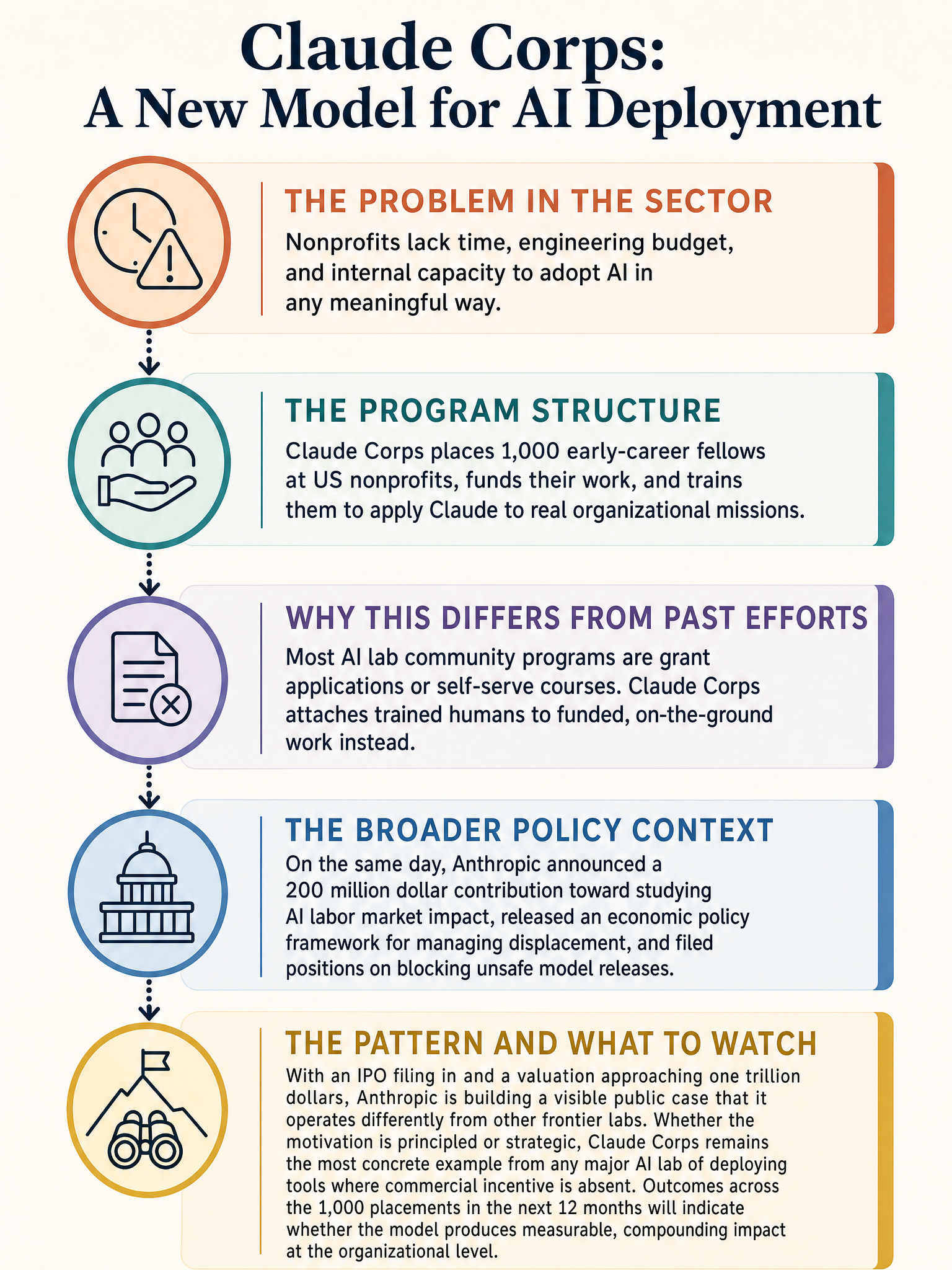
Anthropic has launched the Claude Corps fellowship, a program providing 1,000 early-career professionals with full-time positions to apply artificial intelligence to public benefit projects. Each fellow will receive an annual salary of $85,000 plus benefits for a 12-month term, according to official program details released by the AI safety and research company.
The initiative targets individuals aged 18 and older who have not exceeded two years of full-time professional experience. By embedding a large cohort of AI-literate workers into the public sector and non-profit spaces, Anthropic aims to accelerate the deployment of its Claude LLM models for social good and civic infrastructure.
This move represents a strategic shift in how AI labs approach “AI for Good.” Rather than providing small grants or API credits to existing organizations, Anthropic is directly funding the human capital required to implement these technologies in resource-constrained environments. The program effectively acts as a bridge between high-level AI research and practical, ground-level application in the public interest.
Eligibility and Compensation for Claude Corps Fellows
The Claude Corps program is specifically designed for “early-career” talent. According to the program’s criteria, applicants must be at least 18 years old and possess no more than two years of full-time work experience. This restriction ensures the fellowship reaches those at the start of their professional trajectory, providing them with a high-impact entry point into the AI economy.
Financial terms for the 1,000 positions include a base salary of $85,000 per year. Anthropic has confirmed that this compensation is supplemented by a comprehensive benefits package, though the specific details of health and retirement benefits vary by jurisdiction. The 12-month commitment is structured as a full-time role, requiring fellows to dedicate their professional capacity to the assigned public benefit project.
The scale of the program—1,000 simultaneous roles—is an aggressive expansion of the company’s social impact footprint. For comparison, many corporate fellowships in the tech sector typically range from a few dozen to a few hundred participants. By scaling to 1,000, Anthropic is attempting to create a systemic ripple effect across the non-profit and governmental sectors.
Applying AI to Public Benefit and Civic Infrastructure
The primary objective of the Claude Corps is to move AI from the laboratory to the community. Fellows are tasked with using Claude—Anthropic’s suite of large language models—to solve specific problems within public service, healthcare, education, and environmental protection. This involves not just using the software, but designing workflows and implementing AI-driven solutions that can be sustained after the fellowship ends.
The focus on “public benefit” allows Anthropic to gather diverse data on how its models perform in non-commercial settings. While the company emphasizes the altruistic nature of the program, the deployment of 1,000 experts using Claude in the public sector also serves as a massive real-world test for the model’s utility, safety, and reliability in complex, high-stakes civic environments.
Potential applications for the fellows include automating administrative burdens in local government, improving accessibility to legal services, or enhancing the efficiency of non-profit resource distribution. By placing the “human in the loop” through these fellows, Anthropic mitigates the risks associated with deploying autonomous AI in public services.
The Strategic Role of AI Labs in Social Engineering
The launch of Claude Corps follows a broader trend of AI developers attempting to shape the societal integration of their tools. As models become more capable, the gap between those who can use AI and those who cannot—the “AI divide”—widens. By funding the salaries of 1,000 professionals, Anthropic is attempting to close this gap by injecting expertise directly into the public sector.
This program differs from traditional corporate social responsibility (CSR) in its duration and depth. A year-long, full-time immersion allows fellows to see projects through from conception to implementation. This is a departure from shorter “hackathons” or “innovation challenges” that often result in prototypes that are never actually deployed.
Industry analysts note that such programs also serve as a talent pipeline. By training 1,000 young professionals in the specific nuances of Claude’s capabilities, Anthropic is cultivating a global network of “power users” and advocates who are deeply familiar with their ecosystem, potentially influencing future procurement decisions as governments move toward AI integration.
For those interested in applying or tracking the progress of the fellowships, official updates and application portals are maintained through Anthropic’s primary corporate channels and their dedicated program page.
The next confirmed milestone for the program will be the announcement of the first cohort of selected fellows and the specific public benefit organizations that will host them.
We invite readers to share their thoughts on the impact of AI fellowships in the comments below or share this report with colleagues in the public sector.
Keep reading