
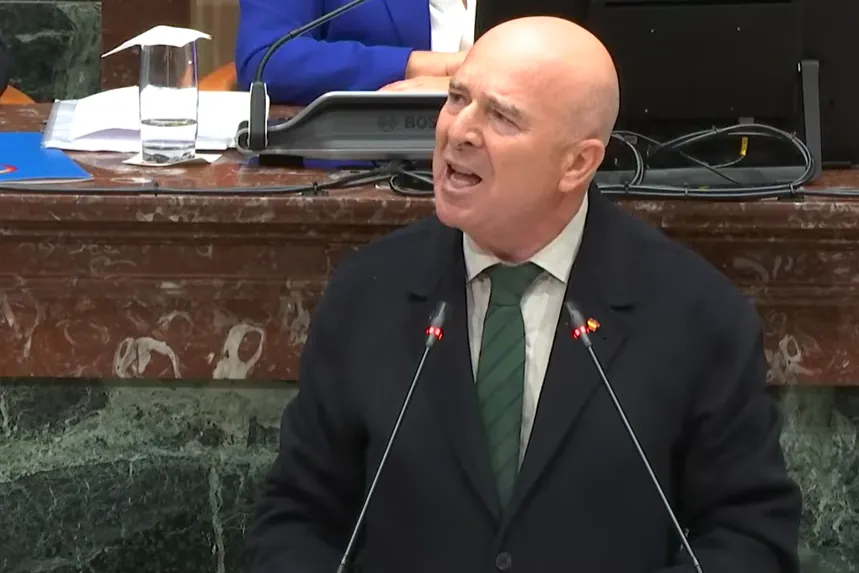
A political firestorm has erupted in the Region of Murcia following provocative remarks made by a Vox deputy during a regional assembly session. Antonio Martínez Nieto has sparked widespread condemnation after suggesting that the fight against abortion and euthanasia may justify the use of violence, a statement that has shifted the focus from a legislative debate on healthcare to a controversy over political rhetoric.
The incident occurred on Wednesday, April 15, 2026, during a session of the Assembly of Murcia. The controversy centers on the Vox deputy’s call to combat abortion and euthanasia, which occurred while the parliament was debating a motion proposed by the People’s Party (PP) regarding the creation of a national law for palliative care.
During his intervention, Martínez Nieto explicitly stated, “Tenemos el deber de combatir, incluso con violencia, la aberración moral del aborto y la eutanasia” (“We have the duty to combat, even with violence, the moral aberration of abortion and euthanasia”). The statement was delivered as part of a broader critique of what the deputy described as the “culture of death,” arguing that current ideologies have turned abortion into an “ordinary contraceptive method.”
The rhetoric has drawn sharp criticism and highlighted deep ideological fractures within the regional parliament. While the session was intended to address the necessity of a state-level framework for palliative care, the discourse devolved into a clash over the fundamental right to life and the legitimacy of political violence.
The Palliative Care Debate and Political Friction
The catalyst for the session was a motion presented by the Partido Popular (PP) that sought to urge the Spanish government to develop a state law for palliative care. However, the motion ultimately failed to pass, as it did not receive support from Vox, the PSOE, or Podemos-IU.

Martínez Nieto used his speaking time to challenge the PP’s approach, questioning how the party could expect a “socialist government,” which he claimed wanted to integrate the “culture of death” into the Constitution, to regulate palliative care according to the PP’s preferences. He argued that any law pushed by the current central government would merely serve as a “reinforcement of euthanasia” rather than a genuine effort to provide dignity in end-of-life care.

Instead of supporting the motion, the Vox representative advocated for the repeal of existing euthanasia laws. He argued that national regulations for palliative care should only be established “when the time comes,” based on criteria of human dignity and respect for life from conception until natural death.
To support his position, the deputy cited the British physician John Langdon Down, the discoverer of Down syndrome, quoting him as saying that a true civilization is judged not by its power or technology, but by its treatment of those who are weak and cannot defend themselves. It was immediately following this reference that Martínez Nieto made his controversial call for the use of violence to combat abortion and euthanasia according to reports from the regional assembly.
Internal Turmoil and Regional Fallout
The fallout from the speech extends beyond the immediate shock of the words. The incident occurs amidst a period of instability for Vox in the Murcia region. Parallel to the parliamentary debate, reports indicate that another Vox deputy in Murcia has left the party to join the Mixed Group, a move that has stripped the party of its ability to block legislation in the regional parliament.
the party is facing internal pressure. José Ángel Antelo has demanded an extraordinary congress for Vox in Murcia, criticizing the party’s leadership. Antelo has gone as far as to claim that the party’s current structure “resembles a limited company (SL) more than a political party,” suggesting a disconnect between the party’s grassroots and its regional leadership.
The reaction from other political factions has been one of alarm. María del Carmen Ruiz Jódar, a deputy for the PP, lamented the current state of Spanish legislation, noting that while the country possesses a “law to die,” it lacks a comprehensive law that guarantees a dignified life until the very end. She emphasized that the pursuit of palliative care should be a “common space” rather than a “political battlefield.”
Key Takeaways from the Assembly Session
- The Statement: Antonio Martínez Nieto (Vox) claimed a duty to fight abortion and euthanasia “even with violence.”
- The Context: The remarks were made during a debate over a PP motion for a national palliative care law.
- The Outcome: The PP’s motion failed to pass due to lack of support from Vox, PSOE, and Podemos-IU.
- Party Instability: Vox is facing internal conflict, with calls for an extraordinary congress and the loss of a deputy to the Mixed Group.
Analysis: The “Culture of Death” Rhetoric
The term “culture of death” used by Martínez Nieto is a recurring theme in the ideological framework of Vox and other conservative movements. It refers to the legal permit of abortion and euthanasia, which the party views as an affront to the sanctity of life. By framing these medical and legal procedures as “moral aberrations,” the deputy positioned the struggle against them as a moral imperative.
However, the introduction of the word “violence” into a parliamentary setting is highly irregular and legally sensitive. In a democratic framework, the “combat” against legislation is typically understood as a legislative, judicial, or electoral process. The suggestion that violence is a legitimate tool for achieving political or moral goals marks a significant escalation in rhetoric that has led observers to claim Vox has “crossed a red line.”
This escalation reflects a broader tension in Spanish politics regarding the balance between religious-conservative values and the secular laws governing reproductive rights and end-of-life decisions. The failure of the PP’s motion further illustrates the difficulty of finding a middle ground between those who want to regulate palliative care as a separate medical necessity and those who see any such regulation as a “trojan horse” for euthanasia.
For those seeking more information on the legal status of palliative care or the current laws regarding euthanasia and abortion in Spain, official government portals and the Spanish Constitution provide the primary legal framework. The debate in Murcia serves as a microcosm of the national struggle to define the limits of “dignity” in medical practice.
As the regional assembly continues its term, the focus will likely remain on whether the leadership of Vox in Murcia will address the internal demands for a congress and how the party will respond to the backlash regarding the call for violence. There are currently no scheduled hearings specifically to sanction the deputy, but the political pressure from both opposing parties and internal dissidents continues to mount.
World Today Journal encourages readers to share their thoughts on the intersection of political rhetoric and legislative debate in the comments section below.