Apple’s M5 Pro and M5 Max Chips: A New Architecture for Professional Workflows
Apple has unveiled its latest silicon, the M5 Pro and M5 Max chips, designed to power the newest generation of MacBook Pro laptops. Announced on March 3, 2026, these chips represent a significant leap forward in performance and efficiency for professional users, particularly those engaged in demanding tasks like video editing, 3D rendering, and artificial intelligence development. The introduction of a new “Fusion Architecture” marks a departure from previous designs, combining two dies into a single system on a chip (SoC) to deliver increased processing power. This move comes as the demand for more powerful and efficient laptops continues to grow, especially within the creative industries.
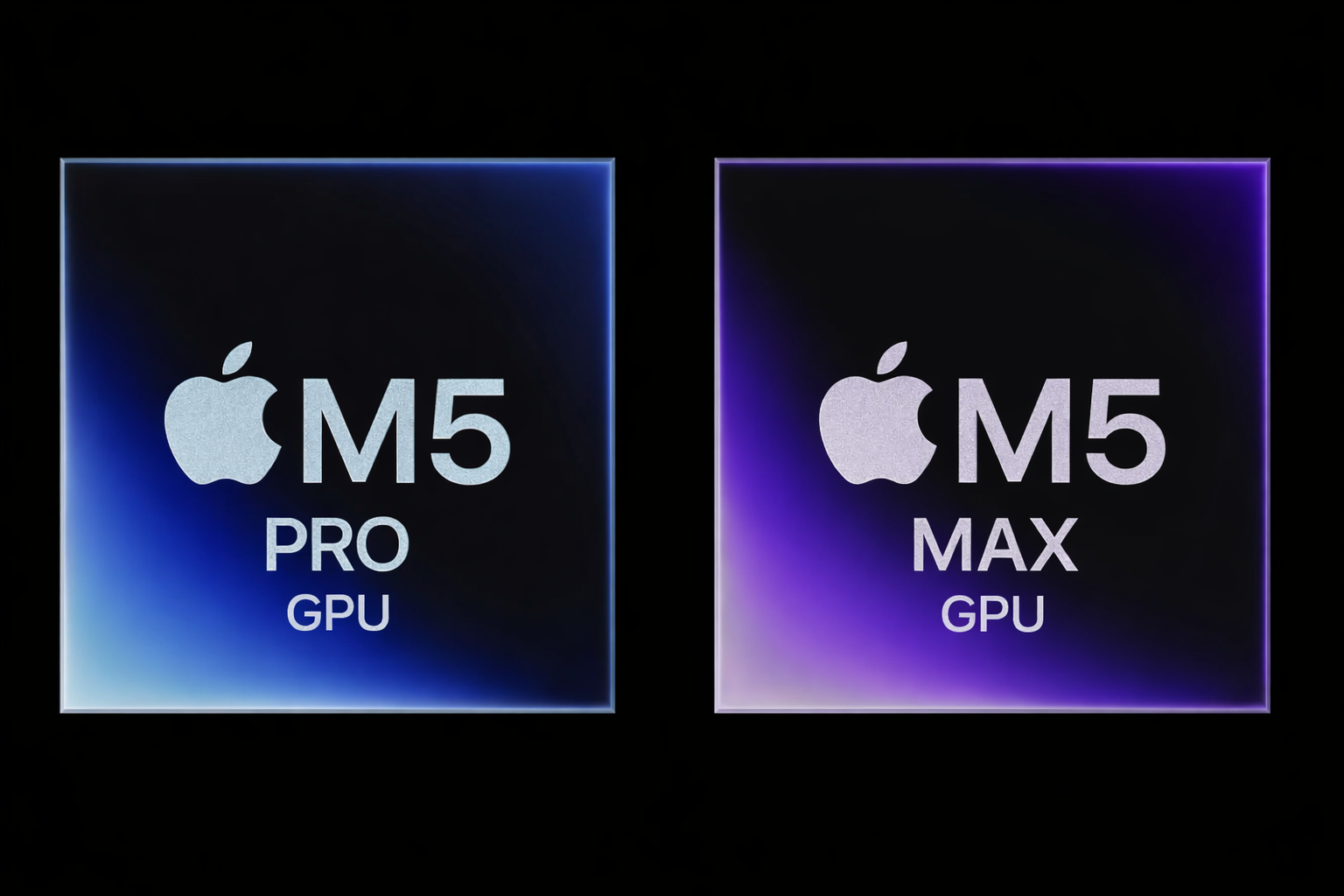
The M5 Pro and M5 Max aren’t simply incremental upgrades; they represent a fundamental shift in Apple’s chip design philosophy. Instead of a monolithic design, Apple now utilizes two interconnected dies – essentially a CPU and a GPU – within a single package. This approach allows for greater scalability and performance, enabling the chips to handle increasingly complex workloads. The new chips are built using a 3nm process, the third generation of this technology, further enhancing efficiency and power delivery. The M5 Pro is available with either a 16-core or 20-core GPU, while the M5 Max boasts a 32-core or 40-core GPU configuration, offering users a range of options to suit their specific needs.
Fusion Architecture and CPU Performance
At the heart of the M5 Pro and M5 Max lies the new Apple-designed Fusion Architecture. This innovative design connects two dies with advanced IP blocks, creating a single SoC that integrates a powerful CPU, scalable GPU, Media Engine, unified memory controller, Neural Engine, and Thunderbolt 5 capabilities. The CPU features an 18-core architecture, comprised of six “super cores” – Apple’s fastest CPU cores to date – alongside twelve all-new performance cores optimized for power-efficient, multithreaded workloads. According to Apple, this combination results in a performance boost of up to 30 percent for professional applications. Apple’s press release details these performance gains, highlighting the chip’s ability to handle complex tasks with greater speed and efficiency.
GPU Power and AI Capabilities
The GPU in the M5 Pro and M5 Max also sees a significant upgrade, scaling the next-generation architecture introduced in the M5 to an up-to-40-core configuration. Each GPU core now includes a Neural Accelerator, and the chips benefit from higher unified memory bandwidth. This translates to over four times the peak GPU compute for AI tasks compared to the previous generation. The increased graphics capabilities provide up to a 35 percent improvement in applications utilizing ray tracing, enhancing visual effects and 3D rendering. This is particularly crucial for professionals working with visually intensive software, such as those used in film, animation, and game development.
Memory and Connectivity
Unified memory remains a key advantage of Apple’s silicon, and the M5 Pro and M5 Max continue this trend. The shared memory architecture allows the CPU, GPU, and Neural Engine to access the same pool of data without copying, resulting in faster performance and reduced latency. This is especially beneficial for large projects where limited VRAM can become a bottleneck in traditional discrete GPU setups. The new chips also feature Thunderbolt 5 support, offering faster data transfer speeds and increased connectivity options. MacRumors’ review highlights the increased SSD speeds, now starting at 1TB and reaching up to twice the speed of the previous generation, with read speeds of up to 13.6 GB/s and write speeds of up to 17.8 GB/s.
Performance Benchmarks and Real-World Usage
Early benchmark results indicate that the M5 Pro and M5 Max deliver on Apple’s promises. Geekbench 6 scores for the M5 Pro and M5 Max range from 28,500 to 29,500 in multi-core CPU tests, surpassing the previous generation M4 Pro and M4 Max chips. As reported by MacRumors, these scores position the new chips favorably against competitors, although direct comparisons are complex due to differing architectures and testing methodologies.
Reviews from publications like CNET praise the performance gains, particularly in GPU-intensive tasks and generative AI applications. The 16-inch MacBook Pro models equipped with the M5 Pro and M5 Max are described as offering “peak creative power,” capable of handling demanding workflows with ease. However, some reviewers note that the laptops can get loud and hot under heavy load, and that performance can drop significantly in low-power mode. Battery life has also seen a slight increase, with some tests showing up to 24 hours of use.
Power Consumption and Thermal Management
While the M5 Pro and M5 Max offer impressive performance, they also require significant power. Tests indicate that the 20-core M5 Pro GPU can consume up to 38 watts, while the 40-core M5 Max GPU can draw as much as 72 watts. However, the 14-inch MacBook Pro model may throttle performance to maintain thermal limits, dropping from 72 watts to 44 watts even in high-performance mode. This suggests that the larger 16-inch model may be better suited for sustained, demanding workloads.
Wi-Fi and Bluetooth Improvements
The new MacBook Pro models also benefit from updated wireless connectivity. The inclusion of the N1 chip provides support for Wi-Fi 7 and Bluetooth 6, offering faster and more reliable wireless performance. This is particularly important for professionals who rely on wireless networks for collaboration and data transfer.
Looking Ahead
The M5 Pro and M5 Max represent a significant step forward in Apple’s silicon development. The new Fusion Architecture, combined with the enhanced CPU and GPU performance, positions these chips as a compelling option for professional users. As software continues to evolve and take advantage of the increased processing power and AI capabilities, the M5 Pro and M5 Max are likely to become even more valuable tools for creative professionals. The next key development will be observing how third-party software developers optimize their applications to fully leverage the capabilities of Apple’s latest silicon.
Apple continues to push the boundaries of laptop performance with its custom silicon. The M5 Pro and M5 Max chips are a testament to the company’s commitment to innovation and its focus on providing professional users with the tools they need to succeed. Keep an eye on Apple’s website for further updates and software compatibility information.
Worth a look
- Get the ORICO Zinc Alloy Dual-Port 64GB USB-A/USB-C Flash Drive for Just $14.50
- Square Enix and PlayStation Launch Major Summer Sales with Up to 80% Off Dragon Quest, SaGa, and Yakuza Series
- Apple Earnings Preview: Stock Eyes New Record Highs (archyde.com)
- Apple Earnings Preview: Stock Nears Record Ahead of Q4 Report (world-today-news.com)