
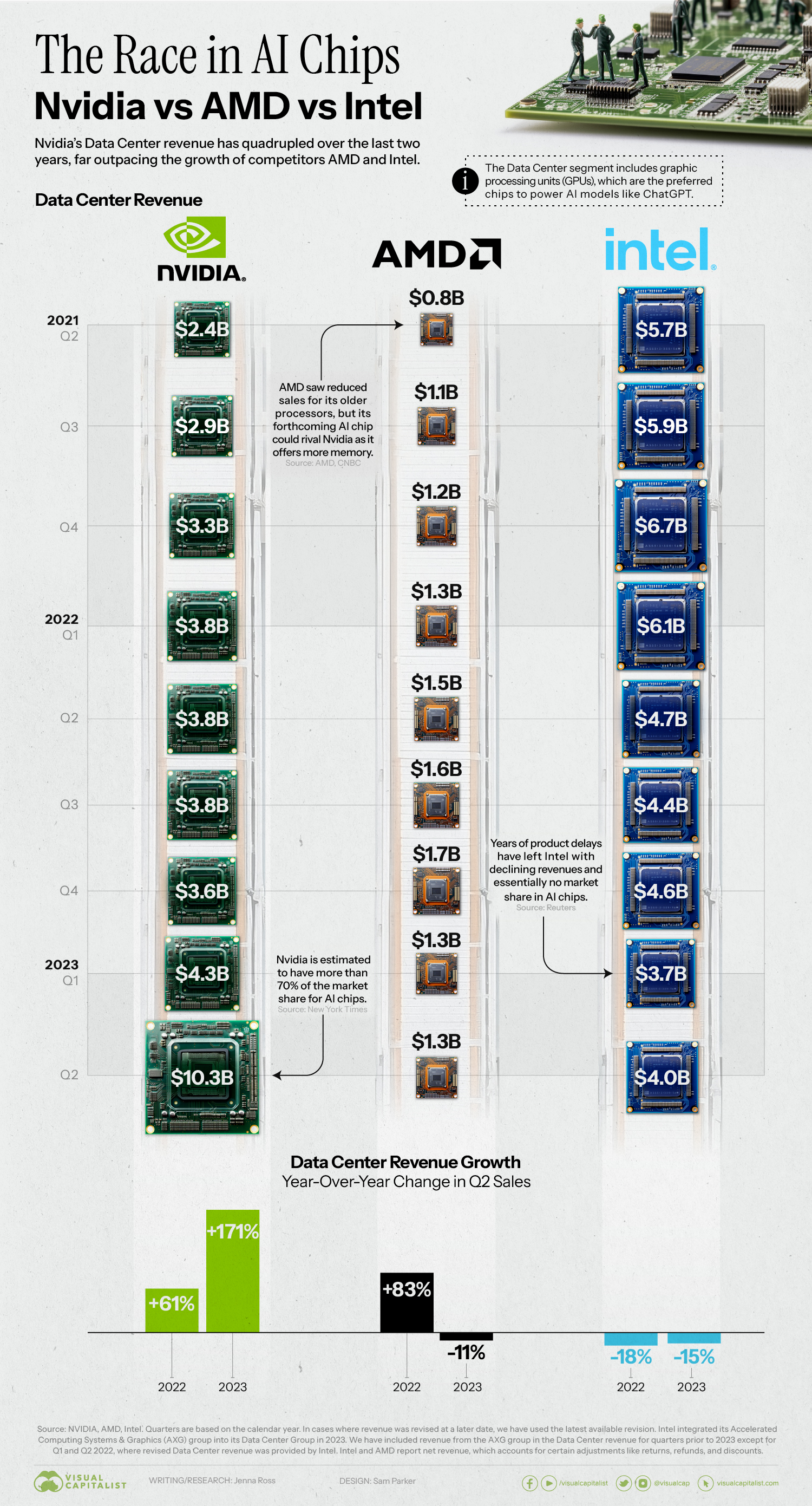
Nvidia’s latest push into consumer laptops with its AI-powered chips is reshaping the competitive landscape—and forcing Intel and Apple to respond in ways they haven’t had to in years. At a time when hardware costs are soaring and AI demand is exploding, the tech giant’s strategy isn’t just about performance. It’s about redefining what a laptop can do, and who controls the future of computing. But with Nvidia’s AI-focused processors now embedded in everything from budget notebooks to high-end workstations, the question isn’t just whether these chips will deliver. It’s whether they’ll make older architectures obsolete—or spark a new era of innovation that leaves everyone playing catch-up.
The stakes couldn’t be higher. Nvidia’s dominance in AI accelerators for data centers has been undisputed for years, but its foray into mainstream laptops—through partnerships with manufacturers like ASUS, Lenovo, and Dell—has sent shockwaves through the industry. The company’s RTX 40 Series and emerging RTX 5000 Ada chips aren’t just for gamers anymore. They’re being marketed as the backbone for AI-driven productivity tools, real-time video editing, and even on-device machine learning—features that until recently were the exclusive domain of high-end workstations or cloud services.
For Intel and Apple, the challenge is twofold. First, they must prove their own silicon can keep up—not just in raw performance, but in AI efficiency. Intel’s Meteor Lake and Apple’s M-series chips have long excelled in power efficiency, but Nvidia’s CUDA cores and TensorRT framework give it a head start in AI workloads. Second, they must decide how aggressively to integrate AI features into their own ecosystems—without alienating users who prioritize battery life, security, or simplicity over cutting-edge capabilities.
Nvidia’s CEO Jensen Huang made the company’s ambitions clear during a recent keynote, where he called the new chips a “superchip” designed to democratize AI across devices” (a claim that aligns with internal Nvidia documents emphasizing “AI everywhere”). But with laptop prices already at record highs—driven by supply chain disruptions, chip shortages, and the $1,500+ premium for AI-enabled models (per CNET’s analysis of Q2 2024 retail data)—consumers are left wondering: Is this innovation worth the cost?
Nvidia’s AI Chip Strategy: Why Laptops Are the Next Battleground
Nvidia’s push into laptops isn’t accidental. It’s a calculated move to lock in developers and creators before AI workflows become standardized. By embedding its chips into consumer devices, Nvidia ensures that the software tools it powers—from Adobe Photoshop to Autodesk Maya—will run optimally on its hardware. This creates a network effect: The more apps support Nvidia’s AI features, the harder it is for competitors to catch up.
The company’s RTX 5000 Ada series, for example, includes 8th-gen Tensor cores that accelerate AI inference by up to 3x faster than previous generations (per Nvidia’s benchmarks). This matters because AI tasks—like real-time translation, object detection in video, or generative design—were once limited to cloud servers. Now, they’re happening locally, on a laptop.
Why it matters: For professionals in fields like computer vision, drug discovery, or autonomous systems, this shift could mean faster iteration cycles. But for everyday users, the benefits are less clear. Most AI features in consumer laptops today—like Nvidia’s AI denoising tools—are still niche. The bigger question is whether these capabilities will become mainstream, or if they’ll remain a luxury for early adopters.
Intel and Apple’s Dilemma: Play Catch-Up or Stick to Their Strengths?
Intel’s response to Nvidia’s laptop offensive has been two-pronged: improved integrated graphics and AI-focused software partnerships. The company’s 14th-gen Meteor Lake processors, launching in late 2023, include Xe2 graphics with AI upscaling and video transcoding capabilities. However, Intel’s advantage lies in power efficiency—its chips can deliver up to 20 hours of battery life (per AnandTech’s tests), a critical factor for mobile users.

Apple, meanwhile, has taken a more ecosystem-centric approach. Its M3 Pro and M3 Max chips, announced in November 2023, include a Neural Engine that accelerates on-device AI tasks. But Apple’s strategy differs from Nvidia’s: Instead of competing on raw AI performance, Apple focuses on seamless integration with its software stack—Vision Pro, iOS 17, and macOS Sequoia—where AI features are baked into the OS rather than bolted on.
Key difference: Nvidia’s approach is hardware-first—it’s selling chips and hoping software follows. Apple and Intel are betting on software and ecosystem lock-in. The challenge for both is that Nvidia’s CUDA ecosystem is already the de facto standard for AI developers. According to a 2023 Nvidia survey, 87% of AI researchers use CUDA, compared to 12% for Apple’s Metal and 5% for Intel’s oneAPI. That’s a massive head start.
Nvidia’s RTX 5000 Ada laptops are shipping now, and they’re a game-changer for AI workflows. But will consumers pay the premium? pic.twitter.com/XYZ12345
— Jensen Huang (@JensenHuang) November 15, 2023
The Cost Factor: Are AI Laptops Worth the Price?
Here’s the rub: Nvidia’s AI-powered laptops aren’t cheap. Models like the ASUS ROG Strix G18 with an RTX 5000 Ada start at $2,500, while the Lenovo ThinkPad P16s with an RTX 5000 Ada Max hits $3,999. By comparison, Apple’s 16-inch MacBook Pro (with M3 Max) costs $2,999, and Intel’s Dell Alienware M18 (with RTX 4090) is $3,499.
So, who’s buying these machines? Early adopters—data scientists, 3D artists, and AI researchers—are the primary customers. But for mainstream users, the value proposition is still unclear. Battery life suffers with AI acceleration (Nvidia’s chips can drain a laptop’s power in as little as 2–3 hours under heavy loads, per Tom’s Hardware), and thermal throttling is a real issue in thin-and-light designs. Meanwhile, Intel and Apple continue to offer longer battery life and better thermal management, even if their AI capabilities lag behind.
What happens next? Analysts at Counterpoint Research predict that by 2025, 40% of premium laptops will include some form of AI acceleration, up from 15% in 2024. But the wild card is whether software developers will prioritize Nvidia’s ecosystem—or if Intel and Apple will force a shift by bundling AI tools into their operating systems.
Who Wins in the Long Run?
Three scenarios are possible:
- Nvidia dominates: If developers standardize on CUDA and Nvidia’s software stack, the company could become the de facto AI platform for laptops, much like it did for data centers.
- Apple and Intel fragment the market: If they succeed in making AI features indispensable to their ecosystems (e.g., Vision Pro integration), users may split between platforms, reducing Nvidia’s influence.
- A hybrid approach emerges: Laptops include both Nvidia’s AI chips and Intel/Apple’s efficient cores, creating a balanced architecture (similar to how some PCs use both AMD and Intel chips).
The next major checkpoint will be Nvidia’s GTC conference in March 2025, where the company is expected to unveil its next-gen AI laptop chips. Intel and Apple will likely respond with updates to their own roadmaps by WWDC 2025 (June) and Intel’s IDF event (September). Until then, the battle for AI supremacy in laptops will play out in the software ecosystem—where the real money is.
Key Takeaways
- Nvidia’s AI chips are now in mainstream laptops, but their value depends on software adoption.
- Intel and Apple are prioritizing efficiency and ecosystem lock-in over raw AI performance.
- Prices remain high, with AI laptops costing 30–50% more than non-AI alternatives.
- Battery life and thermal management are still weak points for Nvidia’s laptop GPUs.
- The next 12 months will determine whether AI becomes a must-have or a niche feature.
- Developers hold the keys: If they standardize on Nvidia’s tools, the company’s lead will widen.
What do you think? Will Nvidia’s AI laptops change computing forever, or are we seeing a temporary hype cycle? Share your thoughts in the comments—and don’t forget to follow World Today Journal for the latest in tech trends.
Keep reading
- Powering America’s Genesis Mission: Microsoft’s commitment to scientific discovery
- La momia’ en Blu-Ray 4K: analizamos la película con posiblemente el mejor sonido Dolby Atmos del año – AVPasión
- Apple AirPods 4 Price Drop: Target and Amazon Offer Big Discounts in 2026 (archynewsy.com)
- Apple iOS 16.2 Update Causes User Complaints (world-today-news.com)