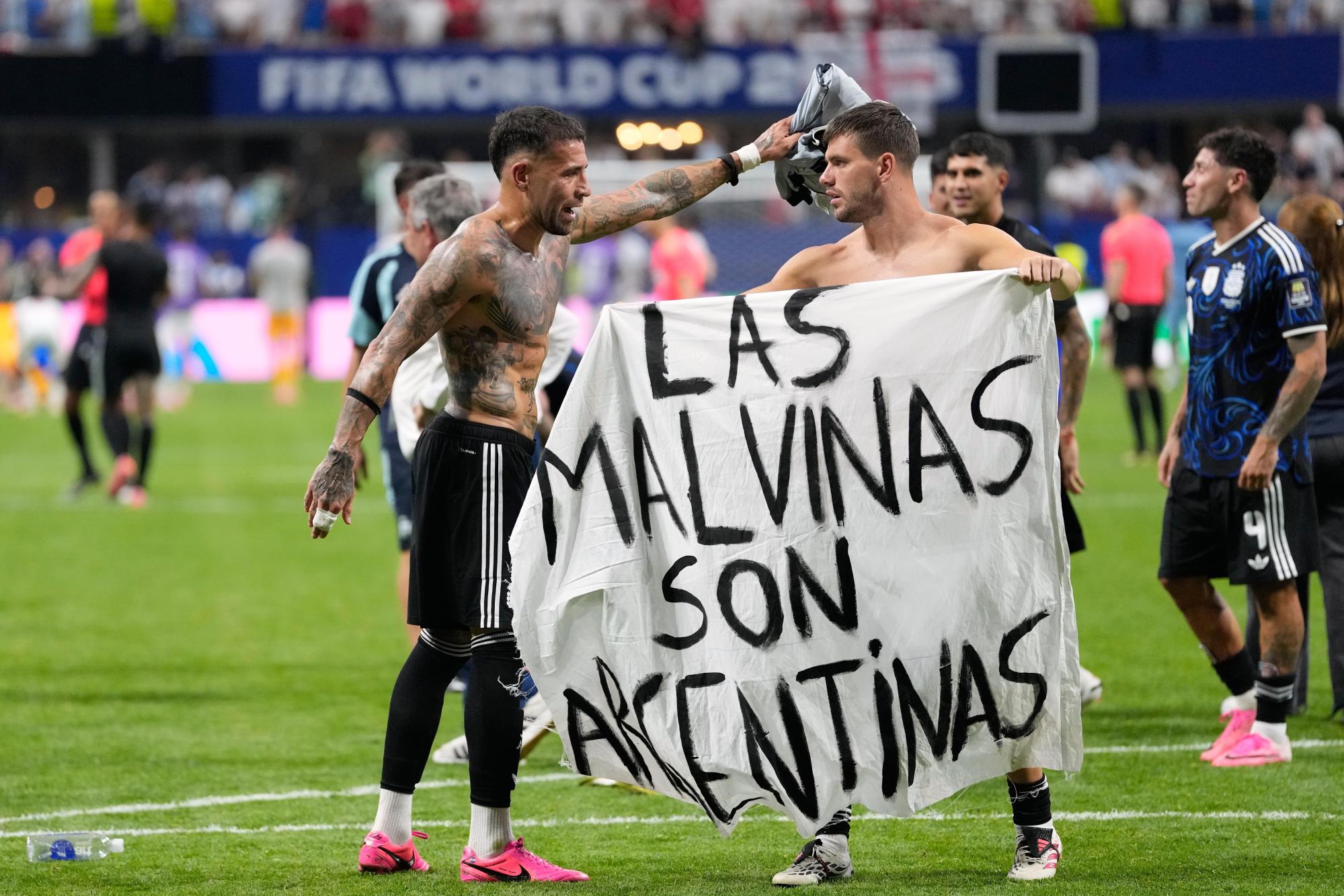
The British government swiftly urged FIFA to investigate the display, while the slogan ignited a massive commercial and cultural phenomenon across South America.
Atlanta Semifinal Celebration Sparks U.K. Outrage and FIFA Probe Calls
Following Argentina’s 2-1 win over England at Mercedes-Benz Stadium, several members of the Argentine squad celebrated by holding up a hand-painted banner handed to them by supporters in the stands. The white sheet featured bold black lettering reading Las Malvinas son Argentinas
—translating to “The Malvinas are Argentine.” Midfielder Giovani Lo Celso initially pulled open the banner, with assistance from teammates Nicolás Otamendi, Cristian Romero, and Lisandro Martínez before virtually the entire team stood behind it.
The display drew an immediate backlash from British officials. U.K. Business Secretary Peter Kyle described the players’ behavior as entirely inappropriate.
On Thursday, the British government formally urged FIFA to investigate the team.
Regulatory Scrutiny Under FIFA Disciplinary Codes
FIFA’s disciplinary code strictly prohibits the display of political, ideological, religious, or offensive messages at stadiums. Under competition rules, fines for political messaging typically range from $5,000 to $20,000, though historical penalties vary.
Precedent exists for sharper sanctions in international competition. During the 2012 London Olympics, a South Korea player was banned for two World Cup qualifying games after displaying a territorial banner regarding disputed islands following a match against Japan.
Presidential Reactions and Player Perspectives
Argentine President Javier Milei defended the celebration during a local Buenos Aires radio interview, calling the banner perfectly valid
and asserting that the message reflects a sentiment shared by all Argentines.
However, Milei acknowledged that the impulsive act would likely prompt disciplinary discussions, stating, What the players do is understandable; they get carried away by their emotions, they act on impulse, and that will likely lead to discussions about a fine.
Vice President Victoria Villarruel offered stronger support on social media, writing, They banned us from bringing (signs) into the stadium, forgetting that we carry them in our blood and in our hearts.
And it hurts.
Lisandro Martínez added, We couldn’t let the Argentine people down.
Argentina coach Lionel Scaloni had previously attempted to distance the athletic fixture from geopolitical tensions, declaring before the match that mixing the two would be crazy.
Commercial Boom and Historical Context Across Argentina
While international sports bodies weigh sanctions ahead of Sunday’s World Cup final against Spain, the banner triggered a commercial boom across Argentina. Small businesses have struggled to keep pace with consumer demand for T-shirts, tote bags, sneakers, and jerseys featuring the slogan. Citizens across Buenos Aires and other cities have downloaded Malvinas Sans,
a digital typeface modeled directly on the hand-painted lettering of the stadium banner.
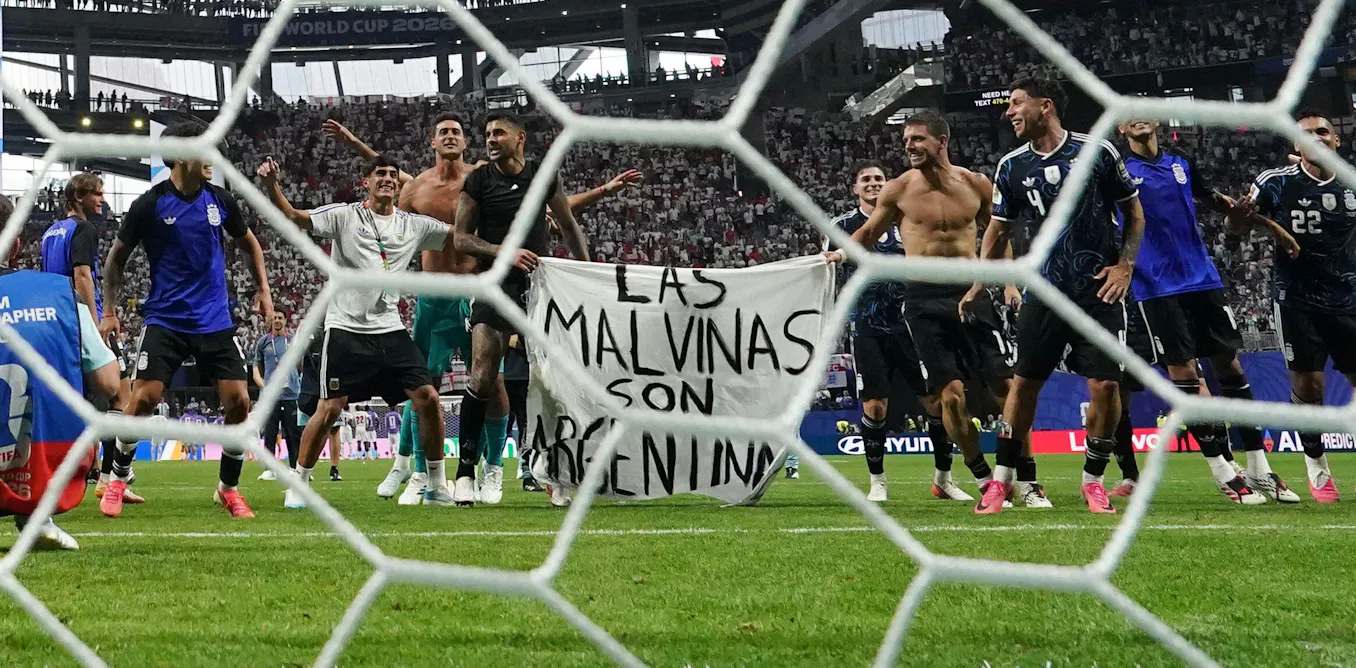
The South Atlantic archipelago, located roughly 300 miles off the coast of Argentina and 8,000 miles from the United Kingdom, has remained a point of contention since British forces expelled Argentine forces in 1833. The territorial dispute erupted into a 10-week war in 1982 under Argentina’s military dictatorship, resulting in the deaths of 649 Argentine troops, 255 British service personnel, and three islanders. Today, the British overseas territory is home to approximately 3,500 residents, roughly 450,000 sheep, and over a million penguins.
Edgardo Esteban, an author and veteran of the 1982 conflict, noted that the cultural crossover has introduced younger generations to the history. The World Cup is now over, and yet people are still talking about the Malvinas because the Malvinas somehow became part of the World Cup,
Esteban said. Kids in schools are asking me, ‘What’s this Malvinas thing?’ Now there’s a passing of the torch.
Related reading