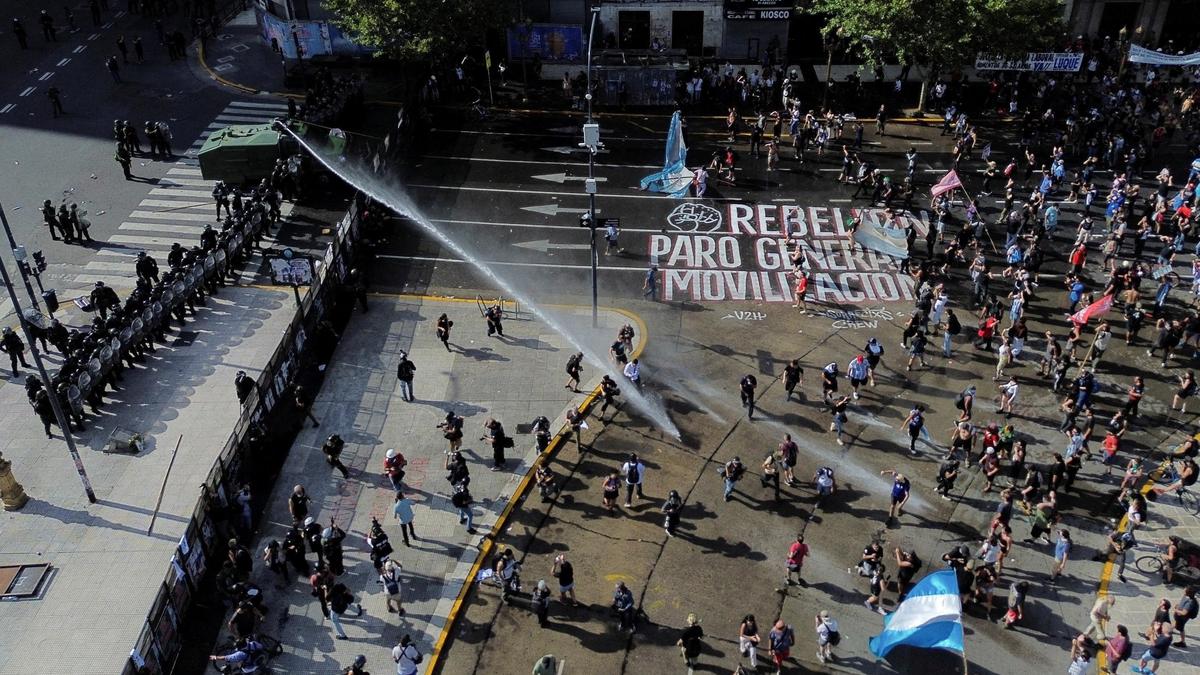
Buenos Aires – A general strike brought Argentina to a standstill on Thursday, February 19, 2026, as workers protested against President Javier Milei’s sweeping labor reforms. The nationwide action, the fourth of Milei’s presidency, saw disruptions to public transportation, healthcare, and essential services, and was marked by clashes between protesters and police in the capital. The reforms, which have already been approved by the Chamber of Deputies, aim to overhaul Argentina’s labor laws, making it easier for employers to hire and fire staff, and reducing worker protections.
The strike underscores the growing tension between Milei’s libertarian government and the country’s powerful labor unions. Milei, who assumed office in December 2023, has pledged to drastically reduce public spending and implement free-market policies to address Argentina’s chronic economic woes, including soaring inflation. His administration has achieved some success in curbing inflation, bringing it down from 150 percent to 32 percent in two years, according to the Associated Press, but these gains have come at the cost of job losses and a decline in disposable income.
Disruptions Across the Nation
The impact of the 24-hour strike was widespread. Reports indicated that many buses were not running in Buenos Aires, leading to heavy traffic as commuters sought alternative transportation. Dozens of flights were cancelled, and train stations were largely deserted. Small groups of protesters blocked roads leading into the capital, further exacerbating the disruption. The CGT labor federation, a major force in Argentine politics, claimed a high level of adherence to the strike call, stating it was the strongest turnout under Milei’s government. Union leader Jorge Sola told Radio con Vos that “90 percent of activity had stopped,” though this claim has not been independently verified.
The disruption extended beyond transportation. Shops and supermarkets remained closed, and garbage collection was suspended, leaving streets littered with refuse. Essential services, including hospitals, experienced staffing shortages, potentially impacting patient care. The scale of the disruption highlights the significant influence of Argentina’s labor unions and the potential challenges Milei faces in implementing his economic agenda.
Clashes in Buenos Aires
The protests escalated into clashes outside the Argentine Congress in Buenos Aires. Several thousand demonstrators gathered to voice their opposition to the labor reforms, and a small group engaged in running battles with police. Protesters reportedly threw bottles and stones at officers, who responded with tear gas, water cannons, and rubber bullets. The Associated Press reported that police made approximately a dozen arrests during the confrontations.
The government’s response to the protests has drawn criticism from some quarters. On Tuesday, February 17, 2026, the Security Ministry issued a statement warning reporters about the “risk” of covering the demonstrations and announced the establishment of an “exclusive zone” for media coverage, stating that “in the event of acts of violence, our forces will act.” This move raised concerns about potential restrictions on press freedom and the government’s willingness to tolerate dissent.
The Contentious Labor Reforms
The proposed labor reforms are at the heart of the conflict. The measures, approved by the Chamber of Deputies and now awaiting a final vote in the Senate, would significantly alter Argentina’s labor landscape. Key provisions include easing restrictions on hiring and firing, reducing severance pay, limiting the right to strike, increasing work hours, and restricting holiday provisions. The government argues that these changes are necessary to stimulate economic growth and reduce unemployment, while unions contend that they will erode worker protections and exacerbate inequality.
Almost 40% of Argentine workers currently lack formal employment contracts, leaving them vulnerable to exploitation and without access to benefits. Unions fear that the reforms will further increase the number of workers in precarious employment situations. However, the government maintains that the reforms will encourage businesses to formalize employment relationships by lowering the tax burden on employers and reducing the costs associated with hiring.
Economic Context and Milei’s Agenda
The strike comes against a backdrop of economic challenges in Argentina. The country’s manufacturing sector is showing signs of a downturn, with over 21,000 companies having closed in the two years since Milei took office. The recent closure of Fate, Argentina’s main tire factory, on February 18, 2026, resulting in 900 job cuts, has further fueled anxieties about the state of the economy.
Milei’s economic policies, characterized by austerity measures and a commitment to free-market principles, have drawn comparisons to those of former U.S. President Donald Trump. He famously wielded a chainsaw at rallies during the 2023 election campaign to symbolize his intention to drastically cut public spending. Unions estimate that approximately 300,000 jobs have been lost since Milei’s austerity measures were implemented. Milei’s alignment with Trump is further evidenced by his recent trip to Washington, where he attended the inaugural session of Trump’s “Board of Peace” initiative and is scheduled to participate in a regional summit in Miami on March 7, as reported by The Independent.
Balancing Act with China and the US
Milei’s close ties with Trump are occurring as he attempts to navigate a complex relationship with China, Argentina’s top trading partner. Despite previously making critical remarks about the Chinese government, Milei’s administration has not distanced itself from Beijing economically. In December 2025, China surpassed Brazil as Argentina’s largest trading partner, with Argentine exports to China surging by 125% year-on-year and imports increasing by 26%. According to the Independent, experts suggest that Milei cannot afford to alienate China due to its significant demand for South American resources.
This delicate balancing act reflects the broader geopolitical dynamics at play in Latin America, where the United States is seeking to counter Chinese influence. Milei’s participation in Trump’s initiatives is seen as a signal of his willingness to align with Washington, but his economic pragmatism suggests that he will continue to prioritize trade relations with Beijing.
What’s Next?
The labor reform bill will now return to the Senate for a final vote. The outcome of that vote remains uncertain, and further protests are likely if the bill is approved in its current form. The government’s handling of the situation will be closely watched by both domestic and international observers. The next key date to watch is the Senate vote, currently unscheduled but expected within the coming weeks.
The ongoing conflict between Milei’s government and the labor unions highlights the deep divisions within Argentine society and the challenges facing the country as it seeks to address its economic and social problems. The situation underscores the importance of finding a sustainable path to economic growth that protects the rights of workers and promotes social justice.
Do you have thoughts on the situation in Argentina? Share your perspectives in the comments below, and please share this article with your networks.
Related reading