
Massive crowds descended upon the Plaza de Mayo and streets across Argentina this week, marking one of the most significant mobilizations against the administration of President Javier Milei. The Argentina university funding protests have evolved from localized student grievances into a national movement, as hundreds of thousands of students, professors, and union members demand the restoration of budgets for the country’s public higher education system.
At the heart of the unrest is a fundamental clash between the libertarian fiscal discipline of the Milei government and a deeply ingrained Argentine cultural tradition: the right to free, high-quality public university education. For many protesters, the current budget cuts represent more than just a fiscal adjustment; they view them as an existential threat to social mobility and the intellectual future of the nation.
The demonstrations, which saw massive turnouts in Buenos Aires, Cordoba, Mendoza, and Tucuman, highlight a growing political crisis. While the government maintains that spending must be slashed to curb hyperinflation and stabilize the economy, the academic community argues that defunding universities during a period of extreme inflation effectively renders the institutions unable to function.
The Legislative Tug-of-War Over University Budgets
The current standoff is the result of a complex legislative battle. In a bid to address the crumbling infrastructure and stagnant salaries of university staff, the Argentine Congress previously approved legislation designed to fund operational costs and adjust teacher salaries to keep pace with the country’s soaring inflation rates. These measures were intended to prevent the collapse of public institutions that serve millions of students from diverse socioeconomic backgrounds.
However, President Javier Milei exercised his executive power to veto these funding laws. The administration argued that such spending contradicted its strict “zero deficit” fiscal policy, which is the cornerstone of Milei’s plan to stabilize the Argentine peso and lower inflation. The government’s position is that no sector of society, including the university system, is exempt from the austerity measures required to rescue the national economy.
The conflict intensified when the parliament moved to overturn the presidential veto. In the Argentine system, a two-thirds majority in both chambers can override a veto, effectively forcing the law into effect. Despite the legislative victory for the universities, the executive branch has continued to resist the implementation of the funds, leading to a legal and political stalemate that has spilled into the streets.
This stalemate is particularly acute because public universities in Argentina are not only free for students but are also autonomous. This autonomy means that while the state provides the funding, the universities manage their own internal affairs. The government’s refusal to release the approved funds is seen by academic leaders as a violation of this constitutional autonomy.
Scale of Mobilization and Student Sentiment
The scale of the protests has been staggering. In Buenos Aires alone, organizers estimated that approximately 600,000 people gathered in and around the Plaza de Mayo, with total nationwide participation estimated at 1.5 million people. These figures reflect a broad coalition of support, extending beyond students to include university staff, labor unions, and various opposition political groups.
For the students, the stakes are personal. With inflation eroding the purchasing power of the middle and lower classes, the cost of textbooks, transportation, and housing has skyrocketed. Without updated funding for university services and scholarships, many students face the prospect of dropping out. Protesters have described the university system as a “source of pride” and a critical engine for the country’s development.
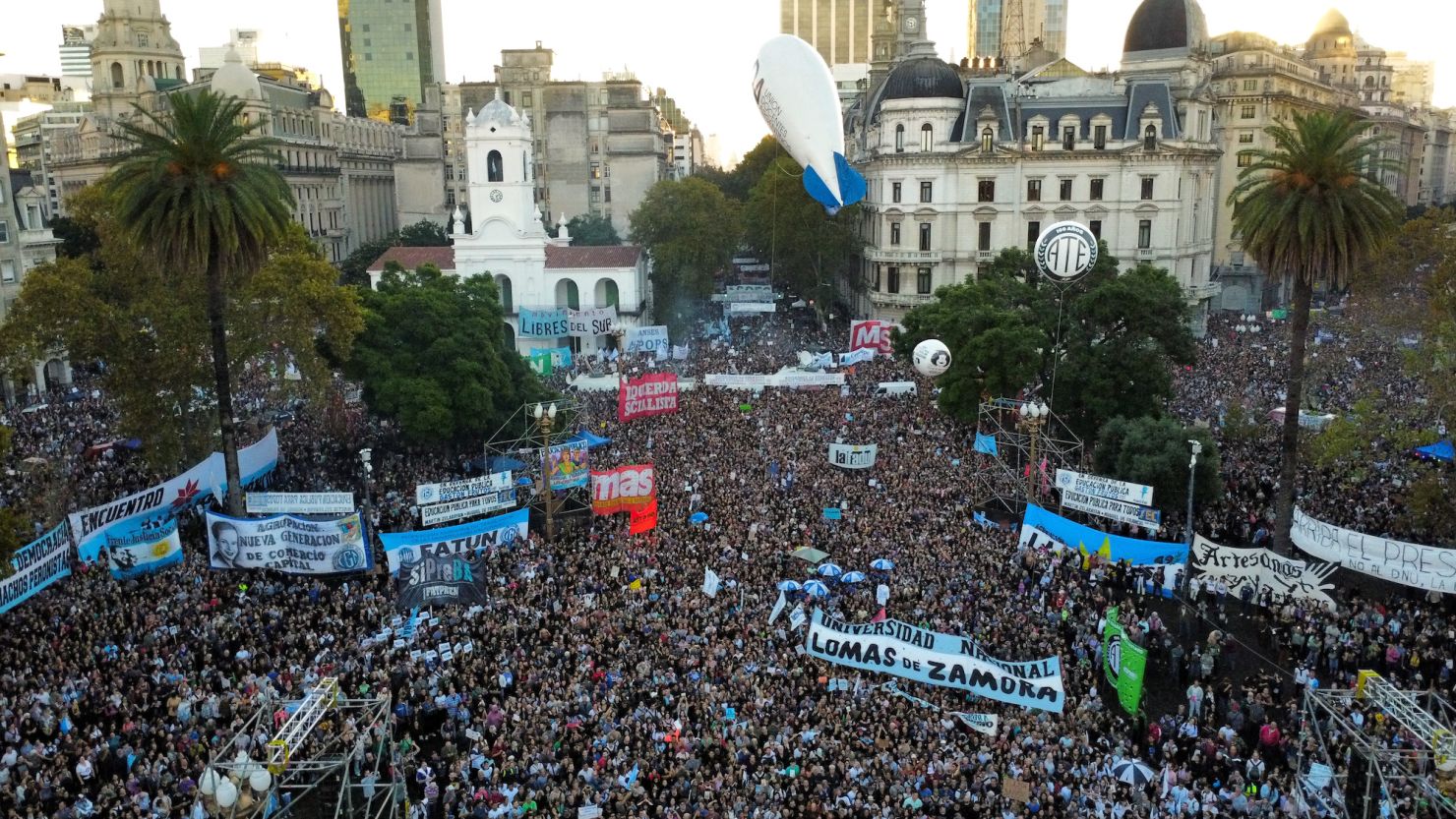
The imagery of the protests has been poignant, with students carrying books and banners emphasizing that education is a public good rather than a commodity. The sentiment expressed in the streets is that the government is not merely cutting a budget, but is actively dismantling the dreams of thousands of young Argentines who rely on public education to escape poverty.
The mobilization also serves as a barometer for the general public’s tolerance of Milei’s “chainsaw” approach to governance. While the President won a decisive victory in the last election on a platform of radical spending cuts, the university protests suggest that there are certain social pillars—such as free education—that the public is unwilling to sacrifice, regardless of the economic urgency.
Political Fallout and Government Response
The Milei administration has responded to the protests with a mixture of defiance, and accusation. Rather than negotiating with university rectors, the government has frequently targeted the political opposition, claiming that the protests are being manipulated by political rivals to destabilize the presidency. The administration has pointed to specific opposition figures, alleging that they are using the students as “cannon fodder” for a broader political agenda.
This strategy of framing the protests as a political conspiracy has done little to dampen the enthusiasm of the marchers. Instead, it has arguably widened the coalition of protesters, as opposition politicians have found common ground with the academic community in opposing the government’s austerity measures. The tension has created a volatile atmosphere in the capital, where the proximity of the protests to the presidential palace (Casa Rosada) serves as a constant reminder of the friction between the executive and the street.
From a policy perspective, the government remains steadfast. The administration argues that the public university system is inefficient and that its funding structures are outdated. There have been suggestions from within the government that a shift toward a more targeted funding model—or even the introduction of fees for those who can afford them—might be necessary. However, such proposals are viewed as heresy by the vast majority of the academic community and the protesting public.
The Broader Economic Context of Austerity
To understand why the Argentina university funding protests are happening now, one must look at the broader economic crisis gripping the country. Argentina has struggled with chronic inflation for decades, but under the current administration, the government has attempted a “shock therapy” approach to halt the spiral. This involves massive cuts to public works, subsidies for energy and transport, and a reduction in the size of the state bureaucracy.
The government’s primary goal is to achieve a primary fiscal surplus, which they believe is the only way to regain international credibility and attract the investment needed for long-term growth. However, the human cost of this transition is immense. As the government cuts spending, the social safety net thins, and public services deteriorate.
The university budget is a flashpoint because it represents one of the last remaining bastions of the traditional Argentine state. Unlike other government departments that can be streamlined, universities are decentralized and deeply integrated into the social fabric of every province. A cut to the university budget is felt immediately in the classrooms and laboratories of the entire country, making it a highly visible and emotive target for protest.
the timing of these cuts coincides with a period of severe recession. As private sector employment shrinks, the role of public universities as a sanctuary for professional training and research becomes even more critical. The academic community argues that cutting education funding during a recession is counterproductive, as it reduces the quality of the workforce exactly when the country needs to innovate to grow.
What This Means for Argentina’s Future
The outcome of this conflict will likely set a precedent for how the Milei administration handles social unrest and legislative overrides. If the government continues to ignore the will of the Congress regarding university funding, it may face a deepening constitutional crisis. Conversely, if the administration bows to the pressure of the street, it may signal a softening of its libertarian resolve, potentially emboldening other sectors—such as healthcare workers and public sector employees—to demand similar concessions.
For the students and faculty, the immediate concern is the survival of their institutions. Without a resolution, universities may be forced to reduce course offerings, limit enrollments, or suffer from a “brain drain” as top professors seek employment abroad. The loss of academic talent would be a long-term blow to Argentina’s competitiveness in science, technology, and the humanities.
The protests have also highlighted a generational divide. While some of the older electorate supports Milei’s radical economic shift as a necessary evil, the youth—represented by the thousands of students in the streets—are asserting their right to a future that includes accessible education. This tension suggests that the political landscape in Argentina is shifting, with education becoming a central pillar of the opposition’s strategy.
As the government continues to push its austerity agenda, the university system remains a critical battleground. The ability of the administration to balance fiscal solvency with the maintenance of essential public services will determine whether its economic experiment succeeds or whether it triggers a wave of social instability that becomes ungovernable.
The next confirmed checkpoint for this conflict will be the upcoming judicial reviews and potential court interventions regarding the legality of the government’s refusal to implement the funding laws overturned by Congress. Legal experts are closely watching the Supreme Court of Argentina to see if it will intervene to enforce the legislative mandate.
World Today Journal encourages readers to share their perspectives on the balance between fiscal austerity and public education in the comments below.
Keep reading