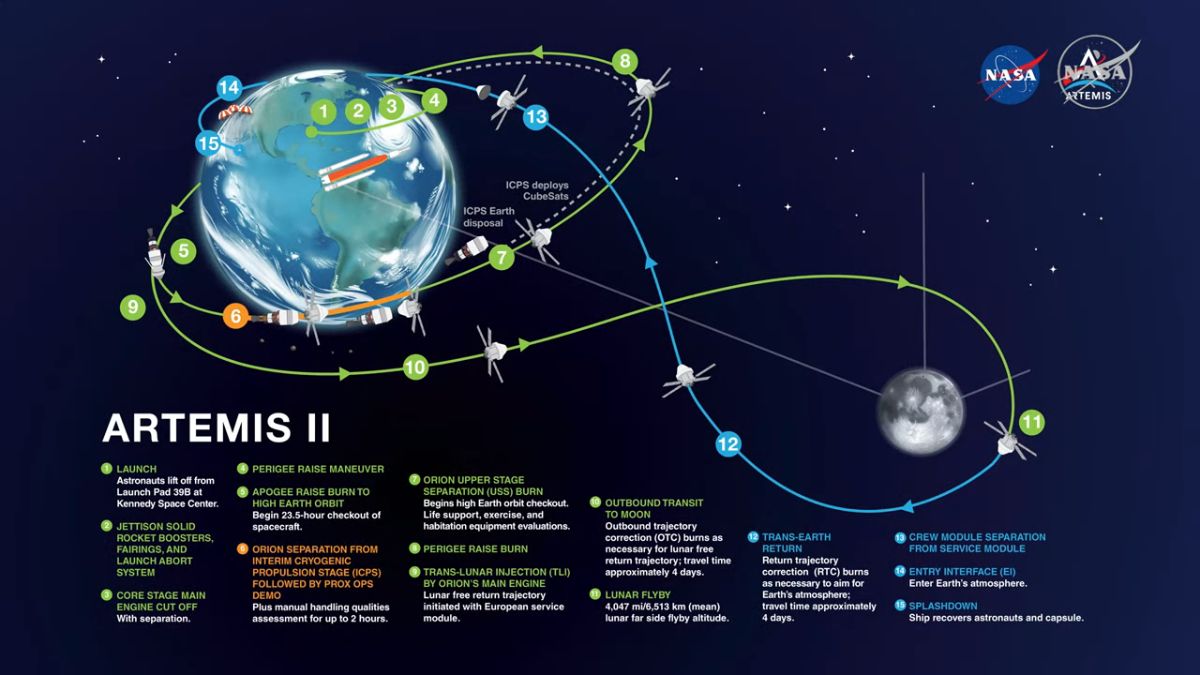
The horizon of human exploration has shifted once again. After a historic 10-day journey that pushed the boundaries of deep space travel, the crew of NASA’s Artemis II mission is now beginning their voyage back to Earth, having successfully completed a lunar flyby that marks the first time humans have ventured around the Moon in over half a century.
Launched from the Kennedy Space Center in Florida, the Artemis II lunar flyby served as a critical stress test for the systems required to sustain human life in the harsh environment of deep space. By sending a four-person crew—comprising three Americans and one Canadian—on a 685,000-mile round trip, NASA has demonstrated the viability of the Orion spacecraft and the Space Launch System (SLS) rocket for future long-term lunar habitation and eventual missions to Mars .
For the global community watching from below, the mission was more than a technical exercise; it was a moment of profound visual and emotional connection. From capturing surreal images of the lunar far side to witnessing a total solar eclipse from the vantage point of the Orion capsule, the crew has provided a rare glimpse into the void, paving the way for the next generation of astronauts who will once again set foot on the lunar surface .
A Record-Breaking Journey into the Void
The mission officially commenced on Wednesday, April 1, 2026, when the SLS rocket lifted off at 6:35 p.m. ET from the Kennedy Space Center on Merritt Island, Florida . This launch represented the first crewed flight of the SLS, NASA’s new heavy-lift rocket designed specifically to propel the Orion spacecraft beyond low-Earth orbit.
The Orion spacecraft acted as the primary exploration vehicle, designed to sustain the crew throughout the 10-day mission and ensure their safe reentry into Earth’s atmosphere . Over the course of the flight, the crew traveled a total distance of 685,000 miles, eclipsing previous records for the farthest distance humans have traveled into space .
Unlike the Apollo missions of the 1960s and 70s, Artemis II was not designed for a landing. Instead, it was a “flyby” mission, intended to test deep space systems and capabilities. This included the execution of a critical correction burn on Flight Day 5 and the demonstration of space suits within the cabin, ensuring that all life-support and navigation hardware performed as expected before NASA attempts a crewed landing .
Witnessing the Surreal: Solar Eclipses and Lunar Craters
One of the most striking aspects of the mission was the crew’s encounter with a total solar eclipse. Astronauts described the experience as “absolutely spectacular” and “surreal” as they watched the Earth block the sun from their position in deep space .

As the Orion spacecraft swept around the Moon, the crew gained a unique perspective of the lunar landscape, including the far side of the Moon—a region never seen by human eyes until the Apollo era and now revisited with modern imaging technology. The mission’s impact extended beyond the crew; in a touching tribute, a crater on the far side of the moon was named in honor of an astronaut’s late wife .
Key Technical Milestones of the Flight
- Launch: April 1, 2026, at 6:35 p.m. ET from Kennedy Space Center .
- Flight Day 5: Completion of a critical correction burn and crew suit demonstrations .
- Flight Day 6: Execution of the lunar flyby and observation of the lunar far side .
- Return Phase: Departure from the lunar sphere of influence on April 7, 2026 .
The Return Trip: Leaving the Moon Behind
As of Tuesday, April 7, 2026, the Artemis II crew has officially concluded the lunar flyby portion of their mission. According to NASA, the Orion spacecraft exited the lunar sphere of influence at approximately 1:25 p.m. ET, at a distance of about 41,072 miles from the moon .
The spacecraft is now on its journey back to Earth. The data collected during these 10 days—ranging from the performance of the SLS rocket to the psychological and physical effects of deep space travel on the four-person crew—will be analyzed to refine the parameters for the subsequent Artemis missions.
Comparing the Artemis Framework
| Mission | Status/Date | Primary Objective | Crewed? |
|---|---|---|---|
| Artemis I | 2022 | Uncrewed test of SLS and Orion | No |
| Artemis II | April 2026 | Crewed lunar flyby and systems test | Yes (4) |
| Future Artemis | TBD | Lunar surface landing and permanent base | Yes |
What This Means for the Future of Space Exploration
The success of Artemis II is a foundational victory for international space cooperation. By including a Canadian astronaut alongside three Americans, the mission underscores the global nature of the Artemis Accords and the shared goal of returning humans to the Moon .
The ultimate goal of the Artemis program is not merely to visit the Moon, but to establish a permanent lunar base. This base will serve as a staging ground for deeper exploration, allowing scientists to study the Moon’s resources and test technologies that will eventually enable humans to travel to Mars .
By proving that the Orion spacecraft can safely carry a crew 685,000 miles and return them home, NASA has mitigated many of the risks associated with deep space transit. The mission has validated the “human deep space capabilities” required to sustain life far beyond the protective magnetic field of Earth .
The next confirmed checkpoint for the mission is the safe splashdown and recovery of the Orion crew. Once the astronauts are back on Earth, NASA will begin the comprehensive debriefing process to prepare for the first crewed lunar landing in over 50 years.
Do you think a permanent lunar base is the right next step for humanity, or should we be looking further toward Mars? Share your thoughts in the comments below.
Worth a look