
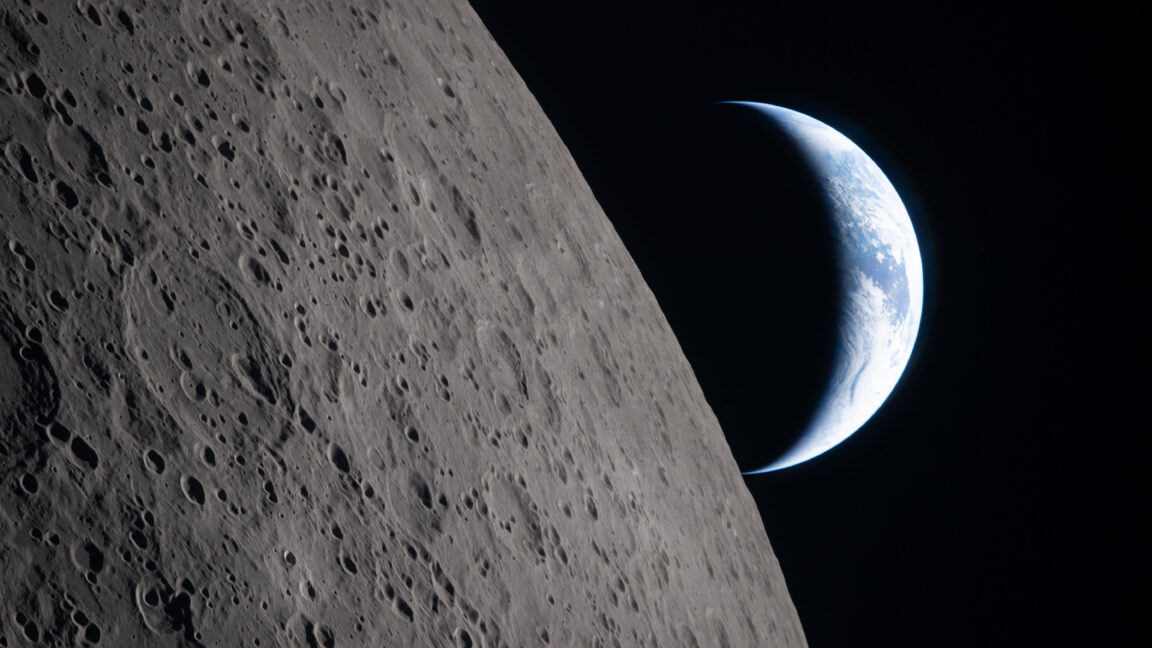
For nearly eight hours on Monday, the crew of NASA’s Artemis II mission stared out their windows at a sight that has remained out of human reach for over half a century. As the Orion spacecraft swept past the lunar surface, the experience proved to be as psychologically overwhelming as it was scientifically significant.
Commander Reid Wiseman, a 50-year-old U.S. Navy test pilot, described the view as something that defies conventional language. “No matter how long we look at this, our brains are not processing this image in front of us. It is absolutely spectacular, surreal,” Wiseman said. “Notice no adjectives. I’m going need to invent some new ones to describe what we’re looking at outside this window.”
The mission has already achieved a historic milestone by setting a new Artemis II distance record, surpassing the previous mark held by Apollo 13. This lunar flyby, which included a solar eclipse, marks the first time humans have traveled this far from Earth, effectively revealing the Moon not just as a distant object of study, but as a tangible place for future exploration according to Britannica.
The journey began on April 1, 2026, when the Space Launch System (SLS) rocket lifted off from Launch Pad 39B at the Kennedy Space Center in Florida at 6:35 p.m. EDT as documented by NASA. This launch sent a four-person crew—NASA astronauts Reid Wiseman, Victor Glover, and Christina Koch, alongside Canadian Space Agency (CSA) astronaut Jeremy Hansen—on an approximately 10-day test flight around the Moon and back.
Breaking Half a Century of Silence
The Artemis II mission is the first crewed flight to circumnavigate the Moon since Apollo 17 in 1972 per Wikipedia records. For the crew, the mission is as much about testing the capabilities of the Orion spacecraft as it is about reclaiming a human presence in deep space.

As the crew made their final approach on Monday, live images streamed back to Earth showed the lunar surface growing larger and more detailed. However, the visual experience for those on the ground was initially limited. Video captured by GoPro cameras outside the capsule was transmitted in low-resolution format due to the inherent bandwidth limitations of communicating from deep space. Despite these technical constraints, the crew was expected to downlink high-resolution telephoto snapshots between Monday night and Tuesday morning.
The mission’s trajectory has pushed the boundaries of human endurance and engineering. By venturing beyond low Earth orbit (LEO), the crew has entered a radiation environment and a distance scale that has not been experienced by humans in 54 years. In doing so, Reid Wiseman has become the first person to command a lunar mission since Gene Cernan on Apollo 17, and at age 50, he is the oldest human to travel beyond LEO according to Wikipedia.
The Commander’s Path to the Moon
Reid Wiseman’s journey to the commander’s seat of Artemis II is the result of decades of rigorous military and scientific preparation. A Baltimore native and a 27-year Navy veteran, Wiseman was selected as a NASA astronaut in 2009 according to NASA. He holds a Bachelor of Science in computer and systems engineering from Rensselaer Polytechnic Institute (1997) and a Master of Science in Systems Engineering from Johns Hopkins University per Britannica.
Before leading the Artemis II crew, Wiseman served as the 17th chief of the Astronaut Office from 2020 to 2022. His previous spaceflight experience includes a 165-day mission as a Flight Engineer aboard the International Space Station (ISS) during Expedition 41 from May through November 2014. During that mission, he completed over 300 scientific experiments and spent nearly 13 hours as a lead spacewalker as detailed by NASA.
Artemis II Mission Profile
| Detail | Specification |
|---|---|
| Launch Date | April 1, 2026 |
| Launch Vehicle | Space Launch System (SLS) |
| Spacecraft | Orion |
| Crew | Wiseman, Glover, Koch, Hansen |
| Mission Duration | Approximately 10 days |
| Key Achievement | Exceeded Apollo 13 distance record |
Engineering the Deep Space Experience
The technical challenges of the Artemis II mission highlight the gap between near-Earth operations and true deep-space exploration. While the ISS operates within the protective magnetosphere of Earth, the Orion crew is exposed to the harsh environment of interplanetary space. This transition requires not only advanced shielding but also a different approach to data transmission.
The “low-resolution” video experienced by the public on Monday is a result of the vast distances the signal must travel. As the spacecraft moves further from Earth, the available bandwidth decreases, making the transmission of high-definition, real-time video extremely difficult. This is why the crew relies on “downlinking” high-quality snapshots—storing the images on board and sending them in bursts when the connection allows for higher data throughput.
Beyond the imagery, the mission serves as a critical test for the Orion spacecraft’s life support systems and navigation. The ability to successfully circumnavigate the Moon and return safely to Earth is a prerequisite for the subsequent Artemis missions, which aim to land the first woman and first person of color on the lunar surface.
What This Means for the Future of Spaceflight
The successful execution of the lunar flyby and the breaking of the distance record signify a shift in NASA’s strategic goals. While the Apollo missions were primarily about “getting there” and proving capability, the Artemis program is focused on sustainability. By revealing the Moon as a place to be explored rather than just visited, NASA is laying the groundwork for a permanent lunar presence.
The emotional reactions of the crew, particularly Commander Wiseman’s struggle to uncover adjectives for the lunar vista, underscore the human element of these missions. These experiences provide invaluable psychological data on how humans react to the “overview effect” on a lunar scale—the cognitive shift that occurs when seeing the Earth as a fragile, distant marble in the void.
With the distance record now broken and the Orion spacecraft’s systems validated in deep space, the focus shifts toward the eventual lunar landing. The data gathered during this 10-day journey will inform every aspect of the landing missions, from radiation protection to the timing of orbital insertions.
The crew is currently preparing for the final leg of their journey back to Earth. The next confirmed checkpoint will be the atmospheric reentry of the Orion capsule and the subsequent recovery of the crew by NASA teams.
We wish to hear from you. Does the return to the Moon inspire you, or do you believe our focus should remain on Mars or near-Earth satellites? Share your thoughts in the comments below.