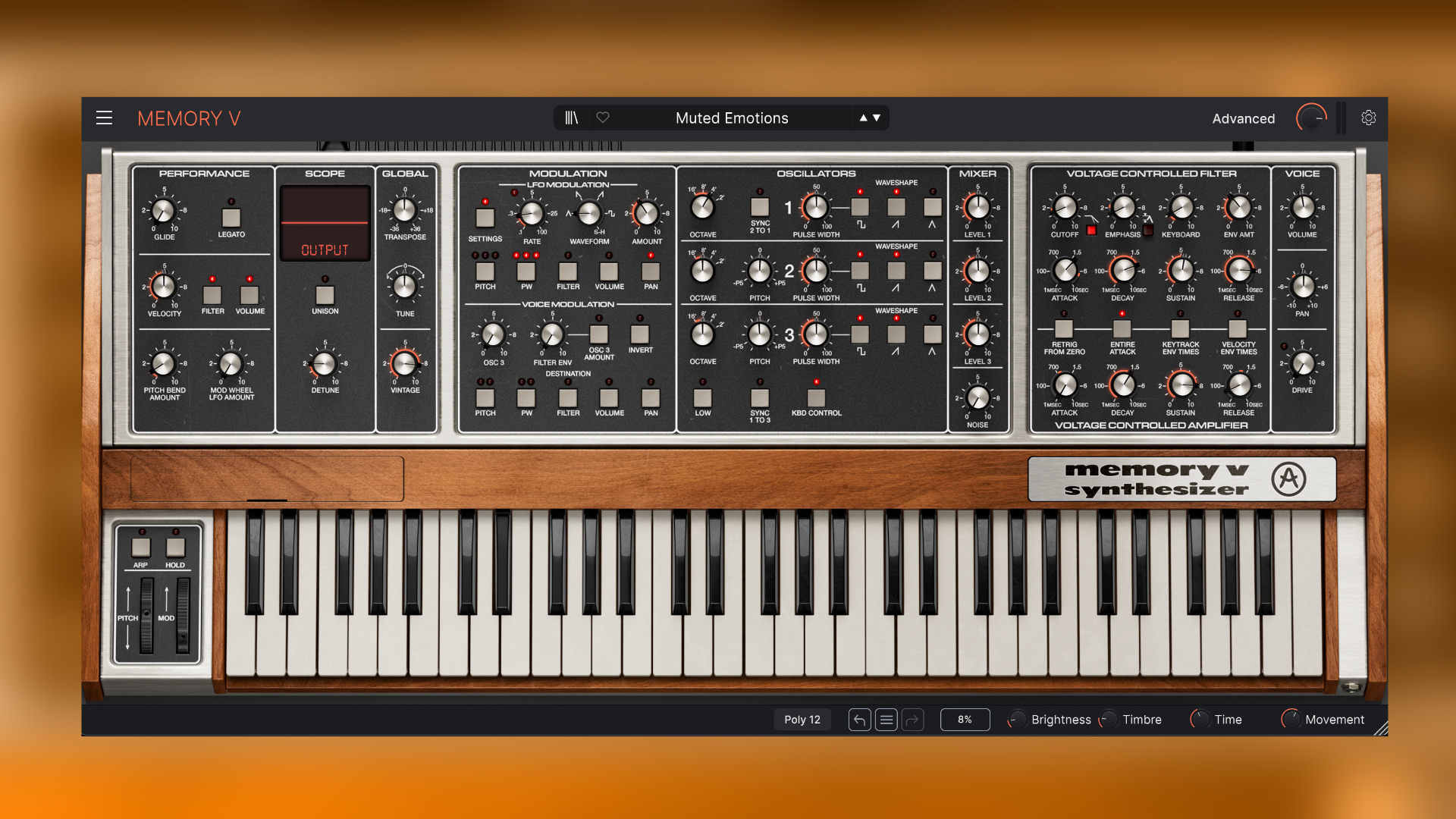
For decades, the Moog Memorymoog has occupied a legendary status in the pantheon of analog synthesis. Released in 1982, this powerhouse was Moog’s answer to the polyphonic revolution, offering a massive, six-voice architecture that combined the warmth of discrete analog oscillators with the precision of digital control. Today, Arturia has officially expanded its V Collection suite with the release of the Memory-V, a software instrument designed to bring the iconic character of this vintage beast to the modern digital audio workstation (DAW).
As a technology editor who has spent years dissecting both hardware circuits and virtual instrument architecture, I find the emulation of such complex instruments to be a high-stakes endeavor. The original Memorymoog, while celebrated for its sound, was notoriously temperamental and difficult to maintain. Arturia’s approach with the Memory-V is to capture the sonic DNA of the 1982 classic while introducing modern workflow enhancements that address the reliability issues inherent in 40-year-old hardware. According to the official product specifications from Arturia, the software features a faithful recreation of the triple-oscillator voice architecture and the signature 24dB/octave ladder filter.
Engineering the Analog Soul in Code
The core of the Memory-V experience lies in its adherence to the original signal path. The Memorymoog was distinct for its “full” sound, often described as having a thicker, more aggressive low end than its Japanese counterparts of the same era. Arturia utilizes its proprietary True Analog Emulation (TAE) and physical modeling technology to recreate the non-linear behaviors of the original components. What we have is not merely a static sample library; We see a dynamic, reactive instrument that responds to modulation and performance nuances just as the physical circuitry would.

Beyond the raw sound, the software introduces a modulation matrix that was not present in the original unit. This addition significantly widens the sound design palette, allowing users to map various sources—such as LFOs, envelopes, and velocity—to almost any parameter within the synth. By integrating these modern features, Arturia aims to bridge the gap between vintage character and contemporary production speed. The interface maintains a layout that will feel familiar to those who have used the hardware, but it adds an advanced panel that slides out to reveal these hidden control capabilities.
Why the Memorymoog Still Matters
When we talk about the Memorymoog, we are talking about a specific sound that defined the textures of early 80s pop, rock, and film scores. Its ability to stack three oscillators per voice allowed for massive, detuned pads and leads that could cut through dense mixes. However, the hardware’s tuning stability was a frequent point of frustration for professional users. By moving this architecture into the digital domain, Arturia eliminates the need for constant calibration, making it a viable tool for modern touring musicians and studio producers who cannot risk a vintage synth falling out of tune mid-session.
The software comes loaded with a library of 300 presets, which serve as a starting point for exploring the engine. These presets were designed to showcase the instrument’s versatility, ranging from classic bass patches that evoke the sound of the 80s to complex, evolving soundscapes that utilize the added modulation capabilities. For those interested in the technical evolution of these instruments, the Bob Moog Foundation provides historical context on how this specific model served as the final major polyphonic project for the company during its initial incarnation.
Key Features and Technical Specifications
- Authentic Triple-Oscillator Engine: Replicates the six-voice, three-oscillator design of the 1982 original.
- Ladder Filter Emulation: Precision-modeled 24dB/octave low-pass filter for that quintessential Moog bite.
- Expanded Modulation: An integrated modulation matrix that allows for deeper sound design than the original hardware.
- Modern Workflow: Includes a high-resolution interface, MIDI learn functionality, and DAW integration for seamless automation.
- Extensive Preset Library: 300 professional presets covering vintage emulations and modern, experimental sounds.
The Future of Vintage Emulation
The release of the Memory-V follows a broader trend in the music technology industry: the “democratization” of rare, expensive, and fragile hardware. As software engineering continues to advance, the distinction between high-end analog hardware and its virtual counterparts is becoming increasingly subtle. While purists may argue that the physical interaction with knobs and the unique aging of individual electronic components cannot be perfectly replicated, the accessibility provided by software like the Memory-V is undeniable.

For current users of Arturia’s V Collection, this addition represents a significant upgrade in terms of sonic variety. The company has confirmed that the instrument is available as a standalone application or as a plug-in for major DAWs including Ableton Live, Logic Pro, and FL Studio. Those looking for the latest compatibility updates can monitor the Arturia support portal for the most recent version releases and system requirement documentation.
As we look ahead, the integration of AI-assisted sound design and even more sophisticated modeling algorithms suggests that we are only at the beginning of this preservation movement. By archiving the sonic signatures of the 20th century, companies like Arturia are ensuring that the sounds that defined an era remain accessible to the next generation of producers. Whether you are a fan of classic synth-pop or a sound designer looking for a new layer of grit in your electronic tracks, the Memory-V is a compelling addition to the digital toolkit.
What are your thoughts on the transition of classic analog synthesizers to software platforms? Does the digital experience capture the “magic” of the original hardware for you, or is the tactile interface a necessary component of the creative process? I invite our readers to share their experiences and sound design tips in the comments section below. Let’s keep the conversation going.
Worth a look