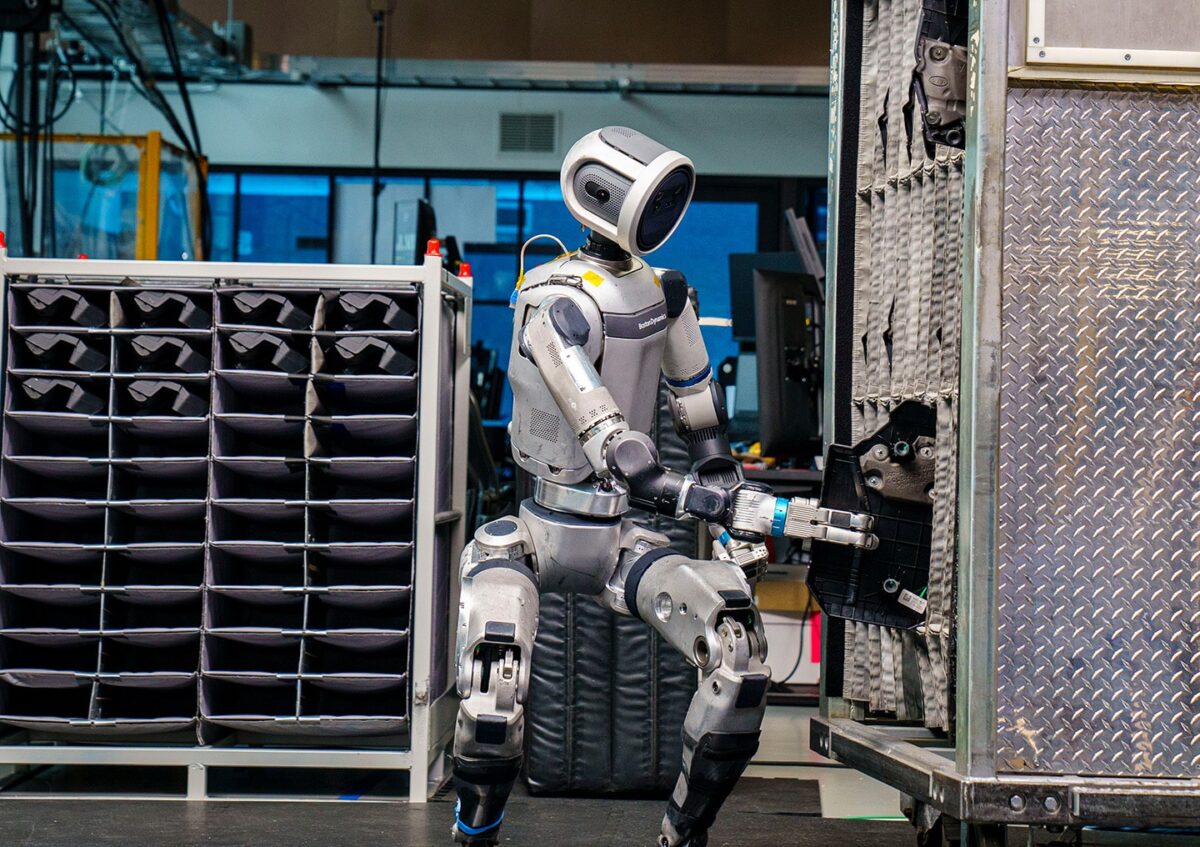
The Dawn of the AI-Powered Factory Worker: Boston Dynamics‘ Atlas and the Future of Robotics
For decades, the vision of humanoid robots seamlessly integrated into our workplaces has lingered in the realm of science fiction. Now, thanks to advancements in artificial intelligence and machine learning, that future is rapidly approaching. Boston Dynamics’ Atlas, once a showcase of pre-programmed acrobatics, is undergoing a transformative evolution, poised to become a practical, AI-driven asset in demanding industrial environments. This article delves into the groundbreaking techniques behind Atlas’s development, its current capabilities, limitations, and the realistic path forward for humanoid robotics in the workplace.
From Scripted Movements to Learned Intelligence
Early iterations of Atlas were impressive feats of engineering,but relied on painstakingly coded motion algorithms. Every movement, every balance correction, was meticulously programmed. This approach, while demonstrating technical prowess, lacked the adaptability needed for real-world applications.The new generation of Atlas represents a paradigm shift. Fully electric,significantly slimmer,and powered by cutting-edge AI running on high-performance computing hardware,this Atlas learns to perform tasks,rather than simply executing instructions.
The core of this learning process lies in a move away from explicit programming towards machine learning. Boston Dynamics engineers are now “teaching” Atlas through exhibition, a method mirroring how humans acquire new skills. This is achieved through two primary techniques:
* Virtual Reality Supervised Learning: Human operators, equipped with VR headsets, directly manipulate atlas’s virtual arms and hands, guiding the robot through the desired task. This interaction generates a wealth of training data, which Atlas then uses to autonomously replicate the movements. Think of it as a digital apprenticeship, where the robot learns by observing and mimicking a skilled instructor.
* Motion Capture Translation: Human movements are recorded using motion capture suits and then intelligently translated to Atlas’s unique biomechanical structure. Crucially,Atlas doesn’t simply copy the movements; it learns the outcome and adapts its own mechanics to achieve the same result. This is a complex process that accounts for differences in anatomy and leverages the robot’s strengths.
Scaling Learning Through Simulation: Training an Army of Digital Robots
The true power of this approach lies in its scalability. Boston Dynamics doesn’t just train one Atlas; it simultaneously trains thousands of digital replicas in a simulated habitat. These simulations expose the robots to a vast range of conditions – uneven surfaces, restricted spaces, mechanical resistance – allowing the system to rapidly test variations and identify robust, stable movement strategies.
This parallel learning process dramatically accelerates development.Once a skill is mastered in simulation, it’s seamlessly uploaded to the control system of every physical Atlas robot, meaning improvements benefit the entire fleet instantly. This “train once, deploy everywhere” model is a game-changer, significantly reducing training time and costs.
Current Capabilities and Realistic Expectations
Atlas’s progress is undeniable.It can now confidently run, crawl, lift, sort objects, and execute coordinated movements that were considered unattainable for humanoid robots just a few years ago. The recent trials with Hyundai are a testament to this advancement, showcasing Atlas’s potential in real-world factory settings.
However, Boston Dynamics is refreshingly candid about the robot’s limitations.Atlas is not on the verge of replacing humans in all tasks. Activities requiring fine motor skills, adaptability to unstructured environments, and complex decision-making – such as dressing, cooking, or handling delicate objects – remain notable challenges.
The company’s strategic focus is therefore deliberately narrow: repetitive, physically demanding work within structured environments like factories and warehouses. These environments offer predictability and repeatability, making them ideal proving grounds for early adoption.
The Future of Work: Augmentation, Not Replacement
The Hyundai partnership underscores this pragmatic approach. Humanoid robots like Atlas are envisioned as tools to augment human capabilities, not to entirely replace them. The goal is to alleviate workers from dangerous,exhausting,and physically taxing jobs,improving workplace safety and efficiency.
It’s critically important to note that even in these specialized roles, Atlas requires ongoing human oversight, maintenance, and continued training. This highlights a crucial point: the near-term future of robotics is one of collaboration between humans and machines, not complete automation.
Addressing Concerns: No “Terminator” Scenario in Sight
Despite growing anxieties surrounding AI and automation, boston Dynamics actively dispels fears of runaway robots.They emphasize the reality: robots are inherently fragile in unpredictable situations, heavily reliant on human input, and surprisingly tough to train.
Atlas represents significant progress, but it also defines the current boundaries of what AI-powered humanoids can achieve outside of carefully controlled environments.