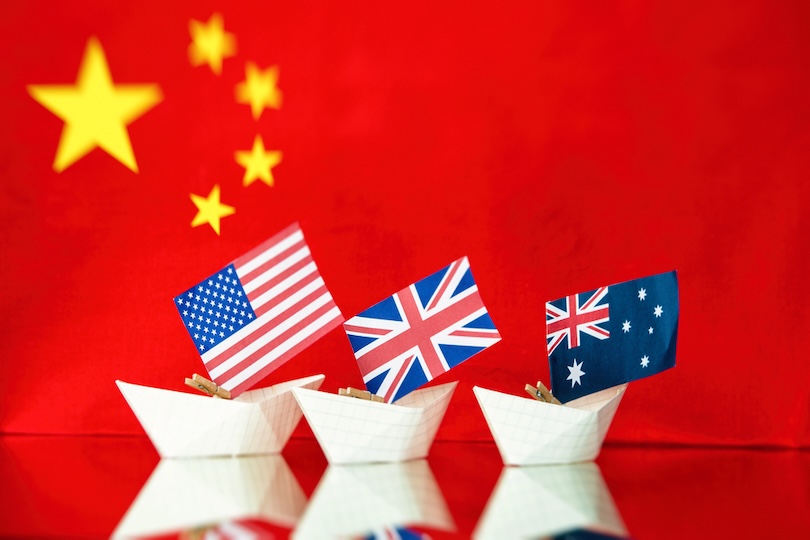
The Interlocking Strategies of AUKUS and the Quad: Securing a Stable and Prosperous Indo-Pacific and beyond
The Indo-Pacific region is undergoing a period of profound strategic realignment, driven by rising geopolitical competition, climate change, and the increasing interconnectedness of global systems. Responding to these challenges requires a nuanced approach that blends hard security with long-term resilience-building. This is precisely the logic underpinning the complementary architectures of AUKUS and the Quad – a dual framework that is rapidly becoming the cornerstone of regional stability and prosperity. This analysis will detail how this integrated approach functions, the specific contributions of each partner, and its expanding relevance beyond the customary Indo-Pacific focus.
A Purposeful Division of Labor: Hard Security and Holistic Resilience
Launched in 2015, the Quad (United States, Japan, Australia, and India) and the more recent AUKUS (Australia, United Kingdom, and United States) are not competing initiatives, but rather strategically aligned components of a larger effort. At its core, this framework recognizes that traditional security concerns are inextricably linked to resource competition, climate instability, and the need for lasting growth. Ignoring these interconnected challenges would be a critical oversight, as they act as potent “threat multipliers,” exacerbating existing tensions and creating new vulnerabilities.
AUKUS provides the essential hard security foundation, focused on safeguarding the maritime commons and maintaining a credible balance of power, particularly through the development and deployment of advanced capabilities like conventionally-armed, nuclear-powered submarines.This capability is vital for deterring coercion and ensuring freedom of navigation in critical sea lanes.Though, military strength alone is insufficient to guarantee long-term stability.
This is where the Quad steps in. Rather than duplicating AUKUS’s security focus, the Quad concentrates on building the underlying infrastructure, establishing regional standards, and fostering robust governance systems that enable societies to thrive within a secure environment. This includes initiatives like India’s Security and Growth for All in the Region (SAGAR) initiative, wich promotes maritime security cooperation, and Japan’s longstanding commitment to Quality Infrastructure Investment, shaping the region’s economic trajectory through sustainable and obvious development. the United States provides crucial institutional weight and coordination, sustaining the framework’s broader strategic impact.
Leveraging Complementary Strengths: A Partnership Built on Expertise
The effectiveness of this architecture stems from a clear-eyed understanding of each nation’s strengths and a deliberate division of labour. Japan, such as, leverages decades of experience and substantial financial resources to champion high-quality infrastructure projects, setting regional standards for sustainability and transparency.This is not simply about economic development; it’s about shaping the rules of the game and fostering a regional order aligned with shared values.
Australia brings to bear its expertise in mining, agriculture, and governance, contributing to the development of stable and resilient partners. The United States underwrites the convening power and coordination necessary for the framework’s success, while India’s growing economic and military influence, coupled with its deep regional knowledge, positions it as a central maritime and regional partner.
This integrated approach transforms military influence into practical institutional outcomes, shaping behaviour through rules, norms, and shared economic interests rather than relying solely on force.The Quad’s explicit focus on climate change, development, and public goods also serves a crucial diplomatic function, providing a non-contentious channel for cooperation and managing sensitivities among partners.
Expanding Horizons: the Indo-Pacific and Beyond
The strategic logic of AUKUS and the Quad extends beyond the traditional boundaries of the indo-Pacific. The interconnected nature of modern supply chains, maritime security, and standards-setting means that the Indian Ocean littoral is now inextricably linked to regions like East Africa.Critical ports, sea lanes, and mineral corridors in East Africa represent vital nodes connecting the Indian Ocean to global markets.australia’s 2023 Defense Strategic Review explicitly highlighted the importance of Indian Ocean security and resilient maritime routes, underscoring this expanding strategic landscape.
Cooperation in this broader context, combining Japan’s financial and technological capabilities with Australia’s expertise, directly addresses shared strategic interests in securing stable, transparent, and resilient partners. This joint commitment to sustainable engagement manages geopolitical risks, utilizing high-quality development to secure long-term strategic access and influence. This isn’t about formal expansion of Indo-pacific institutions into Africa,but a pragmatic recognition of the evolving strategic realities.
A Strategic Necessity for Long-Term Regional Order
The dual architecture of AUKUS and the Quad is not merely a tactical response to immediate challenges; it is a strategic necessity for ensuring long-term regional order. Australia and Japan, in particular, derive important value from this framework, securing their regional flanks while gaining the strategic space to pursue shared, cooperative objectives across a wider geopolitical landscape.
Ultimately,contemporary stability rests on two complementary pillars: a credible security shield provided by AUKUS and a broad,inclusive outreach delivered through the Quad.together, these tracks reinforce deterrence while sustaining
Related reading
- Son Heung-min Visits Los Angeles BMO Stadium
- Trump Appeals to Supreme Court Over US Mail-In Ballot and Voter Verification Rules
- Veterans of Australian Defence Force Operations Post-1990: Prioritised Collaborative Partnerships (world-today-news.com)
- Saudi Arabia Launches First Saudi Water Week in Jeddah to Address Water Security (archyworldys.com)