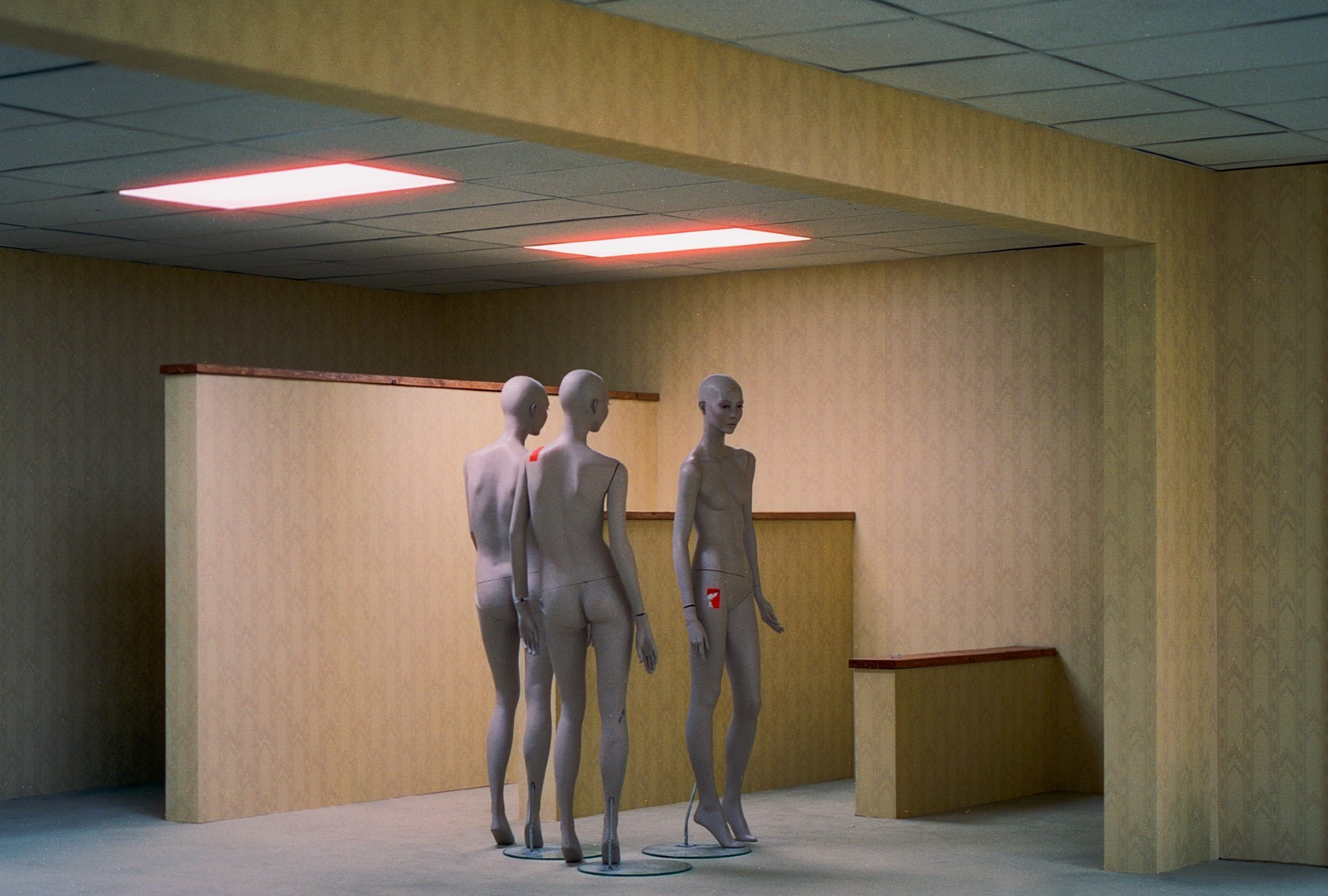
The horror film Backrooms has rapidly emerged as a cultural phenomenon, securing the No. 1 spot at the box office with a record-breaking $80 million debut weekend. Directed by 20-year-old filmmaker Kane Parsons, the movie centers on a protagonist named Clark who becomes trapped in a vast, liminal space characterized by generic office architecture, fluorescent lighting, and particle board furniture. While audiences and critics have debated whether the film serves as an allegory for trauma, memory, or psychological instability, its specific geographical and historical markers suggest a more targeted commentary on the evolution of the technology industry.
The film deliberately grounds its narrative in the Santa Clara Valley, California, during the autumn of 1990. Throughout the production, viewers are repeatedly directed to a specific intersection in San Jose: the corner of Capitol and McKee. Although the film’s setting is firmly rooted in this Silicon Valley location, producers utilized sound stages and exterior locations in British Columbia to capture the aesthetic of the era. This choice highlights the film’s central tension: a story about a “nowhere” space that is paradoxically obsessed with a very specific, real-world point of origin.
A Cautionary Tale of Technological Ambition
The inclusion of the fictional company Async provides a primary clue regarding the film’s deeper meaning. In the narrative, Async is described as a former manufacturer of MRI machines that has pivoted its focus toward studying the “backrooms,” which it claims represents the most significant discovery in human history. This trajectory mirrors the real-world evolution of numerous major technology firms. Companies such as Nintendo, which began as a playing card manufacturer, and Nokia, which once produced rubber goods, underwent similar shifts before finding success in telecommunications and digital media. By framing Async’s pivot in this manner, the film draws a direct parallel to the hyperbole often employed by modern tech industry leaders when describing developments in artificial intelligence, the metaverse, or cryptocurrency.

The film’s focus on the fall of 1990 is historically significant. At that time, ARPANET—the precursor to the modern internet—was primarily utilized as a specialized communications tool for government-funded laboratories, universities, and research institutions. The formal announcement of the World Wide Web would not occur until August 1991, with mass public adoption following by 1993. By placing the narrative at this precipice of digital expansion, the film positions itself as a commentary on the transition from a physical world to an interconnected, virtual reality.
The Internet as a Faulty Copy of Reality
A pivotal moment in the film occurs when the protagonist, Clark, describes the backrooms as a “faulty copy of reality.” This sentiment echoes the concerns of early cyberpunk literature, such as William Gibson’s 1988 novel Neuromancer, which envisioned cyberspace as a navigable, three-dimensional architecture. The film portrays the backrooms as a space that mimics human design but has been rendered sterile and mutated by the demands of capital and industrial-strength efficiency. This interpretation aligns with long-standing discussions regarding how the internet might manifest if it were a physical structure—a “warehouse of junk” defined by commercial expediency rather than human-centered design.

The connection to the internet is further reinforced by the origins of the “Backrooms” mythos, which first appeared on the anonymous image board 4chan. The platform is widely recognized for its role in the development of various internet subcultures and has been associated with significant, often controversial, digital movements. By drawing on this source material, the film invites viewers to consider whether the digital world—much like the backrooms—is a place where one can lose oneself, encounter “golem” versions of real people, and struggle to distinguish between genuine human behavior and algorithmic imitation.
Frequently Asked Questions
- Is Backrooms based on a true story? No, the film is a work of fiction. While it references the very real intersection of Capitol and McKee in San Jose, California, the events depicted are part of a narrative exploration of liminal spaces.
- Where was the movie filmed? Although the story is set in San Jose, the production was filmed in British Columbia, utilizing sound stages and local exteriors to represent the California setting.
- What is the significance of the year 1990 in the film? The year 1990 marks a critical period just before the public launch of the World Wide Web, serving as a symbolic setting to explore the early development and eventual expansion of the internet.
- What is the role of the company Async in the plot? Async serves as a representation of corporate pivots in the tech industry, moving from traditional hardware manufacturing to the exploration of the “backrooms,” which the company characterizes as a monumental technological discovery.
As Backrooms continues its theatrical run, the discourse surrounding its meaning remains active. The film’s success and its record-breaking $80 million opening weekend suggest that its critique of digital isolation and corporate ambition resonates with a broad audience. Future updates regarding the film’s distribution or potential sequels will be available through official studio announcements. We invite readers to share their own interpretations of the film’s themes in the comments section below.
Keep reading