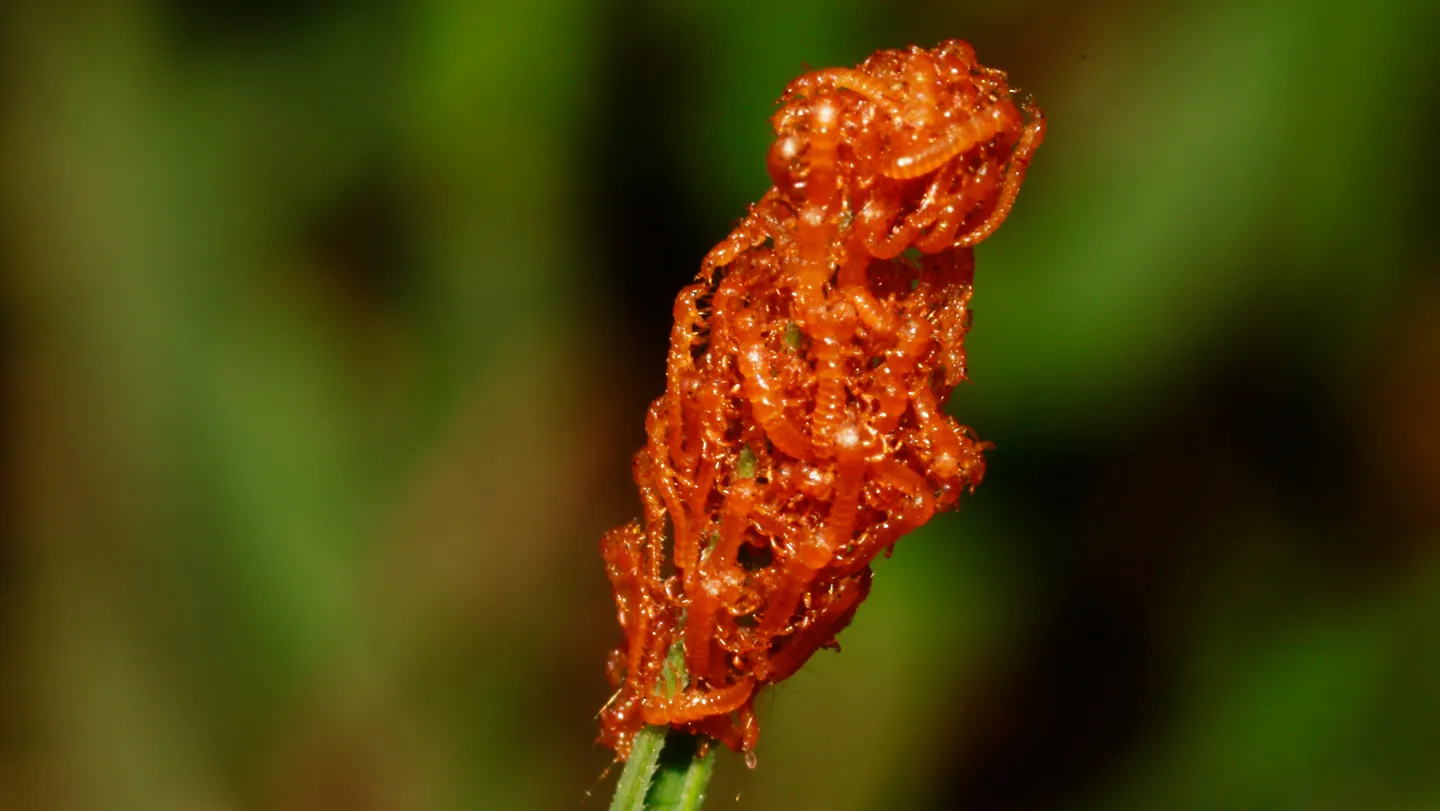
Like wily perfumers, a parasitic beetle’s larvae create floral aromas to lure in bees. Plants are known to cosplay as animals,but this rare discovery could be the first known example of an animal chemically mimicking a plant.
Larvae of the European blister beetle (Meloe proscarabaeus) emerge from the ground in spring,climb up grasses and clump together to form shining orange masses that resemble flowers. When a bee draws near, the larvae rapidly latch on to catch a ride back to its nest, before eating its eggs and continuing their life cycle. How exactly the larvae lure in the bees was a mystery.
The findings,posted January 15 to biorXiv.org, reveal the beetles produce a range of aromatic compounds normally associated with plants and known to attract pollinators. “It wasn’t just that they were producing one compound and then loosely trying to mimic a flower,” says Ryan Alam, a synthetic chemist at the max Planck Institute for Chemical Ecology in Jena, Germany. “it was like their own personal larval perfume.”
Alam collected male and female adults and reared them in tanks in a greenhouse, feeding the voracious beetles on wheatgrass, broad bean and clover. After mating, the females laid their eggs, and a few weeks later larvae emerged and immediately crawled up onto plants. The researchers gathered them up with a paintbrush and ran a series of chemical analyses on the compounds they emitted.
The beetles emit a complex aroma of 17 plantlike compounds,including linalool, a spicy lavender scent used widely in commercial perfume, the results showed. Further analysis found the larvae synthesize the scents from scratch, using two enzymes to tinker with linalool and diversify the bouquet.
The researchers then created synthetic versions of the aromas and ran choice experiments with wild red mason bees (Osmia bicornis). A few were especially attractive for females, which may be an advantage to the larvae as it increases their chance of being transported straight to a nest.
the compounds also attracted the larvae and may be a signal for them to gather together, the study found. This suggests that deep in their evolutionary past, the larvae may have followed the scents to find a flower and wait for a bee. After a while, they started to produce the compounds themselves to boost the floral aroma, before eventually doing away with the plants altogether.
This may have allowed the larvae to emerge in very early spring when there aren’t many flowers around and become the closest apparent food source. And the bees appear to be none the wiser.