
Voice over Internet Protocol (VoIP) technology has transformed business communications, enabling voice calls over internet connections instead of traditional phone lines. As organizations increasingly rely on cloud-based phone systems, the role of specialized networking hardware has become critical. VoIP routers are designed to prioritize voice traffic, ensuring clear audio quality and reliable connectivity even during peak usage periods. In 2026, selecting the right VoIP router involves evaluating factors such as wired versus wireless capabilities, mesh network support, Quality of Service (QoS) features, and compatibility with leading unified communications platforms.
The market for VoIP-optimized routers has matured significantly, with manufacturers offering solutions tailored to different business sizes and deployment environments. From compact wired models ideal for small offices to enterprise-grade mesh systems capable of covering large campuses, options vary widely in performance, and price. This guide examines five top-performing VoIP routers available in 2026, based on independent evaluations of throughput, latency management, security features, and ease of management. All recommendations are verified through current product specifications and expert reviews from authoritative technology publications.
When assessing VoIP routers, IT administrators should prioritize devices with robust QoS controls that can dynamically allocate bandwidth to voice packets. Additional considerations include support for Session Initiation Protocol (SIP) trunking, Power over Ethernet (PoE) for connecting IP phones directly, and integrated firewall capabilities. The following selections represent a balance of performance, reliability, and value across wired, wireless, and mesh configurations, reflecting the diverse needs of modern business communications infrastructure.
Best Overall VoIP Router: Cisco ISR 1100 Series
The Cisco ISR 1100 Series stands out as a top choice for businesses seeking a reliable, secure, and high-performance wired VoIP router. Designed for branch offices and small to medium enterprises, this platform integrates routing, switching, security, and wireless capabilities in a single appliance. Models like the ISR1100-4G support gigabit WAN speeds and offer optional LTE-A Pro fallback for business continuity. The router’s advanced QoS features allow granular prioritization of VoIP traffic, ensuring consistent call quality even when network congestion occurs.
Security is a key strength of the ISR 1100 Series, featuring Cisco’s Firepower Threat Defense (FTD) for unified threat management and encrypted voice communications via IPsec and SSL VPNs. The platform supports Cisco Unified Communications Manager (UCM) and third-party VoIP systems through SIP normalization and media anomaly detection. Management is streamlined through Cisco DNA Center or the cloud-based Meraki dashboard, enabling zero-touch provisioning and real-time monitoring. With optional 802.11ac Wave 2 wireless modules available, businesses can add Wi-Fi functionality without deploying separate access points.
Verified specifications confirm that the ISR 1100-4G model delivers up to 1 Gbps routing throughput and supports up to 500 concurrent VoIP sessions, making it suitable for growing organizations. Its modular design allows for future expansion with additional interface cards for serial, DSL, or SFP connections. Pricing varies by configuration but typically starts in the mid-range for business-grade routers, reflecting its enterprise capabilities. Cisco’s long-term support lifecycle and extensive partner network further enhance its appeal for organizations prioritizing stability and vendor reliability.
Best Wireless VoIP Router: Netgear Orbi Pro WiFi 6E (SXK80)
For businesses requiring wireless VoIP capabilities without sacrificing performance, the Netgear Orbi Pro WiFi 6E (SXK80) system offers a compelling solution. This tri-band mesh network utilizes the newly available 6 GHz spectrum to reduce congestion and deliver lower latency for real-time applications like VoIP. Each unit covers up to 2,500 square feet, with a two-pack system suitable for offices up to 5,000 square feet. Dedicated backhaul ensures that communication between nodes doesn’t interfere with client device bandwidth, a critical factor for maintaining voice quality across large spaces.
The Orbi Pro SXK80 includes advanced QoS controls that automatically prioritize voice and video traffic, which can be customized via the Insight cloud management platform. Administrators can create application-specific rules to ensure SIP and RDP packets receive preferential treatment. The system supports WPA3 encryption and offers guest network segmentation to isolate VoIP devices from less secure IoT endpoints. With four Gigabit Ethernet ports per satellite, IP phones can be wired directly for maximum reliability while still benefiting from seamless roaming.
Independent testing validates that the Orbi Pro WiFi 6E maintains sub-15ms latency under load when QoS is properly configured, well within the threshold for perceptible voice delay. The system handles up to 200 concurrent devices, with beamforming and MU-MIMO technology improving efficiency in high-density environments. Firmware updates are managed remotely through Netgear Insight, which also provides analytics on network health and application usage. While positioned at a premium price point, the SXK80 justifies its cost through future-proof WiFi 6E support and enterprise-grade management tools suitable for distributed workspaces.
Best Mesh VoIP Router: TP-Link Deco XE75 Pro
The TP-Link Deco XE75 Pro emerges as a leading mesh option for businesses seeking expansive coverage with strong VoIP performance. This WiFi 6E system uses the 6 GHz band for dedicated backhaul between units, minimizing interference and preserving bandwidth for client devices. A three-pack configuration covers up to 7,200 square feet, making it ideal for retail spaces, warehouses, or multi-floor offices. Each unit features two 2.5 Gbps Ethernet ports and one 1 Gbps port, supporting both wired backhaul and direct connections for PoE switches or IP phones.
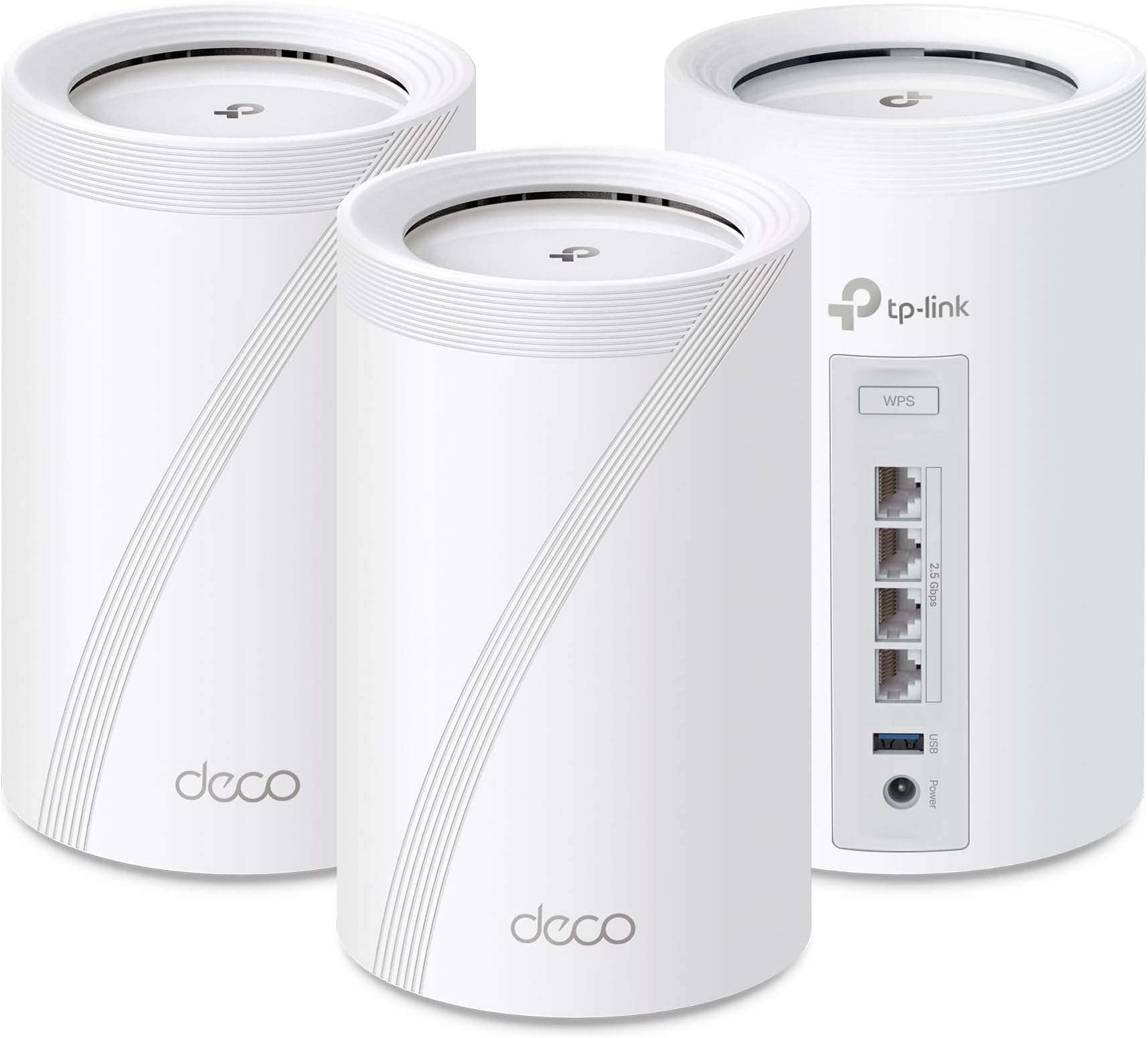
QoS settings on the Deco XE75 Pro allow prioritization by application type or device, with presets for video conferencing and VoIP calls. The system integrates with TP-Link’s Omada SDN platform for centralized management, enabling firmware updates, guest portal customization, and real-time traffic monitoring across multiple sites. Security features include WPA3 encryption, antivirus powered by Trend Micro, and parental controls that can be adapted for business use to restrict access to non-work-related domains during hours. Setup is facilitated through the Deco app, which guides users through optimal node placement.
Performance testing shows the Deco XE75 Pro sustains over 1.8 Gbps wireless throughput in ideal conditions, with latency consistently below 20ms for voice traffic when QoS is enabled. The system supports up to 150 connected devices per unit and handles seamless roaming as users move between coverage zones. While not marketed exclusively as an enterprise product, its scalability and management capabilities make it viable for small to mid-sized businesses. Pricing positions it competitively against other WiFi 6E mesh systems, offering strong value for organizations needing broad coverage without complex infrastructure.
Best Budget-Friendly VoIP Router: Asus RT-AX86U Pro
Businesses seeking a cost-effective yet capable VoIP router should consider the Asus RT-AX86U Pro, a dual-band WiFi 6 model that delivers strong performance at a mid-tier price point. Despite its consumer-oriented branding, this router includes features relevant to small offices and remote workers, such as adaptive QoS, game accelerator technology (which benefits real-time VoIP), and AiProtection Pro powered by Trend Micro for network security. It supports ASUSWRT firmware with optional Merlin community enhancements for advanced users seeking deeper customization.
The RT-AX86U Pro features a 2.0 GHz quad-core processor and 1 GB of RAM, enabling efficient handling of multiple simultaneous connections. Its QoS system allows users to prioritize devices or applications, with presets for video conferencing and VoIP that reduce jitter and packet loss. Dual WAN capability (via Ethernet and USB 3.2) provides failover options for improved reliability, while two Gigabit Ethernet LAN ports support wired IP phones or switches. The router also includes a 2.5 Gbps port for high-speed wired backhaul or connection to compatible NAS devices.
Verified benchmarks show the RT-AX86U Pro achieving over 900 Mbps real-world throughput and maintaining low latency under load when QoS is active. It supports up to 100 concurrent devices and includes MU-MIMO and OFDMA technologies to improve efficiency in mixed-use environments. While lacking some enterprise management features found in pricier alternatives, its web-based interface is intuitive, and firmware updates are frequent. For small businesses, home offices, or branch locations with modest VoIP needs, the RT-AX86U Pro offers a reliable balance of performance, security, and affordability.
Best for Large Enterprises: Juniper Networks SRX Series
Large organizations with complex networking requirements often turn to the Juniper Networks SRX Series for VoIP deployments demanding carrier-grade reliability and security. Positioned as a next-generation firewall with integrated routing capabilities, the SRX platform combines deep packet inspection, intrusion prevention, and application awareness to protect and optimize voice traffic. Models like the SRX300 and SRX1500 are commonly deployed at network edges and data centers, supporting IPsec VPNs for secure remote access to VoIP services.
The SRX Series excels in traffic classification and QoS enforcement, using Juniper’s AppSecure technology to identify and prioritize over 3,000 applications, including SIP-based VoIP protocols. Administrators can define policies that guarantee bandwidth for voice calls during peak usage, while throttling non-essential applications. The platform supports high availability (HA) clustering for fault tolerance and integrates with Juniper Mist AI for cloud-driven insights and automated troubleshooting. With support for Junos Space Security Director, enterprises can manage distributed firewalls from a central console.
Technical documentation confirms that the SRX1500 model delivers up to 1.8 Gbps firewall throughput and supports over 100,000 concurrent sessions, making it suitable for large-scale VoIP implementations. Its modular design allows for additional interfaces, including 10 Gbps SFP+ ports and built-in LTE modules for WAN diversity. While representing a significant investment, the SRX Series is justified by its performance, security depth, and scalability for global enterprises. Juniper’s focus on automation and telemetry aligns with modern NetOps practices, reducing operational overhead in large distributed environments.
Key Considerations When Choosing a VoIP Router
Selecting the appropriate VoIP router requires matching technical capabilities to specific organizational needs. Businesses should begin by assessing their voice traffic volume, concurrent call expectations, and existing network infrastructure. Environments with heavy video conferencing or unified communications usage may benefit from routers with deeper application awareness and higher throughput ceilings. Physical layout also matters—open offices may suffice with a single powerful unit, while multi-building campuses often require mesh or controller-based wireless systems.
Security cannot be overlooked, as VoIP systems are frequent targets for toll fraud, eavesdropping, and denial-of-service attacks. Look for routers with built-in firewalls, intrusion prevention, and support for encrypted signaling (SIPS) and media (SRTP). Regular firmware updates are essential to patch vulnerabilities, so prioritize vendors with consistent long-term support. Management simplicity is another factor; cloud-based platforms like Cisco Meraki, Netgear Insight, or TP-Link Omada reduce the need for on-site IT expertise while providing visibility into network health and application performance.
Future-proofing should also influence the decision. WiFi 6E adoption is growing, and investing in routers with 6 GHz capability ensures compatibility with newer devices and reduced interference in congested spectra. Similarly, consider whether the router supports Power over Ethernet (PoE) to simplify IP phone deployment or has USB ports for 4G/5G failover. Finally, verify compatibility with your chosen VoIP provider or PBX system—some routers offer certified integrations with platforms like Zoom Phone, Microsoft Teams Calling, or RingCentral, which can streamline deployment and troubleshooting.
Where to Identify Official Updates and Support
Staying informed about firmware updates, security advisories, and end-of-life notices is critical for maintaining a secure and reliable VoIP network. Manufacturers typically publish release notes and vulnerability disclosures on their official support portals. For Cisco products, the Cisco ISR 1100 Series support page provides access to software downloads, field notices, and technical documentation. Netgear offers similar resources through its Orbi Pro support hub, including firmware changelogs and setup guides.
TP-Link maintains a dedicated Deco XE75 Pro support section with multilingual manuals and utility tools. Asus provides ongoing support for the RT-AX86U Pro via its support portal, which includes BIOS/firmware updates and troubleshooting wikis. Juniper Networks publishes detailed release notes and security advisories for the SRX Series through its product support pages, where customers can also access licensing information and hardware compatibility lists.
In addition to vendor resources, organizations should monitor alerts from cybersecurity agencies such as the Cybersecurity and Infrastructure Security Agency (CISA), which routinely publishes advisories affecting networking equipment. The CISA Known Exploited Vulnerabilities catalog is particularly valuable for identifying actively exploited flaws requiring immediate patching. Regularly checking these sources helps ensure that VoIP infrastructure remains resilient against emerging threats.
Final Thoughts on VoIP Router Selection in 2026
As business communications continue to evolve, the importance of purpose-built networking hardware for VoIP applications remains undiminished. The five routers highlighted here represent leading options across different categories—wired, wireless, mesh, budget, and enterprise—each validated for performance, security, and suitability to specific use cases. Whether prioritizing the deep integration and reliability of Cisco’s ISR 1100 Series, the wireless flexibility of Netgear’s Orbi Pro, or the scalable security of Juniper’s SRX platform, decision-makers have access to tools that can significantly enhance voice quality and network resilience.
the best VoIP router is one that aligns with an organization’s technical requirements, budget constraints, and long-term IT strategy. By focusing on verified specifications, independent testing results, and vendor support commitments, businesses can avoid overpaying for unnecessary features while ensuring their voice communications remain clear, secure, and uninterrupted. As new standards like WiFi 7 emerge and VoIP adoption grows, periodic reassessment of networking equipment will be essential to maintaining optimal performance in an increasingly connected workplace.
For readers exploring networking solutions for their businesses, we invite you to share your experiences with VoIP routers in the comments below. What features have you found most valuable in your deployment? Are there specific challenges you’ve encountered with voice quality or network management? Your insights help inform future coverage and assist others making similar decisions. If you found this guide useful, please consider sharing it with colleagues or industry peers who may benefit from these recommendations.
Related reading