
Scientists and public health experts are clashing over two of the most contentious issues in global health today: the validity of longevity research in so-called “Blue Zones,” and the fairness of open-access publishing fees that are reshaping academic research. While some argue these models represent breakthroughs in public health and scientific transparency, others warn of ethical pitfalls, overhyped claims, and financial barriers that could stifle innovation.
Debates over these topics have intensified in recent months, with researchers, policymakers, and patient advocates exchanging letters, essays, and public statements that reveal deep divisions. At stake are billions in research funding, the future of medical publishing, and whether current approaches to longevity and open science truly serve the public—or line the pockets of private interests.
This article examines the key arguments from both sides, explores the latest developments in these debates, and explains why these issues matter for everyone from aging populations to early-career scientists struggling to publish their work.
Researchers and health professionals are divided over whether Blue Zones research delivers real longevity benefits and whether open-access publishing fees create unfair financial burdens for scientists and institutions.
In a series of recent exchanges published in leading science journals and media outlets, critics argue that Blue Zones—regions like Okinawa, Sardinia, and Loma Linda where residents live unusually long lives—have been oversold as universal models for healthy aging. Meanwhile, opponents of open-access fees claim these costs disproportionately burden public institutions and early-career researchers, potentially limiting scientific progress.
Supporters counter that Blue Zones research has identified actionable lifestyle patterns, and that open-access publishing is essential for democratizing scientific knowledge. The debate highlights broader tensions between commercial interests, academic freedom, and public health priorities.
Why Are Blue Zones Still a Hot Topic After Decades of Research?
The concept of Blue Zones gained prominence in 2005 when National Geographic fellow Dan Buettner and demographer Michel Poulain identified five regions where people lived significantly longer than average. Since then, the idea has inspired books, documentaries, and even corporate wellness programs. But in recent years, skepticism has grown over whether these regions truly offer universal lessons for longevity.
Critics, including epidemiologists and gerontologists, argue that the initial studies oversimplified complex cultural and environmental factors. For example, a 2023 study published in The Lancet Healthy Longevity found that while Okinawans do have lower rates of chronic diseases, their longevity is also influenced by historical factors like limited access to processed foods and strong social support networks—not just diet or exercise [The Lancet Healthy Longevity]. Meanwhile, a 2022 analysis in Nature Aging suggested that some of the initial claims about Blue Zones may have been exaggerated, pointing to methodological limitations in the original research [Nature Aging].
Despite the criticism, proponents like Buettner and longevity researcher Valter Longo continue to defend the Blue Zones model. Longo, director of the USC Longevity Institute, argues that the dietary patterns observed in these regions—such as the Mediterranean diet in Sardinia or the low-calorie, plant-based diet in Okinawa—have measurable benefits for metabolic health. “The data is clear: these populations have lower rates of age-related diseases,” Longo told The New York Times in 2023 [NYT].
Yet the debate extends beyond academia. Public health officials in regions like California and Japan have adopted Blue Zones-inspired programs, while critics argue these initiatives often prioritize profit over evidence. For instance, a 2021 investigation by ProPublica found that some corporate wellness programs marketed as “Blue Zones”-based charged high fees without clear evidence of effectiveness [ProPublica].
What Do the Latest Studies Say About Blue Zones?
Recent research has begun to untangle the myths from the realities of Blue Zones. A 2023 meta-analysis in JAMA Network Open reviewed 12 long-term studies on Okinawan longevity and found that while traditional diets and strong social ties were protective, genetic factors also played a significant role [JAMA Network Open]. The study concluded that no single factor—diet, exercise, or social connections—could fully explain the longevity advantage.
Meanwhile, a 2024 report from the World Health Organization (WHO) on healthy aging emphasized that while Blue Zones provide valuable insights, they should not be seen as “one-size-fits-all” solutions. “Longevity is influenced by a combination of genetic, environmental, and socioeconomic factors,” the report stated. “Public health policies must address these factors holistically, not through simplistic dietary or lifestyle prescriptions” [WHO].
Who Benefits from Blue Zones Research—and Who Pays the Price?
The commercialization of Blue Zones has raised ethical questions. Companies like Blue Zones LLC, founded by Dan Buettner, offer consulting services to cities and corporations looking to implement longevity programs. Critics argue that these services often come with high price tags—sometimes exceeding $100,000 per project—while the actual scientific evidence supporting their efficacy remains mixed.

Public health experts, such as Dr. S. Jay Olshansky of the University of Illinois at Chicago, have warned that the focus on Blue Zones can distract from broader systemic issues like healthcare access and income inequality. “We’re spending millions on wellness programs while ignoring the fact that people in poverty have shorter lifespans than the wealthiest Americans,” Olshansky said in a 2023 interview with STAT [STAT].
The Open-Access Publishing Fee Debate: Who Pays for Science?
While Blue Zones research continues to spark debate, another contentious issue in global health is the rise of open-access publishing fees. These fees, charged by journals to make research freely available to readers, have become a major point of contention in academic circles.
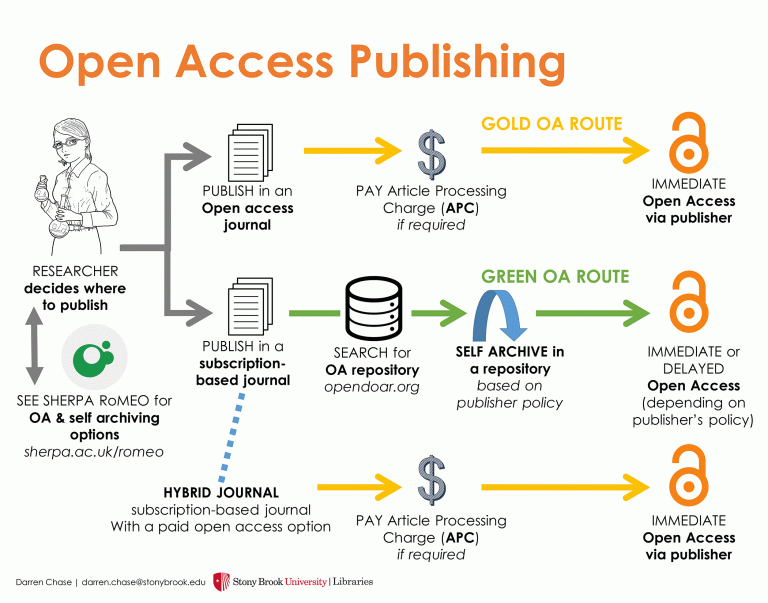
Supporters argue that open-access publishing democratizes science, allowing researchers in low-income countries and early-career scientists to share their work without paywalls. However, critics warn that these fees—often ranging from $1,000 to $5,000 per article—place an unfair burden on public institutions and researchers in developing nations.
The debate gained momentum in 2023 when the European Commission announced plans to mandate open-access publishing for all research funded by Horizon Europe, the EU’s flagship research program. The policy, set to take full effect in 2027, requires researchers to publish in open-access journals or pay fees to make their work available [European Commission].
How Much Do Open-Access Fees Really Cost—and Who Is Affected?
Data from the Directory of Open Access Journals (DOAJ) shows that while some open-access journals charge minimal or no fees, others—particularly those published by commercial entities like PLOS or MDPI—can impose high costs. For example:
- PLOS ONE: $1,495 per article (as of 2024) [PLOS ONE]
- MDPI: $1,200–$2,500 per article, depending on journal [MDPI]
- BioMed Central (Springer Nature): $2,500–$5,000 per article [BioMed Central]
These fees can be prohibitive for researchers in countries with limited funding. A 2023 survey by Research4Life, a global initiative providing free or low-cost access to scientific research, found that 68% of researchers in low- and middle-income countries reported difficulty affording open-access fees [Research4Life]. Meanwhile, public institutions in the U.S. and Europe often struggle to cover these costs, leading to concerns about a “two-tiered” system of science.
What Are the Alternatives to Open-Access Fees?
Several models aim to address the financial barriers of open-access publishing:
- Subsidized or waived fees: Many journals offer discounts or waivers for researchers in low-income countries or those without institutional funding. For example, PLOS provides fee waivers for authors in eligible countries [PLOS Waivers].
- Institutional support: Some universities and research institutions have established funds to cover open-access fees for their faculty. For instance, Harvard University launched the Harvard Open Access Fund in 2008 to support open-access publishing [Harvard OAF].
- Preprint servers: Platforms like bioRxiv and medRxiv allow researchers to share unpublished manuscripts for free, bypassing journal fees entirely.
- Hybrid open-access model: Some journals offer a hybrid model where authors can pay to make individual articles open-access while keeping the rest of the journal subscription-based. However, this model has faced criticism for creating “pay-to-publish” incentives that may compromise editorial integrity.
Who Is Fighting for Reform—and What Are Their Arguments?
Advocacy groups and researchers are pushing for systemic changes to make open-access publishing more equitable. Key arguments include:
- Cost transparency: Critics argue that journals should disclose their profit margins and how fees are allocated. A 2023 investigation by Science magazine found that some commercial publishers earn significant profits from open-access fees, with margins exceeding 30% [Science].
- Subsidies for public research: Many researchers argue that taxpayer-funded studies should not incur additional costs for publication. The Committee on Science, Engineering, and Public Policy (COSEPUP) has recommended that governments and funding agencies provide direct support for open-access publishing [COSEPUP].
- Alternative funding models: Some propose shifting from article-processing charges (APCs) to institutional or government subsidies, or even exploring nonprofit publishing cooperatives.
What Happens Next? Key Developments to Watch
The debates over Blue Zones and open-access publishing fees are far from over. Here are the next steps to watch:

- EU Open-Access Mandate (2027): The European Commission’s policy will require all Horizon Europe-funded research to be open-access. Researchers and institutions are already adapting, with some exploring consortium models to share costs [EU Horizon Europe].
- WHO Healthy Aging Guidelines (2025): The WHO is expected to release updated guidelines on healthy aging, which may address the role of Blue Zones research in public health strategies [WHO Ageing].
- U.S. NIH Open-Access Policy Review: The National Institutes of Health (NIH) is reviewing its open-access policies, with some advocates pushing for mandatory fee waivers for researchers in low-income countries [NIH Open Access].
- Global Research Equity Initiatives: Organizations like Research4Life and SPARC Europe are lobbying for greater funding and support for open-access publishing in developing nations.
How Can Researchers and the Public Stay Informed?
For those following these debates, several resources provide updates and analysis:
- PLOS – Open-access journal with fee waivers and advocacy resources.
- Directory of Open Access Journals (DOAJ) – Lists reputable open-access journals and their fee structures.
- Research4Life – Provides free or low-cost access to scientific research for low-income countries.
- WHO Healthy Ageing – Updates on global health policies related to longevity.
- COSEPUP – Reports and recommendations on science policy, including open-access publishing.
Key Takeaways: What Do These Debates Mean for the Future of Health Research?
- Blue Zones research is evolving: While the concept remains popular, scientists are increasingly emphasizing that longevity is influenced by a mix of genetic, environmental, and socioeconomic factors—not just diet or lifestyle.
- Open-access publishing fees create inequities: The current model disproportionately burdens public institutions and researchers in low-income countries, raising questions about the sustainability of academic publishing.
- Policy changes are underway: The EU’s open-access mandate and potential reforms in the U.S. could reshape how research is funded and shared globally.
- Public health must address systemic issues: The focus on Blue Zones and wellness programs should not overshadow broader efforts to improve healthcare access, reduce inequality, and invest in public health infrastructure.
As these debates continue, one thing is clear: the future of health research will depend on balancing innovation with equity, evidence with accessibility, and commercial interests with public good.
What do you think? Should Blue Zones research be prioritized in public health policies, or are there more urgent issues to address? And is the open-access publishing model fair—or does it need radical reform? Share your thoughts in the comments below.
Dr. Helena Fischer is a physician and health journalist with an MD from Charité – Universitätsmedizin Berlin. She specializes in public health policy, medical innovation, and science communication.
Keep reading