
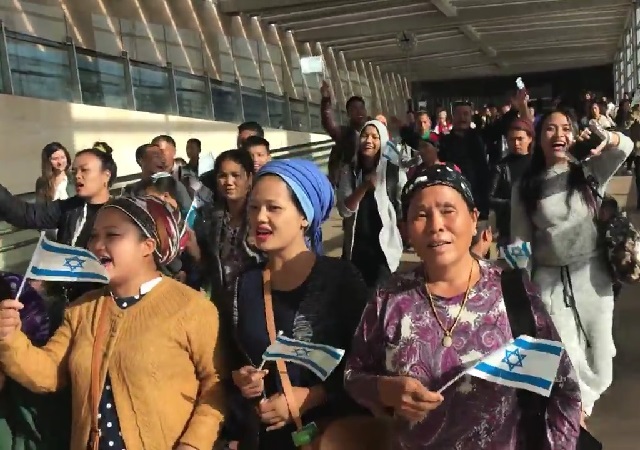
The B’nei Menashe community in northeastern India has long maintained that they are descendants of one of the lost tribes of Israel, specifically the tribe of Manasseh. For generations, this belief has shaped their identity, religious practices, and aspirations, even as they lived far from the Jewish homeland. In recent years, increasing numbers have begun migrating to Israel under the country’s Law of Return, which grants citizenship to Jews and those with Jewish ancestry.
This ongoing migration reflects both a deep historical connection and a modern humanitarian effort to reunite a dispersed community with its ancestral roots. While mainstream historians and geneticists have found little evidence to support the claim of ancient Israelite descent, the Israeli government has continued to facilitate the immigration of B’nei Menashe members, recognizing their sincere commitment to Judaism.
The community’s journey has not been without challenges. Many who arrive in Israel face difficulties integrating into society, including language barriers, economic hardship, and cultural adjustment. Yet, for those who develop the move, the opportunity to live in a Jewish state and practice their faith openly represents the fulfillment of a centuries-old dream.
According to verified reports, the Israeli government has approved the relocation of several hundred B’nei Menashe individuals in recent years, with additional groups awaiting clearance. These movements are coordinated through humanitarian organizations and approved by Israel’s Ministry of Interior and Jewish Agency for Israel.
The story of the B’nei Menashe highlights broader questions about identity, faith, and belonging in a globalized world. It also underscores how nations like Israel navigate complex claims of heritage when offering refuge and citizenship to people seeking to return to their ancestral homelands.
Who Are the B’nei Menashe?
The B’nei Menashe are an ethnic group primarily located in the Indian states of Manipur and Mizoram, near the border with Myanmar. They number approximately 10,000 people, according to community estimates. For decades, they have preserved traditions they believe trace back to ancient Israel, including ritual practices, dietary laws, and oral histories recounting a journey from the Land of Israel through Central Asia and into Southeast Asia.
Their belief in descent from the tribe of Manasseh stems from a combination of biblical interpretation and cultural memory. Manasseh was one of the twelve sons of Jacob (Israel), and his tribe was among the ten northern tribes said to have been exiled by the Assyrian Empire around 720 BCE. The B’nei Menashe believe they are part of this dispersed group that eventually migrated eastward over many centuries.
While these claims are central to the community’s identity, they remain unverified by mainstream scholarship. Genetic studies conducted over the past two decades have not found Middle Eastern ancestry consistent with ancient Israelite populations. Instead, results show genetic ties to other Tibeto-Burman groups in the region. Scholars such as those at Tel Aviv University and the Hebrew University of Jerusalem have noted the lack of biological evidence supporting the claim of Israelite descent.
Despite this, the B’nei Menashe have adopted normative Jewish practices in recent decades, studying Hebrew, observing the Sabbath, and following kosher dietary laws. Many have undergone formal conversion to Judaism under the supervision of rabbinical courts recognized by the Israeli Chief Rabbinate.
Israel’s Response and the Law of Return
Israel’s Law of Return, enacted in 1950, grants every Jew the right to immigrate to Israel and obtain citizenship. The law also extends to individuals with Jewish ancestry, including those who have converted to Judaism. Over the years, Israel has interpreted this law flexibly to accommodate various groups claiming Jewish heritage, including the B’nei Menashe.
In 2005, Israel’s Sephardic Chief Rabbi Shlomo Amar officially recognized the B’nei Menashe as “descendants of Israel” and affirmed their right to return under the Law of Return. This recognition was a significant milestone, though it did not automatically grant immigration rights to all members of the community. Instead, it opened the door for individual cases to be reviewed and approved.
Since then, immigration has proceeded in stages, often limited by government quotas and diplomatic considerations. According to data from the Jewish Agency for Israel, over 4,000 B’nei Menashe have made aliyah (immigration to Israel) since the early 1990s. The agency has played a key role in facilitating absorption, providing Hebrew language instruction, job placement assistance, and cultural orientation programs.
More recently, in 2023, the Israeli government approved the arrival of an additional 250 B’nei Menashe individuals, with plans to bring more in subsequent years. These approvals are typically announced by the Ministry of Interior and coordinated with nonprofit organizations such as Shavei Israel, which has been instrumental in supporting the community’s connection to Judaism and assisting with relocation logistics.
Challenges of Integration in Israel
While moving to Israel fulfills a spiritual goal for many B’nei Menashe, the transition to life in a new country presents real difficulties. Upon arrival, immigrants often settle in designated absorption centers or development towns, where they receive temporary housing and support services. However, moving beyond these initial stages requires mastering Hebrew, finding employment, and adapting to Israeli social norms.
Unemployment rates among recent B’nei Menashe immigrants have been higher than the national average, particularly in the first few years after arrival. Many arrive with agricultural or artisanal skills that do not easily translate to Israel’s technology-driven economy. Language remains a significant barrier, as most B’nei Menashe speak indigenous languages from Northeast India, such as Thadou-Kuki or Mizo, before learning Hebrew.
Despite these hurdles, community leaders report strong motivation to succeed. Many express a deep sense of gratitude for the opportunity to live in a Jewish state and raise their children in a faith-based environment. Synagogues and community centers in cities like Nazareth Illit, Upper Nazareth, and Beit She’an have become hubs for B’nei Menashe life, offering religious services, educational programs, and social support.
Efforts to improve integration include specialized ulpan (Hebrew language) courses tailored to the community’s background, mentorship programs pairing newcomers with established Israeli citizens, and vocational training initiatives funded by the Ministry of Absorption and international donors.
Faith, Identity, and the Meaning of Return
For the B’nei Menashe, the journey to Israel is as much a spiritual pilgrimage as it is a physical relocation. Their belief in ancestral ties to the Land of Israel has sustained them through generations of isolation from mainstream Jewish communities. The opportunity to pray at the Western Wall, celebrate Jewish holidays in the open, and study Torah in Hebrew represents a profound validation of their identity.
This sense of return resonates with broader Jewish historical narratives of exile and redemption. Just as the Babylonian exile led to longing for Zion, the B’nei Menashe view their centuries-long separation from the Jewish world as a temporary estrangement now being overcome.
Scholars of religion and migration note that such movements often involve complex negotiations of identity. While some question the historical accuracy of the B’nei Menashe’s claims, others emphasize the sincerity of their religious commitment and the legitimacy of their desire to join the Jewish people. As one researcher at the Van Leer Jerusalem Institute observed, “What matters is not only where people come from, but where they believe they belong—and how they live that belief.”
The Israeli government’s continued engagement with the B’nei Menashe reflects a balance between humanitarian concern, religious recognition, and practical immigration policy. By facilitating their aliyah, Israel affirms its role as a refuge for Jews worldwide while navigating the complexities of defining who qualifies for that protection.
What’s Next for the B’nei Menashe?
As of early 2026, the Israeli government has not announced a new large-scale approval for B’nei Menashe immigration, but smaller groups continue to be processed on a case-by-case basis. The Jewish Agency for Israel maintains an active role in supporting those who have already arrived, with ongoing programs focused on employment integration and Hebrew proficiency.
Community leaders in both India and Israel have expressed hope that future cohorts will be able to join family members already settled in the country. They also advocate for increased recognition of the B’nei Menashe’s unique heritage within Israeli society, including educational initiatives that share their story as part of the nation’s diverse Jewish tapestry.
For now, the process remains gradual and contingent on government decisions. Those wishing to follow developments can monitor official announcements from Israel’s Ministry of Interior and the Jewish Agency for Israel, which periodically update aliyah quotas and absorption plans.
The story of the B’nei Menashe serves as a reminder that identity is often shaped not only by history and genetics, but by faith, memory, and the enduring human desire to belong. Their journey continues—one step, one family, one prayer at a time.
If you found this article informative, please consider sharing it with others who may be interested in global migration, cultural identity, or Israeli society. We welcome your thoughts and questions in the comments below.