
During the FIFA World Cup 2026 quarter-finals on July 11, Switzerland’s Breel Embolo received a controversial second yellow card for simulation against Argentina at Kansas City Stadium. The ruling transformed a 1-1 match into a 3-1 extra-time defeat, sparking an international debate over VAR protocol application that drew responses from IFAB and FIFA.
The 72nd-Minute Turning Point at Kansas City Stadium
Switzerland looked poised to seize control of the quarter-final fixture on July 11, 2026, after Dan Ndoye leveled the score at 1-1 following an early deficit. The European side carried significant momentum into the second half of the knockout clash in Kansas City, Missouri. That trajectory inverted abruptly in the 72nd minute during a challenge involving Swiss forward Breel Embolo and Argentina midfielder Leandro Paredes.
Portuguese referee Joao Pinheiro initially awarded a foul to Switzerland and issued a yellow card to Paredes. However, following a Video Assistant Referee review, the official reversed his assessment. The referee concluded that Paredes made no contact and that Embolo dived, rescinding the caution given to the Argentina midfielder and issuing it instead to the Swiss forward.
Because Embolo had already received a yellow card in the 44th minute for a foul on Paredes, the simulation booking resulted in a second caution and an immediate dismissal. The 29-year-old forward became only the fourth player on record to receive a second yellow card for simulation at a World Cup, joining a rare historical list that includes Ghana’s Asamoah Gyan against Brazil in 2006.
How the Red Card Altered the Match Momentum
The numerical disadvantage instantly altered the strategic balance on the pitch. Switzerland manager Murat Yakin revealed that he had been preparing an attacking substitution to press home his team’s momentum just before the incident. Instead, the team was forced to retreat with 10 men.
The red-card decision sparked outrage among the Swiss camp and added fuel to ongoing tournament complaints from prior opponents, including Egypt, alleging refereeing bias toward Lionel Messi’s squad. Capitalizing on the extra space in extra time, Argentina secured victory through goals from Julian Alvarez and Lautaro Martinez, sealing a 3-1 win to advance to the semi-finals.
Argentina coach Lionel Scaloni acknowledged the fortunate turn of events after the match. Scaloni stated that the truth was luck had been on their side that day because the opponents had a player sent off, which was when his team started attacking, and added that they had to be realistic, according to reporting published by Reuters.
IFAB Laws Versus FIFA Interpretation
The dismissal ignited a regulatory dispute between the International Football Association Board and world football’s governing body regarding the boundaries of VAR intervention. Under official IFAB laws, VAR is strictly prohibited from intervening on standard yellow cards or reviewing simulation offenses unless those infractions directly relate to a penalty award or a direct red card. Review protocols permit VAR intervention for yellow-card incidents solely to correct mistaken identity when an official cautions the wrong player for an infraction that genuinely occurred.

On Monday, the Zurich-based IFAB confirmed in a statement that Embolo’s second caution should not have been issued under current protocols. The organization added that while using the mistaken identity clause to address simulation was well-received and will be evaluated in a forthcoming protocol review under circular no. 32, it could not be applied in that manner during the tournament.
FIFA defended the decision, maintaining that its application aligned with tournament standards. The governing body stated that FIFA’s interpretation of mistaken identity had been applied consistently throughout the FIFA World Cup, noting that VAR successfully corrected factual errors caused by opponent simulation in two separate instances. FIFA confirmed it maintained ongoing contact with IFAB throughout the tournament and noted that the panel recognized the interpretation as valid for discussion in future protocol revisions.
Reactions and Tournament Fallout for Embolo
For Embolo, the tournament conclusion marked the final chapter of an unusually turbulent build-up. The forward faced a delayed arrival at the Swiss training base due to a visa complication involving U.S. travel authorities, who requested additional background checks concerning a legal case stemming from a 2018 altercation in Basel.
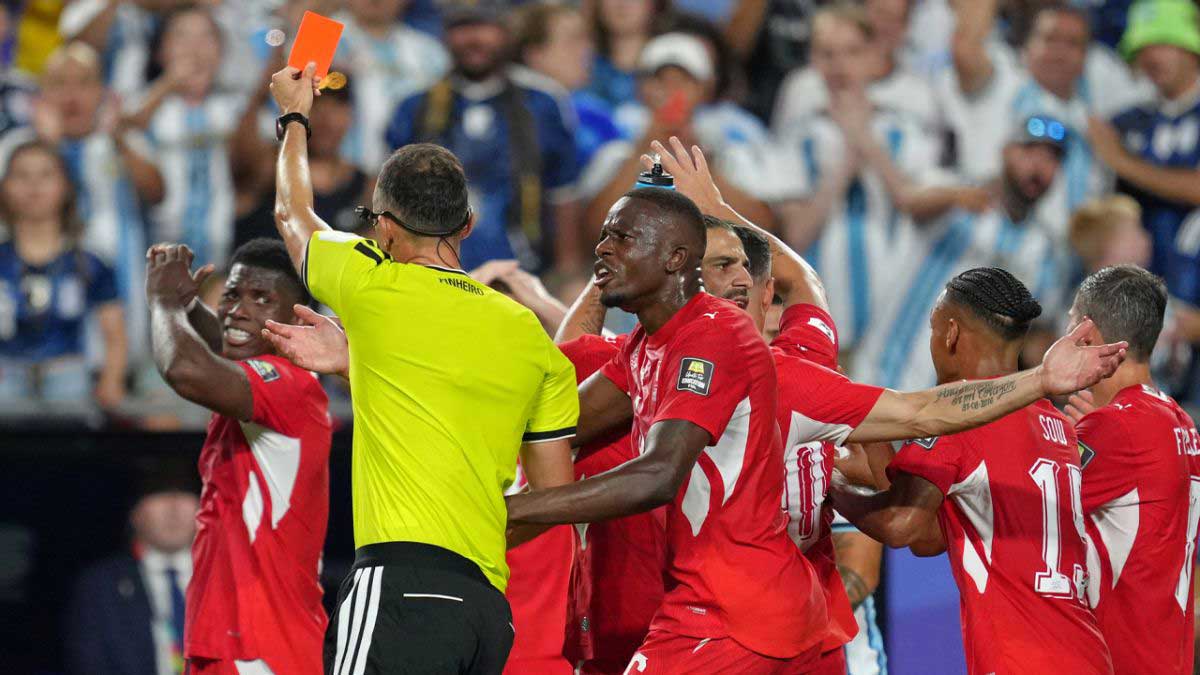
Despite scoring earlier in the tournament against Qatar in the group stage and Algeria in the round of 32, his tournament ended in tears. Yakin stated that he did not blame Embolo at all, describing him as a true team player who was shattered, according to Reuters. The manager expressed deep frustration over the regulatory enforcement, stating that they were punished because of a rule that, in his opinion, was completely unacceptable, that he did not understand it, that it was very painful, and that that rule had destroyed their game that day.
Pundits offered differing perspectives on the incident. Former Manchester City striker Bradley Wright-Phillips voiced little sympathy for the forward’s predicament during a broadcast appearance. I feel for Embolo’s teammates, I don’t feel for him. He has cost his team maybe getting through to the semi-finals, Wright-Phillips said, as reported by Reuters. With Spain ultimately capturing the World Cup 2026 title by defeating Argentina 1-0 in the final, the Swiss quarter-final exit remains one of the tournament’s most fiercely debated rulings.
Worth a look